

Film Blocking Explainer
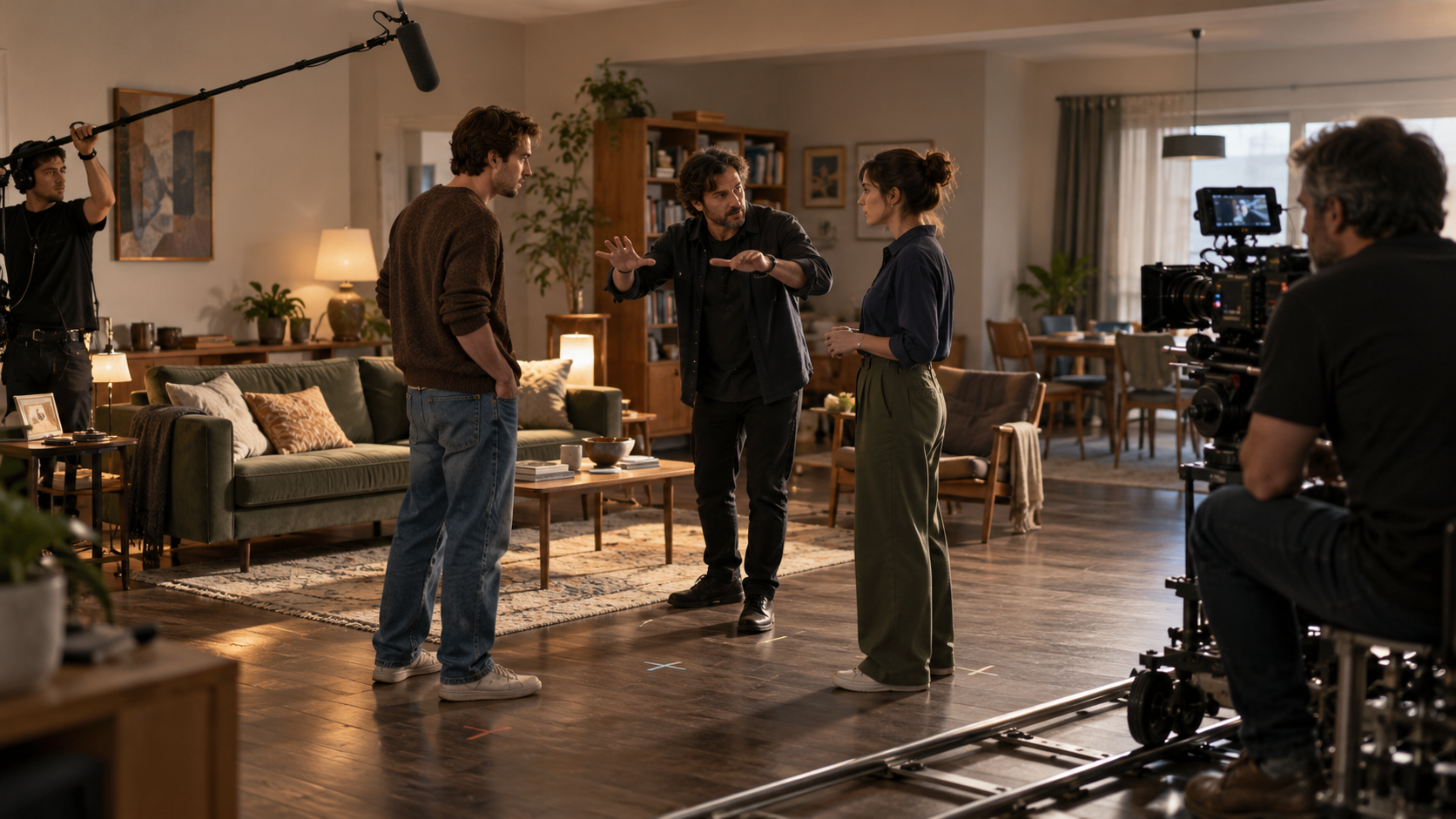
Film blocking is the planned movement and positioning of performers within a scene, coordinated with the camera, set, light, sound, and props. It determines who can see whom, how distance expresses a relationship, when information enters the frame, and whether an action can be photographed clearly. Blocking is not simply telling actors where to stand. Strong blocking grows from character intention and the physical logic of the location, then gives the crew a repeatable structure for capturing the scene.
A director may begin by rehearsing the scene with actors before fixing camera positions. The performers explore entrances, exits, eyelines, seating, handling of objects, and shifts in power or attention. Once the dramatic shape works, the director and cinematographer refine marks and decide whether the camera observes, follows, leads, or reveals. A complex move can reduce the need for cutting, while simple stillness can concentrate attention. The choice should serve the scene rather than advertise choreography.
Blocking affects nearly every department. Camera and grip teams need paths and safe clearances; lighting must remain convincing as people move; the boom operator needs access without entering frame; costume and hair departments monitor continuity; and art teams place furniture and props that support action. Marks on the floor can help repeat positions, but actors are not machines. Crews often light zones or adjust coverage so performance has room to breathe while focus and exposure remain reliable.
Coverage breaks the blocked scene into angles such as a master, two-shots, singles, inserts, and reaction shots. Repeating the action from each angle gives the editor choices, but continuity must be managed: a cup lifted with one hand, a turn begun on a line, or a cross behind another actor may need to match. Perfect repetition is not always the goal. Editors can favor the emotionally strongest take and bridge small differences when screen direction and dramatic intention remain understandable. The common misconception is that blocking is either spontaneous acting or a rigid diagram. In practice it is negotiated. Locations, accessibility, stunts, children, animals, lenses, and time can all change the plan. Directors may simplify a movement to protect performance or redesign a shot after seeing the rehearsal. Viewers can notice blocking by tracking distance, eyelines, obstacles, and who controls space. Those patterns often communicate relationships before dialogue explains them. A practical way to read or discuss Film Blocking is to begin with the basic definition and then identify the choices made in a particular example. Blocking coordinates performer positions and movement with camera, light, sound, props, and the physical logic of the set. Next, ask who sets the relevant rules, who performs the work, and which results follow from creative judgment, law, contracts, technology, budget, or production limits. Similar-looking examples can operate differently because their audience, market, format, timing, and agreements are different. Coverage repeats blocked action from several angles, creating editorial flexibility while increasing the need for continuity tracking. It also helps to distinguish a formal industry category from an informal critical label or one organization's current practice. That separation keeps a memorable anecdote from becoming a false universal rule. Dates and territories matter: tools, distribution systems, audience behavior, and standard agreements change, while older examples can preserve assumptions that no longer apply everywhere. When a claim sounds absolute, compare it with a second kind of source and look for the conditions under which the claim is true. Then trace the process from the visible result back through the less visible decisions, handoffs, and quality checks that produced it. A useful analysis asks how movement changes attention and power, not merely whether a shot is long, complicated, or perfectly symmetrical. Finally, compare the example with a contrasting case and note which part of the definition still holds. This method keeps the explanation grounded, highlights the people and systems behind the outcome, and leaves room for reasonable disagreement about hybrid or borderline cases.
Blocking coordinates performer positions and movement with camera, light, sound, props, and the physical logic of the set.
Directors often explore a scene's dramatic beats with actors before committing the camera to a path or set of angles.
Distance, height, eyelines, entrances, exits, and the handling of objects can make relationships legible without explicit dialogue.
Coverage repeats blocked action from several angles, creating editorial flexibility while increasing the need for continuity tracking.
Floor marks support repeatability, but crews can light and frame flexible zones so performers are not reduced to mechanical movements.
A useful analysis asks how movement changes attention and power, not merely whether a shot is long, complicated, or perfectly symmetrical.
Explore more "Explainers"
Discover additional explainers across politics, science, business, technology, and other fields. Each explainer breaks down a complex idea into clear, everyday language—helping you better understand how major concepts, systems, and debates shape the world around us.