

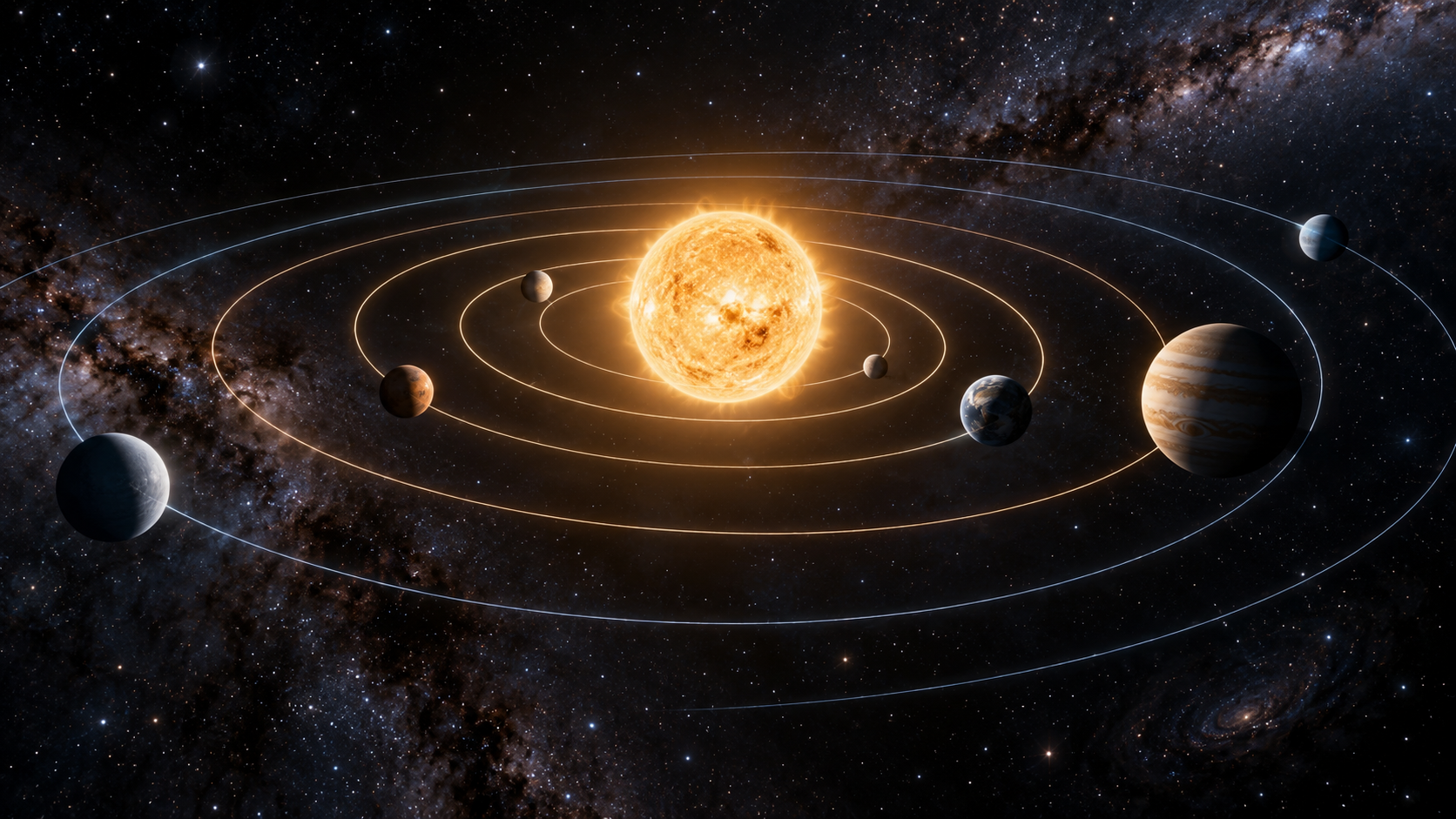
How Orbital Resonance Shapes Planetary Systems Explainer
Every orbiting body feels the gravity of its neighbors. Usually the direction of those small tugs changes from one orbit to the next, so many effects partially cancel. In an orbital resonance, two or more periods are near a ratio of small whole numbers, such as 2:1 or 3:2. Conjunctions then recur in a patterned sequence instead of at random orbital locations.
Repeated timing allows tiny forces to accumulate. A resonance can change orbital eccentricity, inclination, or the orientation of an orbit. The outcome depends on geometry and on the phase of the encounters. Resonance does not mean the bodies always line up in one fixed row; it means a particular combination of orbital angles oscillates rather than circulating freely.
Some resonances stabilize a system. Neptune and Pluto are in a 3:2 resonance, and their coordinated geometry keeps close approaches from occurring even though their orbital paths overlap in distance from the Sun. Several moons also use resonant timing. In the Jupiter system, Io, Europa, and Ganymede form a linked pattern that continually flexes their orbits and contributes to internal heating.
Other resonances can destabilize or clear regions. Repeated tugs from Jupiter create gaps in the asteroid belt at particular period ratios. A body entering an unfavorable resonance may gain eccentricity until it crosses another orbit or is scattered. The same mechanism can sculpt rings, moon systems, debris disks, and populations of small bodies.
Planets can be captured into resonance while they migrate through a gas disk or exchange angular momentum with smaller bodies. Later interactions may preserve the chain, move it slightly away from an exact ratio, or break it. Resonant and near-resonant exoplanet systems therefore contain evidence about how their planets formed and moved.
Astronomers identify resonance from accurately measured periods and from the behavior of orbital angles over time. A period ratio close to a small fraction is suggestive but not conclusive. Detailed dynamical models are needed to show that the relevant angle librates and that the configuration remains viable. Resonance is synchronized gravity, not a mysterious locking force.
Resonance links orbital periods through small-integer ratios and makes gravitational encounters recur in a pattern.
The cumulative tugs can alter eccentricity, inclination, and orbital orientation.
Favorable resonant phases can prevent close encounters and stabilize bodies such as Pluto and Neptune.
Other resonances increase eccentricity or clear gaps, as seen in parts of the asteroid belt.
Migration can capture planets or moons into resonant chains that record the system's earlier evolution.
A near-integer period ratio is only a clue; orbital-angle behavior and long-term models establish true resonance.
Explore more "Explainers"
Discover additional explainers across politics, science, business, technology, and other fields. Each explainer breaks down a complex idea into clear, everyday language—helping you better understand how major concepts, systems, and debates shape the world around us.