

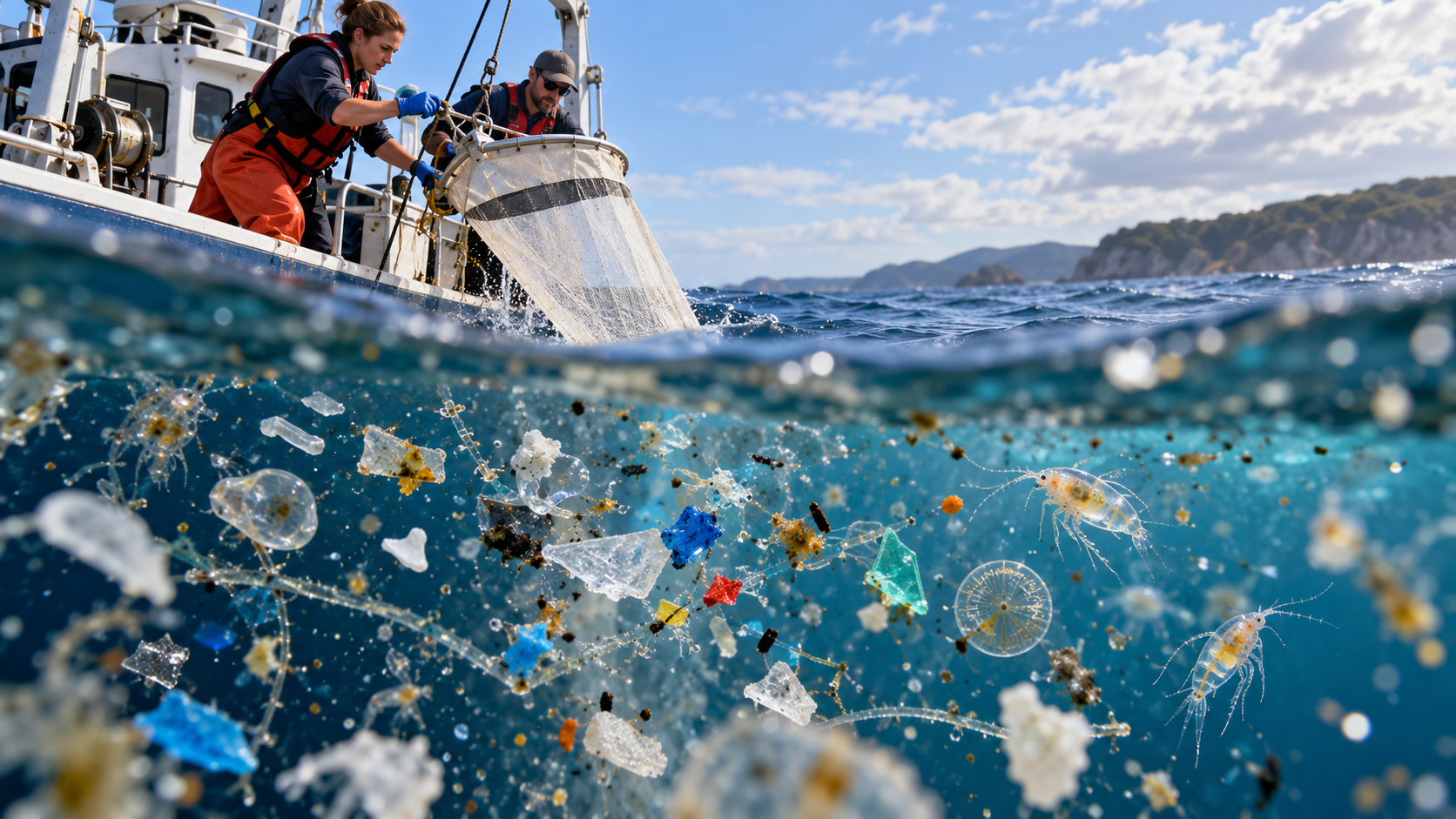
How Microplastics Move Through the Ocean Explainer
Microplastics are plastic particles generally smaller than five millimeters. Some are manufactured at small size, while many form as sunlight, heat, waves, and abrasion break larger items into fragments and fibers. Rivers, storm drains, wastewater, fishing activity, wind, and direct coastal litter carry particles into the ocean from both land and sea.
Once afloat, particles are transported by surface currents, tides, waves, and turbulent mixing. Large-scale circulation can concentrate some debris in subtropical convergence zones, but these regions are not solid islands of trash. Concentrations change with weather, depth, particle type, and sampling method, and much of the plastic expected from inputs is not found at the surface.
Density helps determine motion. Some polymers are naturally denser than seawater and tend to sink, while buoyant plastics may remain near the surface at first. Organisms and sticky organic material colonize a particle in a process called biofouling, increasing its effective density. Aggregation with marine snow can also carry microplastics downward.
Sinking is not necessarily permanent. Grazing, decomposition, changes in salinity, or loss of a biofilm can make a particle rise again. Storms, bottom currents, and animal activity resuspend particles from seabed sediment. Beaches and estuaries alternately trap and release debris. A single particle may therefore cycle through several ocean compartments.
Animals encounter microplastics by filtering water, eating prey, or mistaking particles for food. Some particles are expelled, while others remain temporarily or move through tissues depending on size and chemistry. Plastics can contain additives or carry other chemicals, but real-world exposure and biological effects vary widely and are still being measured.
Tracking is difficult because particles differ in polymer, shape, color, age, and size down to dimensions smaller than common filters detect. Contamination from clothing and laboratory air can distort samples. Standardized collection, chemical identification, and shared databases improve comparisons. Preventing release matters because fragmentation and dispersal make recovery from the open ocean extremely difficult.
Rivers, wastewater, stormwater, fishing, wind, and fragmentation of larger debris supply microplastics to the ocean.
Currents, waves, tides, and turbulence redistribute particles rather than forming a single uniform surface patch.
Polymer density, biofouling, and attachment to marine snow can move particles downward.
Resuspension and changing biofilms can return sedimented particles to the water column or surface.
Organisms ingest particles in different ways, and exposure depends strongly on particle size, shape, and chemistry.
Standardized sampling and contamination control are essential because the smallest particles are hardest to measure.
Explore more "Explainers"
Discover additional explainers across politics, science, business, technology, and other fields. Each explainer breaks down a complex idea into clear, everyday language—helping you better understand how major concepts, systems, and debates shape the world around us.