

How Alloys Gain New Properties Explainer
An alloy combines a metal with one or more additional elements to produce a material whose behavior differs from the pure metal. The ingredients do not merely average their properties. They alter atomic packing, phase stability, defects, grain structure, and electron scattering. Processing then determines which of those structures actually forms, so composition alone cannot specify performance.
In a solid solution, solute atoms replace host atoms or occupy spaces between them. Because their size and bonding differ, they distort the crystal lattice and make dislocation motion more difficult. Dislocations are line defects that allow metals to deform at stresses far below those needed to slide a perfect crystal. Blocking them generally raises strength, though often at some cost to ductility.
Alloys can also contain multiple phases. Carefully controlled heat treatment may create fine precipitates that obstruct dislocations, as in many aluminum and nickel alloys. Steel properties depend strongly on how carbon and other elements influence iron phases and transformations. Cooling rate can produce soft, ductile structures or much harder metastable ones, and tempering can rebalance hardness and toughness.
Grain boundaries interrupt crystal order. Smaller grains can strengthen many metals because dislocations encounter more boundaries, but grain size also affects creep, corrosion, and fracture. Rolling, forging, casting, welding, and additive manufacturing create different textures, pores, residual stresses, and segregation. A locally overheated region may therefore behave differently from the nominal bulk alloy.
Added elements can improve corrosion resistance by forming a stable surface film, change electrical or magnetic behavior, lower melting temperature, or preserve strength at high heat. Benefits involve tradeoffs. A highly strong alloy may be difficult to form; a corrosion-resistant composition may be costly; and a phase stable at room temperature may degrade during long service at elevated temperature.
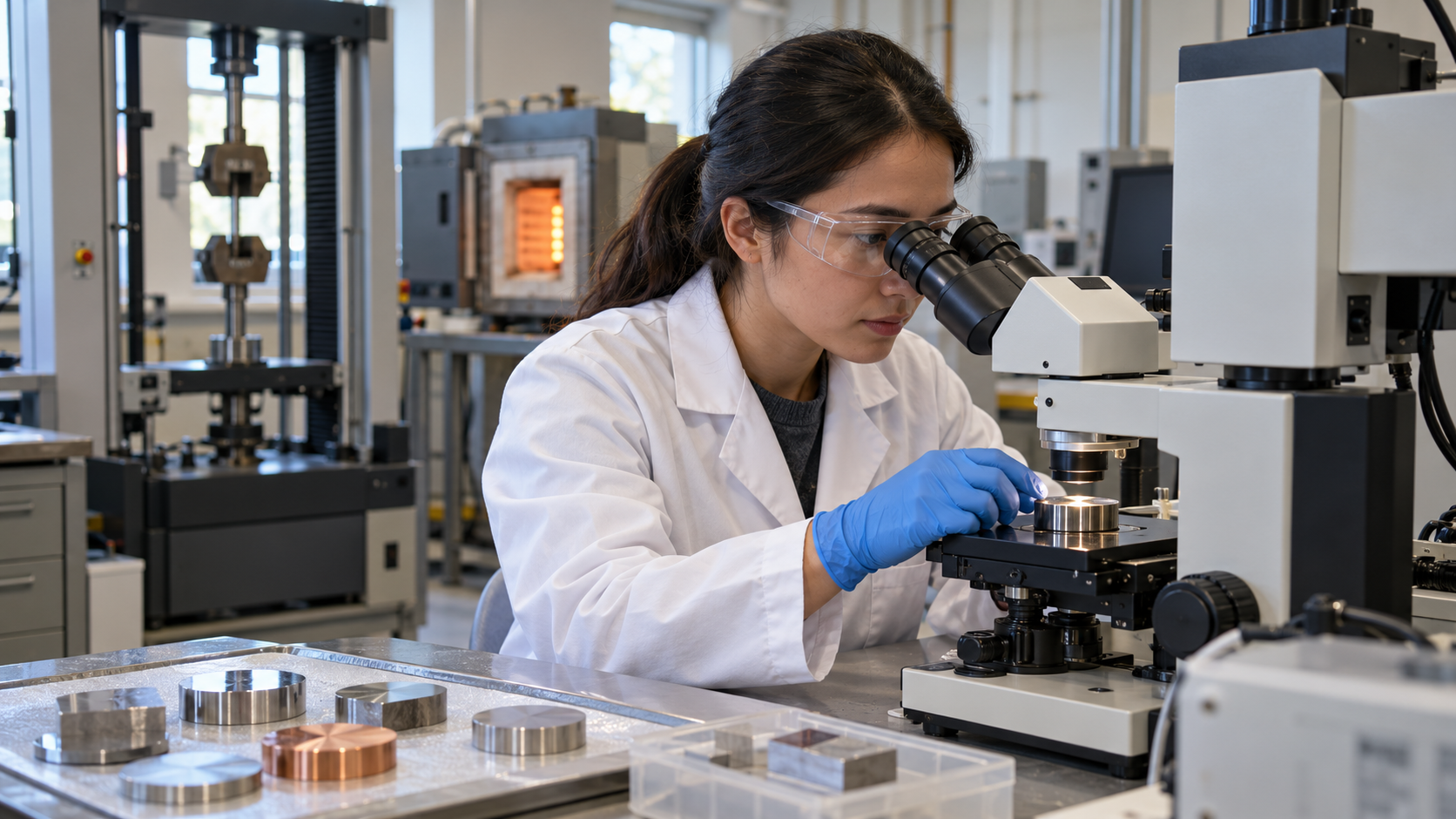
Metallurgists use phase diagrams, microscopy, diffraction, mechanical tests, corrosion exposures, and composition analysis to connect processing with structure and properties. The same alloy name can cover allowed composition ranges and heat-treatment states. Safe design therefore relies on certified material condition and service data, not on assuming that every piece containing the same elements performs identically.
Alloying changes atomic structure and defects rather than merely mixing properties.
Solute atoms impede dislocation motion and can strengthen a metal.
Precipitates and phase transformations are controlled through heat treatment.
Grain size and manufacturing history affect strength, toughness, and corrosion.
High-temperature, electrical, magnetic, and surface behavior can also be tuned.
Certified composition and processing state are both essential to predict performance.
Explore more "Explainers"
Discover additional explainers across politics, science, business, technology, and other fields. Each explainer breaks down a complex idea into clear, everyday language—helping you better understand how major concepts, systems, and debates shape the world around us.