

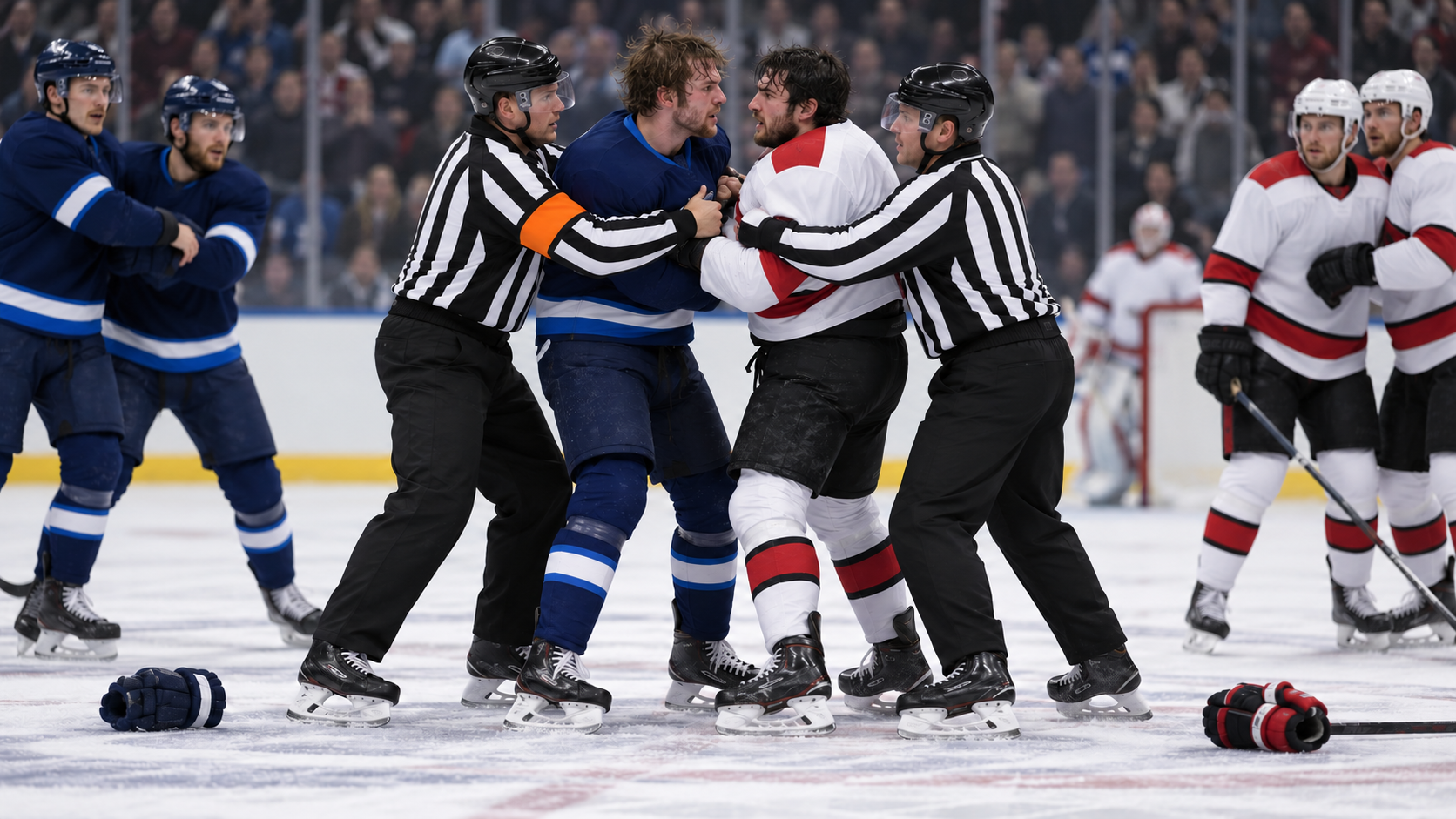
How Hockey Fighting Penalties Work Explainer
NHL fighting begins when players throw or attempt to throw punches, or wrestle in a way that officials judge to be a fight rather than ordinary roughing. The referee has broad discretion to distinguish a fight from a brief scrum or isolated shove.
Each participating fighter ordinarily receives a five-minute major. When the majors are coincidental, the teams generally remain at even strength because substitute players may take the ice. The penalized players serve their time and wait for an appropriate stoppage to return.
Additional penalties can change the outcome. An instigator penalty targets a player who starts a fight through distance traveled, first punch, threats, or similar conduct. An aggressor penalty applies when a player continues against an unwilling or defenseless opponent and includes further discipline.
A player leaving the bench or penalty box to join an altercation faces severe sanctions. Linespersons intervene when it is safe, while the referee records participants and sequence. Viewers should wait for the announced penalty package because equal five-minute majors are only the starting point.
A fighting major is five minutes for each player assessed one.
Usually no; substitutes may replace the penalized players, keeping equal strength.
An added penalty for a player judged to have clearly initiated the fight through specified conduct.
Explore more "Explainers"
Discover additional explainers across politics, science, business, technology, and other fields. Each explainer breaks down a complex idea into clear, everyday language—helping you better understand how major concepts, systems, and debates shape the world around us.