

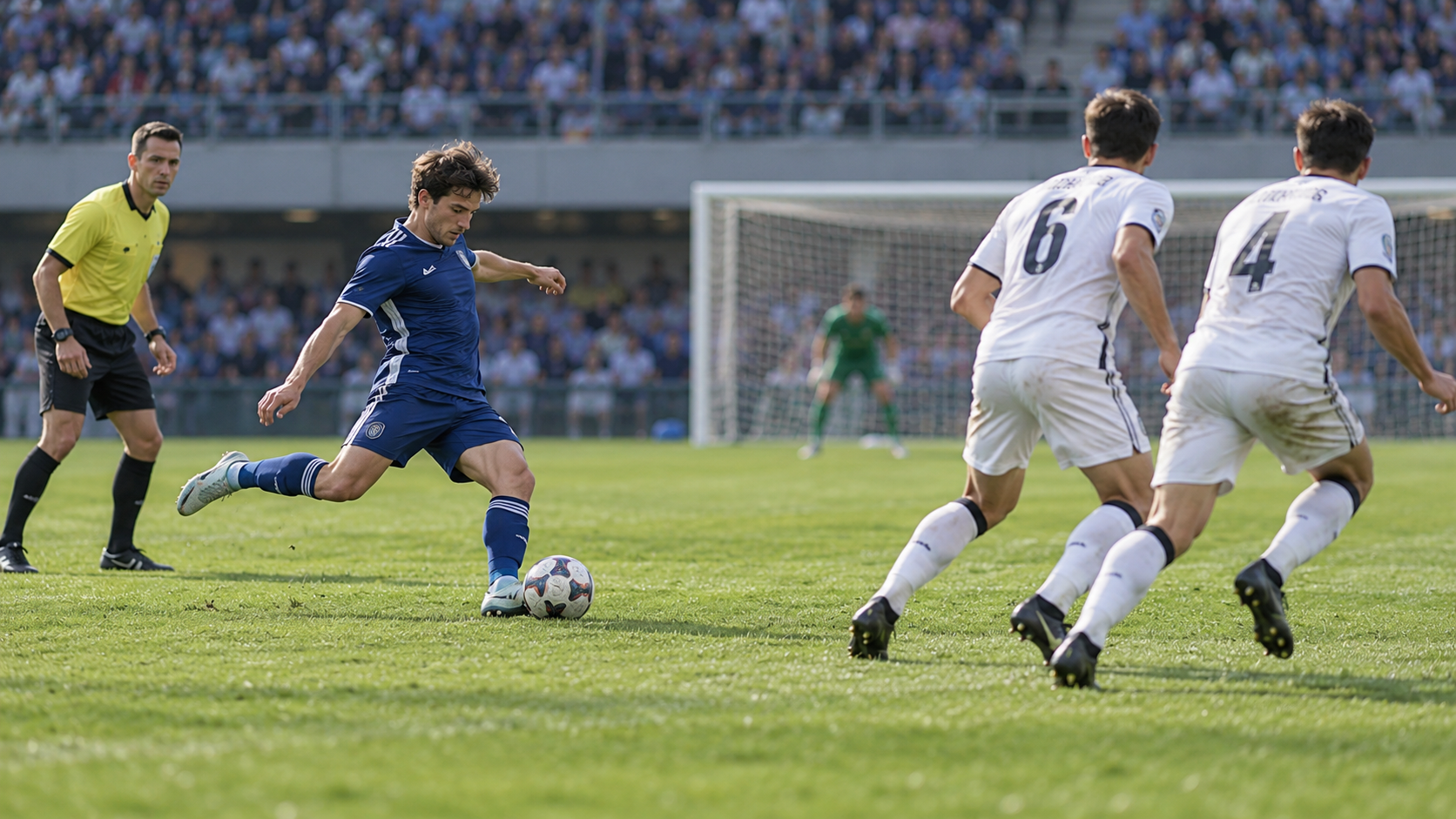
How Soccer Quick Free Kicks Work Explainer
A quick free kick is simply a legal free kick taken before the referee has organized a ceremonial restart. The ball must be stationary and placed at the correct location, and it becomes live when it is kicked and clearly moves. The attacking team may restart promptly when the referee has not required a whistle.
Defenders are still required to retreat at least 9.15 metres, or 10 yards. However, the attacking team may choose speed over perfect distance. If a nearby defender is retreating normally and the quick kick strikes that player, play can continue because the kicker accepted the risk of restarting early.
A defender cannot deliberately prevent the restart by standing over the ball, kicking it away, or moving in to block the kick. Such delay can bring a caution. The referee may also hold the kick for misconduct, an injury, a substitution, or when the attacking team asks officials to enforce the distance.
Once the referee makes the restart ceremonial, players must wait for the whistle. The practical choice belongs to the attacking side: restart before the defense sets itself, or wait for a measured wall and a clear signal. A quick kick is not a separate rule, but a tactical use of the ordinary free-kick procedure.
No. A whistle is needed when the referee has made the restart ceremonial or otherwise signals that play must wait.
Yes. They must retreat 9.15 metres, although a quick kick can be taken before they arrive.
Play may continue when the kicker chose a quick restart and the defender was not deliberately interfering.
Explore more "Explainers"
Discover additional explainers across politics, science, business, technology, and other fields. Each explainer breaks down a complex idea into clear, everyday language—helping you better understand how major concepts, systems, and debates shape the world around us.