

“Humanity’s 21st century challenge is clear: to meet the needs of all within the means of the planet.”
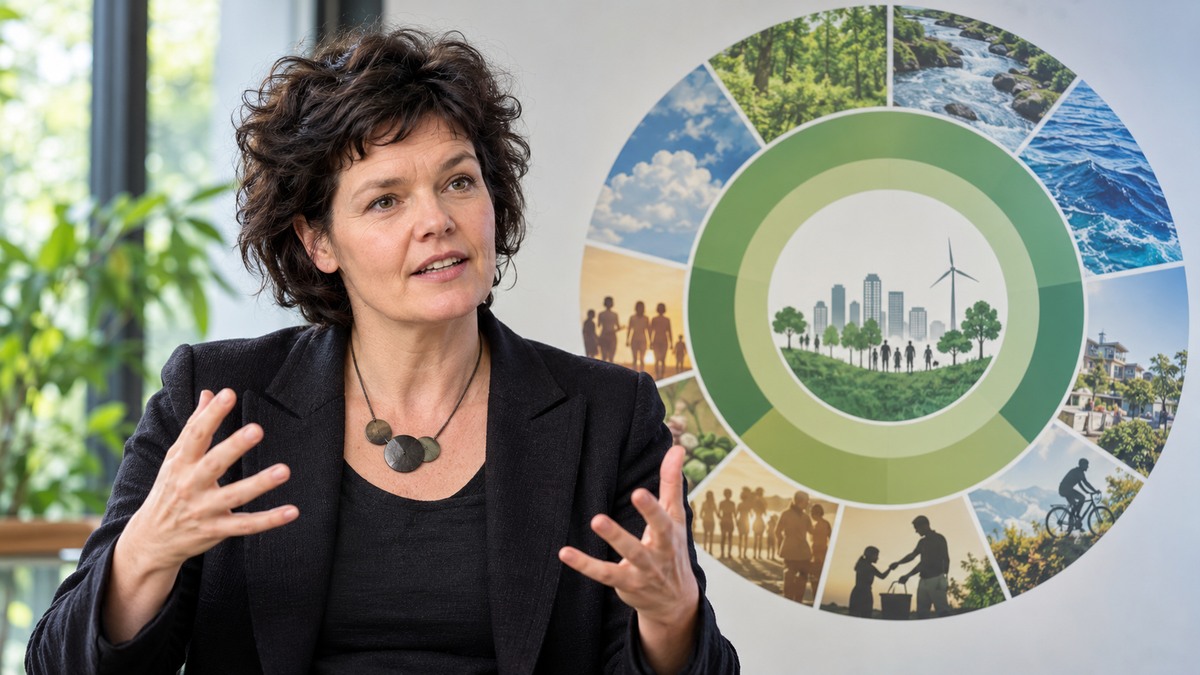
Kate Raworth used this formulation in presenting Doughnut Economics, including her 2018 TED talk. The model places a social foundation beneath which people lack essentials and an ecological ceiling beyond which human activity destabilizes Earth systems, defining a safe and just space between them. For business, the framework changes the question from maximizing one output to operating within interconnected social and ecological conditions. Revenue growth can accompany progress, but it is not a complete proxy for whether an enterprise meets needs without shifting costs to workers, communities, or future generations. Read closely, the quotation is an operating claim rather than a decorative slogan. It asks leaders to connect an admired principle with the conditions, measures, and behavior through which customers and employees would actually experience it.
Leaders can map the company’s most material dependencies and impacts against both human needs and planetary pressures. Product, sourcing, and investment decisions should target absolute improvements where possible, with goals tied to science, living conditions, and transparent baselines. To make that connection visible, decision makers should name the choice the idea is meant to change, the evidence they will review, and the person responsible for follow-through. A principle becomes useful when others can observe its effect on work.
A broad framework can become a colorful dashboard that hides tradeoffs or weak data. Boundaries operate at different scales, and responsibility is shared across firms and governments. Companies should state scope, uncertainty, allocation methods, and where collective policy is required. The strongest interpretation holds ambition and restraint together. Teams should ask who benefits, who carries risk, what evidence would disconfirm the current belief, and how a person affected by the decision can question it before costs become difficult to reverse.
Climate, biodiversity, housing, and inequality increasingly intersect with business continuity. Circular design and regenerative practices can reduce pressure, but rebound effects matter: an efficient product does not help enough if total extraction and consumption continue to rise unchecked. Choose one major product line and identify its largest social benefit, social harm, ecological dependency, and ecological pressure. Set one absolute outcome for the next year and one partnership needed because the boundary cannot be managed by the company alone. A practical review should compare the promise with outcomes, experience, and unintended effects. The final test is not whether the words sound inspiring, but whether they help the organization learn earlier, act responsibly, and create value that can withstand scrutiny. Results should be shared in plain language, including disappointments, so later decisions begin with accumulated evidence rather than a polished story that hides the conditions under which the earlier choice succeeded.
Kate Raworth used this formulation in presenting Doughnut Economics, including her 2018 TED talk. The model places a social foundation beneath which people lack essentials and an ecological ceiling beyond which human activity destabilizes Earth systems, defining a safe and just space between them.
For business, the framework changes the question from maximizing one output to operating within interconnected social and ecological conditions. Revenue growth can accompany progress, but it is not a complete proxy for whether an enterprise meets needs without shifting costs to workers, communities, or future generations.
Leaders can map the company’s most material dependencies and impacts against both human needs and planetary pressures. Product, sourcing, and investment decisions should target absolute improvements where possible, with goals tied to science, living conditions, and transparent baselines.
A broad framework can become a colorful dashboard that hides tradeoffs or weak data. Boundaries operate at different scales, and responsibility is shared across firms and governments. Companies should state scope, uncertainty, allocation methods, and where collective policy is required.
Climate, biodiversity, housing, and inequality increasingly intersect with business continuity. Circular design and regenerative practices can reduce pressure, but rebound effects matter: an efficient product does not help enough if total extraction and consumption continue to rise unchecked.
Choose one major product line and identify its largest social benefit, social harm, ecological dependency, and ecological pressure. Set one absolute outcome for the next year and one partnership needed because the boundary cannot be managed by the company alone.
Explore more "Quotes of The Day"
Discover more notable quotes from influential voices across politics, science, business, technology, sports, and culture. Each quote offers insight into how ideas, beliefs, and decisions shape the world around us.