

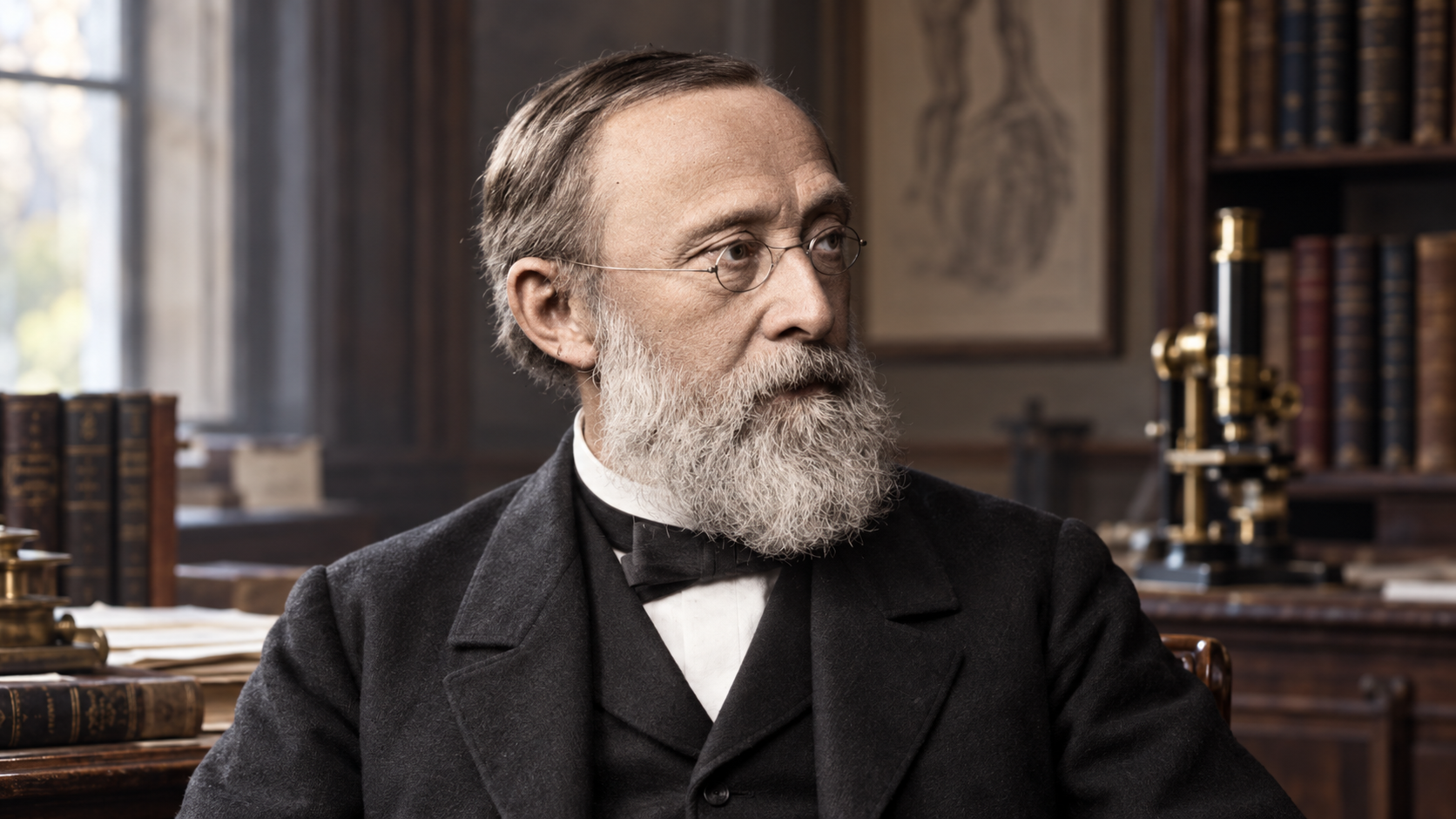
“Medicine is a social science”
Rudolf Virchow is remembered for work in pathology and for insisting that the circumstances surrounding illness belong within medicine’s field of attention. This short statement is an English rendering of his position, preserved in discussions of social medicine. Longer translations differ in the way they express the connection between medicine and politics, so the selected clause keeps to their shared wording. Virchow’s nineteenth-century public-health work included an investigation of a typhus epidemic in Upper Silesia in 1848. His concern extended beyond describing disease to considering the conditions in which people lived. That history helps explain the statement without proving the exact date on which he first used these particular words. The quote does not mean that medicine abandons biology. It widens the frame around biological events, asking how an individual’s surroundings, opportunities, and place in society affect the practical possibilities for health.
A diagnosis can name an illness while leaving much of a patient’s situation unexplained. The person may face insecure housing, an unpredictable job, difficulty reaching an appointment, or competing demands on a small income. These examples illustrate social questions that can matter to care; they do not show that every illness has the same social cause. Virchow’s perspective is useful because it allows attention to such questions alongside investigation of bodily processes. It also helps distinguish identifying a need from having the power to resolve it. A clinician may recognize a barrier that requires cooperation with public agencies or other services. Recognizing that limit is more honest than promising that a prescription or a referral will settle every problem. The word social directs attention toward relationships and arrangements, including decisions made far from an examination room. It makes the setting of disease an object of inquiry rather than a background detail to be ignored.
The continuing challenge is to turn a broad insight into careful, accountable work. Asking about living conditions should serve a patient’s goals and respect privacy, rather than become a new way to judge or categorize people. Gathering information is useful only when it supports a credible response or clarifies what remains beyond the service’s reach. Public-health decisions likewise need evidence about which changes help, who benefits, and whether an intervention creates new burdens. Virchow’s sentence supplies a reason to ask these questions, not a ready-made answer to all of them. It can also remind readers that responsibility for health is shared across institutions, while avoiding the claim that any single institution controls every outcome. The social dimension of medicine becomes most convincing when it remains specific: a documented obstacle, an identified decision, and a practical opportunity to improve conditions. Seen this way, the quote connects scientific observation with an interest in how people actually have to live.
This is the common opening clause of English translations of Virchow’s statement about medicine and society.
His nineteenth-century work in social medicine provides context; a first delivery date for this wording is not asserted.
The sentence expands medical attention to the circumstances surrounding disease and access to care.
Social explanations should be investigated rather than assumed, and they complement inquiry into biological processes.
Housing, employment, and the ability to reach services can become practical questions during care planning.
Responses require cooperation and evidence. The quotation alone cannot establish which policy will work in a particular setting.
Explore more "Quotes of The Day"
Discover more notable quotes from influential voices across politics, science, business, technology, sports, and culture. Each quote offers insight into how ideas, beliefs, and decisions shape the world around us.