

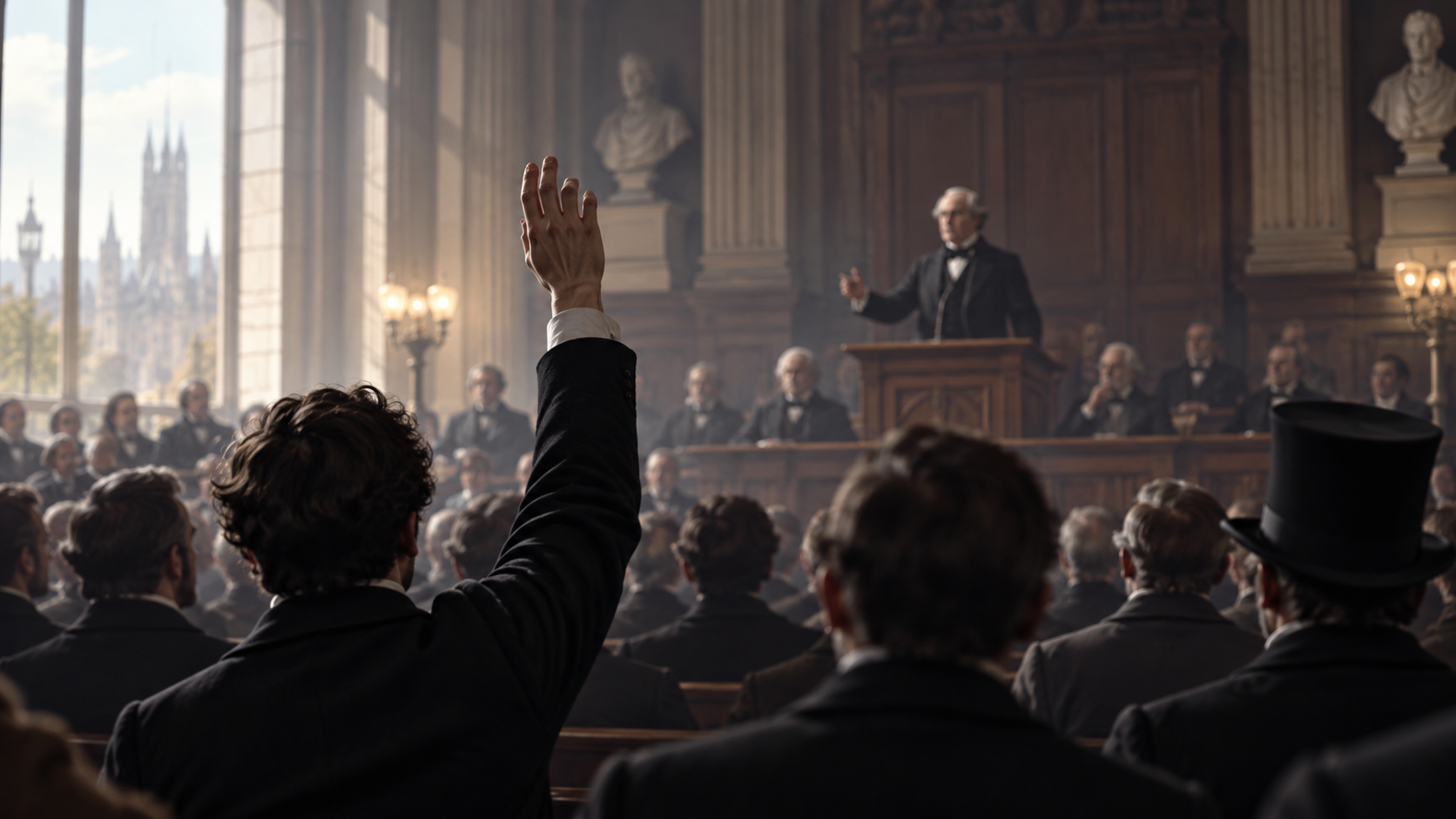
“We can never be sure that the opinion we are endeavouring to stifle is a false opinion; and if we were sure, stifling it would be an evil still.”
John Stuart Mill made this argument in the second chapter of On Liberty, published in 1859. The chapter examines freedom of thought and discussion, asking what is lost when authorities or majorities suppress an opinion. Mill offered several answers. The prohibited view might be true; it might contain part of the truth; or, even when wrong, its challenge might force accepted beliefs to be understood as reasons rather than repeated as formulas. His concern extended beyond formal government censorship to the social pressure that can make unpopular speech practically impossible. The quotation summarizes his warning that confidence does not make any institution infallible.
Mill’s argument is frequently invoked as if it required every claim to receive equal attention. It does not. Editors routinely decide what is relevant, supported, and worthy of scarce reporting resources. Defamation, threats, deception, and coordinated harassment raise questions different from sincere disagreement. The useful distinction is between evaluating speech and suppressing it merely because it unsettles a prevailing view. Journalism serves the public when it tests dissent with evidence, identifies expertise, and describes the strength of the record. False balance can mislead just as surely as censorship when a marginal assertion is presented as equivalent to well-supported findings.
The quotation remains valuable in polarized debates where disagreement is quickly treated as disloyalty or bad faith. Newsrooms need methods that allow rigorous challenge without turning every issue into a spectacle of two opposing quotations. That can mean publishing underlying data, seeking knowledgeable critics, separating factual claims from value judgments, and explaining why some evidence carries more weight. Readers also benefit from encountering the strongest version of an opposing case rather than a caricature. Mill’s lasting contribution is a discipline of intellectual humility: conclusions can be firm, but they should remain answerable to reasons and facts that others are free to examine.
Mill’s warning supplies a practical reason for protecting dissent even when a majority feels certain. Newsrooms routinely decide which expert claims, public statements, and minority views deserve attention; the answer cannot be that every assertion receives equal space, but neither should familiarity be mistaken for proof. Editors can test a consensus by seeking qualified disagreement, examining the strongest contrary evidence, and explaining why a rejected claim fails rather than merely labeling it unacceptable. That approach is especially important when knowledge is developing and authorities revise earlier conclusions. It is equally important not to convert Mill into a defense of misinformation: an opinion may be heard and still be judged unsupported after transparent examination. The journalistic value of the passage lies in its resistance to enforced certainty. Reporting becomes more reliable when conclusions remain proportionate to the evidence, when credible challenges are answered directly, and when readers can see how an institution moved from competing possibilities to its best-supported account.
Mill’s chapter on thought and discussion argued that suppression harms both dissenters and the majority. Even a mistaken view can reveal neglected evidence or force defenders of a true belief to understand its grounds.
Open debate does not require false equivalence or unlimited amplification. Evidence, relevance, and harm still matter. The warning is against treating confidence or popularity as proof of infallibility.
Journalism applies the principle through adversarial verification, corrections, and serious engagement with informed criticism. The goal is not endless indecision but conclusions that remain open to better evidence.
Explore more "Quotes of The Day"
Discover more notable quotes from influential voices across politics, science, business, technology, sports, and culture. Each quote offers insight into how ideas, beliefs, and decisions shape the world around us.