

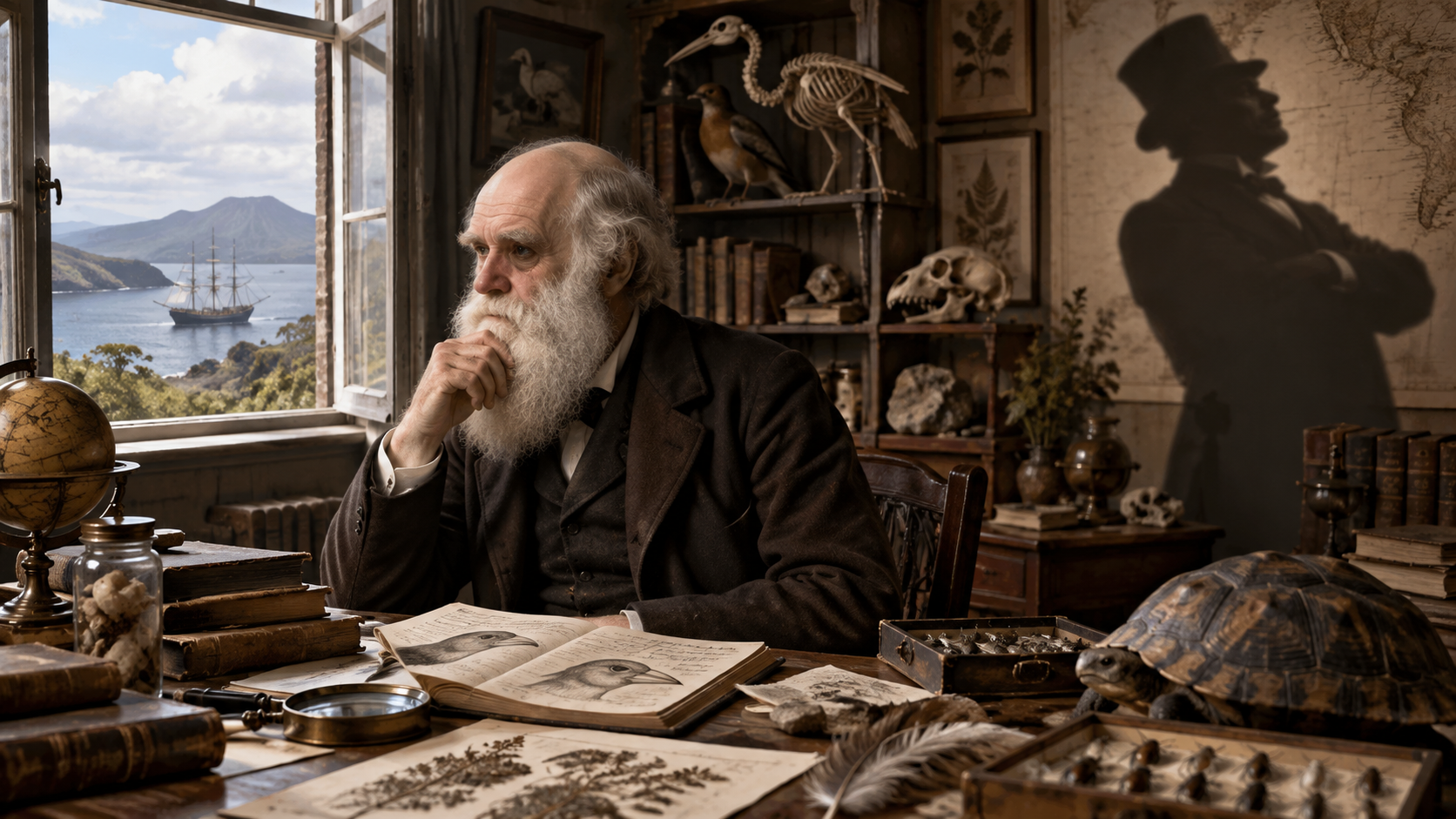
“Ignorance more frequently begets confidence than does knowledge.”
Charles Darwin wrote this line in the introduction to The Descent of Man in 1871. He was responding to confident declarations that the origin of humanity could never be understood scientifically. Darwin contrasted those declarations with the more cautious posture of researchers who recognized both evidence and unanswered questions. The sentence is sometimes treated as a general insult aimed at people who know little. In context, it is a methodological warning about the mismatch between certainty and inquiry. Serious investigation often expands awareness of complexity, while limited acquaintance with a subject can make a simple conclusion feel complete.
Journalism faces the same problem whenever a fast-moving event rewards immediate certainty. Early casualty numbers change, scientific findings carry margins of error, and legal documents can be misread before specialists examine them. A reporter who clearly marks uncertainty may sound less decisive than a commentator offering a single confident explanation. That does not make caution weak. Good reporting separates confirmed facts, credible estimates, working hypotheses, and unknowns. It also revises language as evidence improves. Darwin’s observation should not be used to dismiss nonexperts automatically; witnesses and affected communities often possess knowledge institutions lack. The issue is whether confidence matches the quality and scope of evidence.
Digital platforms amplify the most definite claim, not necessarily the best supported one. Readers can resist that incentive by asking what evidence would change a speaker’s mind, whether relevant expertise is present, and how much uncertainty a source acknowledges. Newsrooms can help by avoiding false precision, explaining ranges, and preserving a visible correction record. The quotation’s enduring value is epistemic humility: knowledge does not require permanent hesitation, but it should produce conclusions proportionate to the evidence. Confidence is most trustworthy when it has survived questions and can state its limits.
Darwin’s contrast between ignorance and confidence is a useful warning label for science coverage. Expertise is not proved by hesitation alone, and confidence is not automatically evidence of error; the question is whether the certainty expressed matches the quality and limits of the underlying research. Reporters can test that alignment by examining study design, sample size, replication, conflicts of interest, and the range of qualified interpretation. They should avoid presenting one striking paper as a settled revolution, but they should also avoid manufacturing balance when a broad body of evidence supports one conclusion. Clear reporting separates what researchers observed from the mechanism they propose and from the public policy someone favors. Darwin’s sentence remains valuable because information systems reward simple, emphatic claims, especially when uncertainty is difficult to summarize. Good journalism does not make uncertainty vague. It makes it specific—showing what is known, how well it is known, and which new evidence could reasonably change the assessment.
Darwin was answering claims that human origins lay permanently beyond investigation. He argued that such declarations reflected limited knowledge, while scientific work proceeded by gathering evidence and revising explanations.
The line does not prove that confidence signals ignorance or that experts are always right. It warns against certainty that outruns evidence. Firsthand experience and institutional expertise must both be examined rather than ranked automatically.
Breaking news, public health, and science coverage frequently involve changing information. Explicit uncertainty, ranges, and corrections help audiences distinguish honest revision from unreliability.
Explore more "Quotes of The Day"
Discover more notable quotes from influential voices across politics, science, business, technology, sports, and culture. Each quote offers insight into how ideas, beliefs, and decisions shape the world around us.