

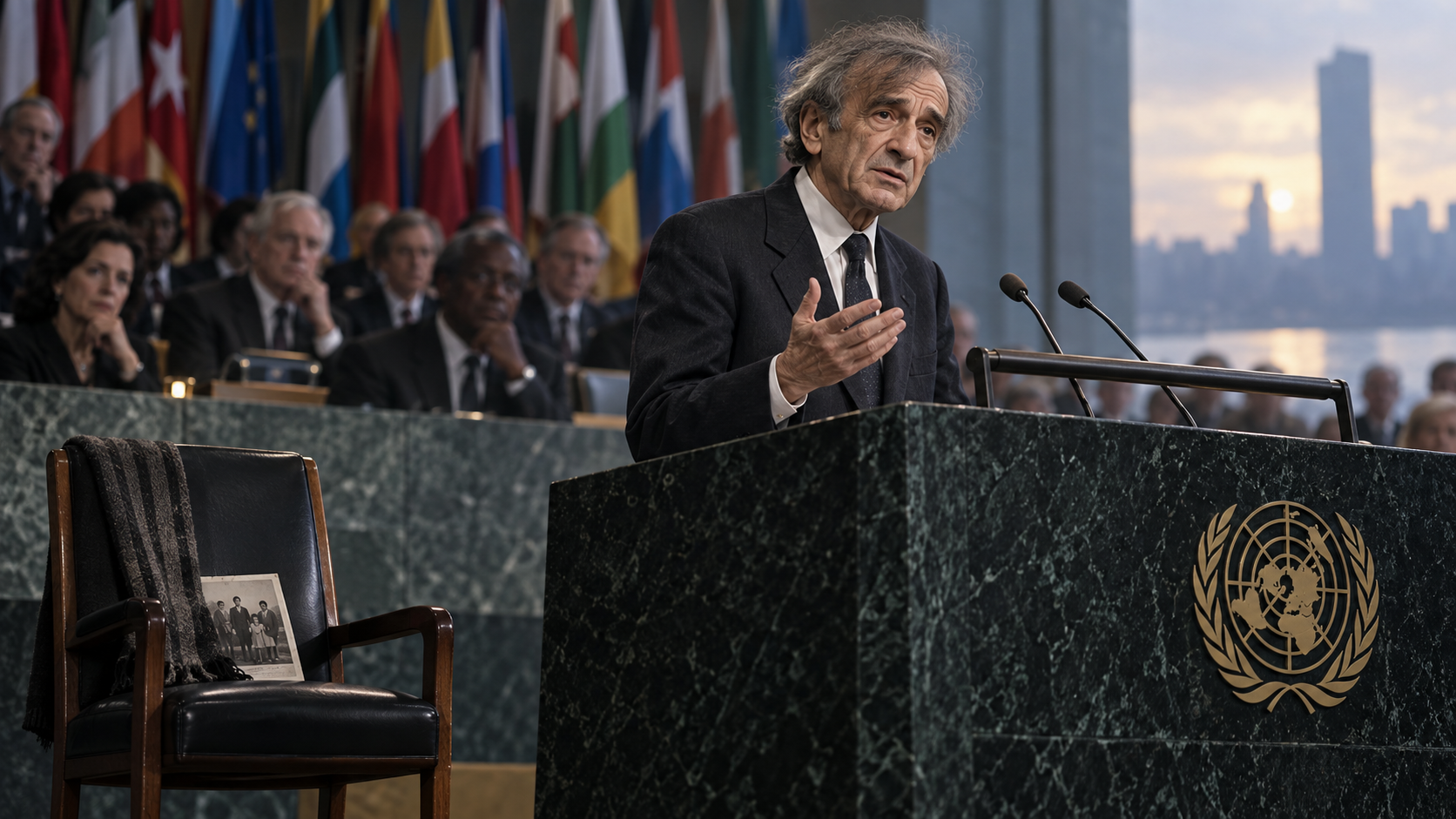
“Neutrality helps the oppressor, never the victim. Silence encourages the tormentor, never the tormented.”
Elie Wiesel delivered these words when accepting the Nobel Peace Prize in 1986. A survivor of Auschwitz and Buchenwald, he used the speech to connect memory of the Holocaust with contemporary suffering and the duties of witnesses. The paired sentences rejected a moral symmetry between those inflicting harm and those subjected to it. Wiesel was not speaking about journalistic balance as a technical format. He was arguing that silence in the presence of known persecution has consequences and that refusing to take a moral position can reinforce the power already causing the harm.
Journalists must handle the quotation carefully. Reporting should not decide contested facts by moral intuition or label people oppressors without evidence. Neutral methods—verification, fair opportunity to respond, and separation of fact from commentary—protect accuracy. But those methods are different from presenting documented abuse as an even disagreement between equivalent claims. False balance can obscure power and make established facts appear uncertain. The task is to report evidence proportionately, identify responsible actors, and include relevant context without turning journalism into a substitute court or political campaign.
The line remains relevant in coverage of war, detention, discrimination, and attacks on civilians. Silence can result from censorship, danger, limited access, or the editorial judgment that distant suffering will not attract an audience. News organizations cannot cover every crisis equally, but they can examine whose experiences are repeatedly excluded and why. Wiesel’s warning is strongest when joined to rigorous reporting: testimony must be verified, imagery used ethically, and claims placed within law and history. Bearing witness is not simply showing pain. It is constructing a factual record that makes denial and indifference harder to sustain.
Wiesel’s condemnation of neutrality is often invoked in moral emergencies, but journalism still needs a careful distinction between neutrality and fairness. Fairness requires accurate evidence, meaningful opportunity to respond, and honest treatment of uncertainty. It does not require presenting perpetrators and victims as equivalent or withholding a supported conclusion to appear detached. In coverage of mass violence, repression, or systematic abuse, passive constructions and symmetrical language can hide agency. Reporters should identify who controlled events, what independent evidence establishes, and how legal or historical terms are being used. They should also resist turning suffering into a device for moral theater; testimony deserves context, consent, and protection. Wiesel’s statement remains relevant because silence can result from editorial choices as well as censorship—from ignoring a pattern, delaying publication without cause, or demanding impossible proof from vulnerable sources. Responsible journalism bears witness while making every factual claim answerable to the record.
Wiesel’s acceptance speech moved from Holocaust memory to people facing persecution and political imprisonment in the 1980s. He described remembrance as an obligation to those suffering in the present.
Moral clarity does not eliminate evidentiary standards. The quotation warns against false equivalence and passive silence, not against verification, precise attribution, or fair reporting of genuinely disputed facts.
Conflict reporting creates records used by citizens, courts, historians, and families. Ethical witness combines attention to victims with corroboration, context, and restraint in the use of traumatic material.
Explore more "Quotes of The Day"
Discover more notable quotes from influential voices across politics, science, business, technology, sports, and culture. Each quote offers insight into how ideas, beliefs, and decisions shape the world around us.