

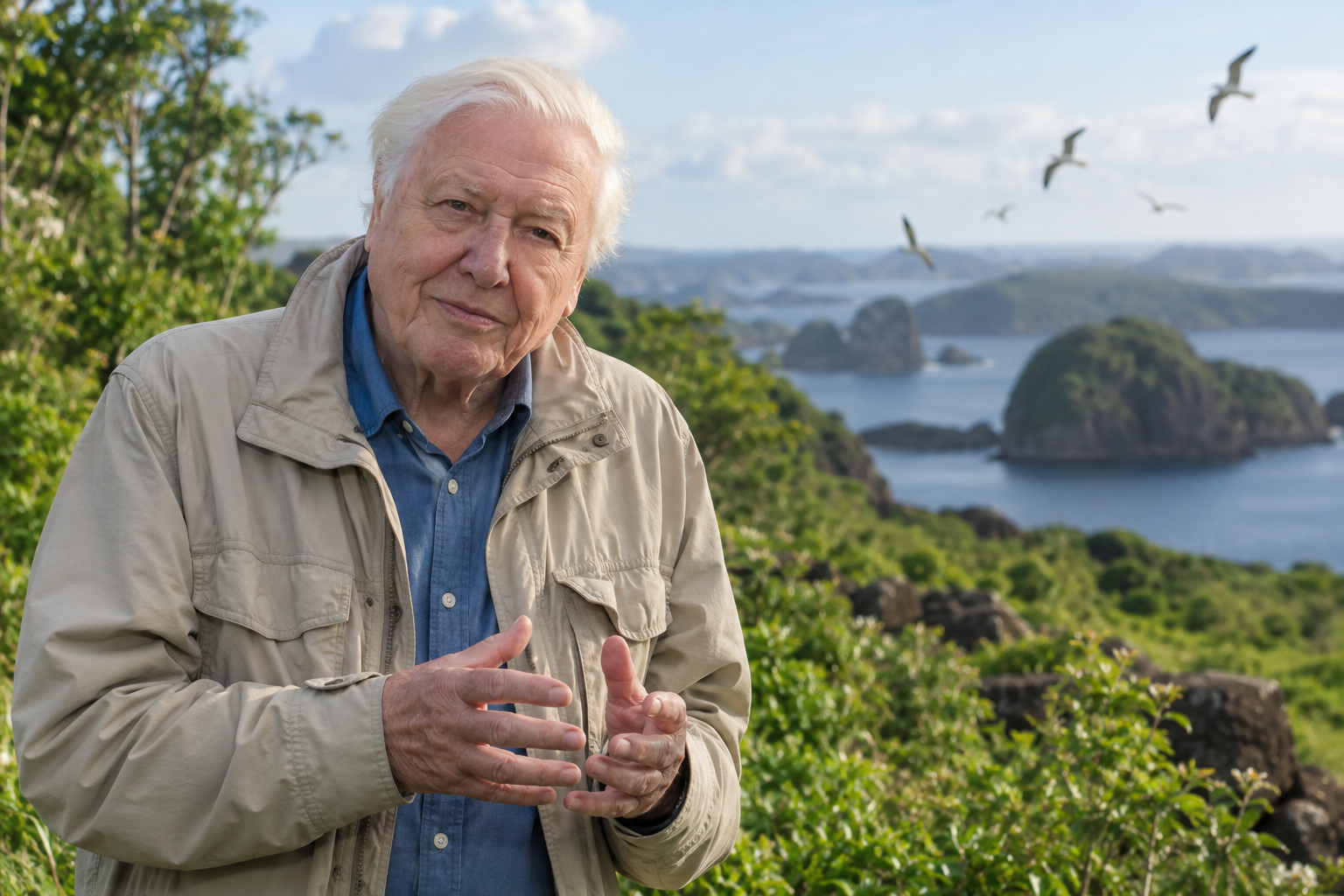
“Surely, working together, we are powerful enough to save it.”
David Attenborough delivered this appeal at the opening ceremony of the COP26 climate conference in Glasgow on November 1, 2021. The sentence completed a contrast: humanity had proved powerful enough, while acting separately, to destabilize the planet and should therefore be capable of working together to protect it. United Kingdom government sources reproduce the wording and identify the setting. Attenborough spoke as COP26’s People’s Advocate, addressing political leaders at a summit focused on national climate commitments, finance, adaptation, and the rules for implementing the Paris Agreement. The quotation is a closing call to cooperation, not a claim that cooperation alone guarantees success.
The idea is compelling because climate change crosses borders, economic sectors, and generations. Greenhouse gases accumulate regardless of where they are emitted, while the capacity to reduce emissions or withstand harm is distributed unevenly. No household, company, or country can solve that system by itself. The line therefore points toward coordination: governments setting enforceable policy, industries changing technology and investment, researchers sharing evidence, and communities shaping solutions that affect their land and livelihoods. For journalists, the quote suggests a reporting frame broader than individual virtue. Personal choices matter, but infrastructure, law, finance, and international bargaining often determine which choices are available.
Optimism should not obscure conflicts inside the word “together.” Countries differ over historical responsibility, current emissions, development needs, and who should pay for loss, damage, or adaptation. A coalition can announce common purpose while postponing difficult decisions. Cooperation may also exclude Indigenous peoples, workers, or frontline communities unless participation is designed into the process. Attenborough’s sentence is best read as a statement of capacity and obligation, not evidence that institutions are already aligned. Coverage should identify who made each pledge, whether it is conditional, how it will be funded, and which independent measures can reveal progress or delay.
That distinction keeps summit reporting from becoming a parade of speeches. A useful climate story compares targets with existing law, budgets, construction timelines, and verified emissions data. It explains where collaboration produced a concrete result—such as shared standards, technology transfer, or coordinated conservation—and where national incentives still pull apart. It also revisits promises between conferences, when public attention is lower and implementation becomes visible. Attenborough’s confidence in collective problem-solving offers a necessary counterweight to fatalism. Journalism serves that confidence by refusing both despair and easy celebration, documenting whether institutions convert shared language into measurable protection for ecosystems and people.
Attenborough spoke during COP26’s opening ceremony in Glasgow as the summit’s People’s Advocate, addressing leaders gathered to advance implementation of the Paris climate framework.
The quotation argues that collective capacity can be redirected, but agreement is not the same as delivery. Responsibility, finance, representation, and enforcement remain contested.
Reporting can test cooperation by tracking laws, budgets, emissions, construction, finance, and community outcomes between high-profile climate summits.
Explore more "Quotes of The Day"
Discover more notable quotes from influential voices across politics, science, business, technology, sports, and culture. Each quote offers insight into how ideas, beliefs, and decisions shape the world around us.