

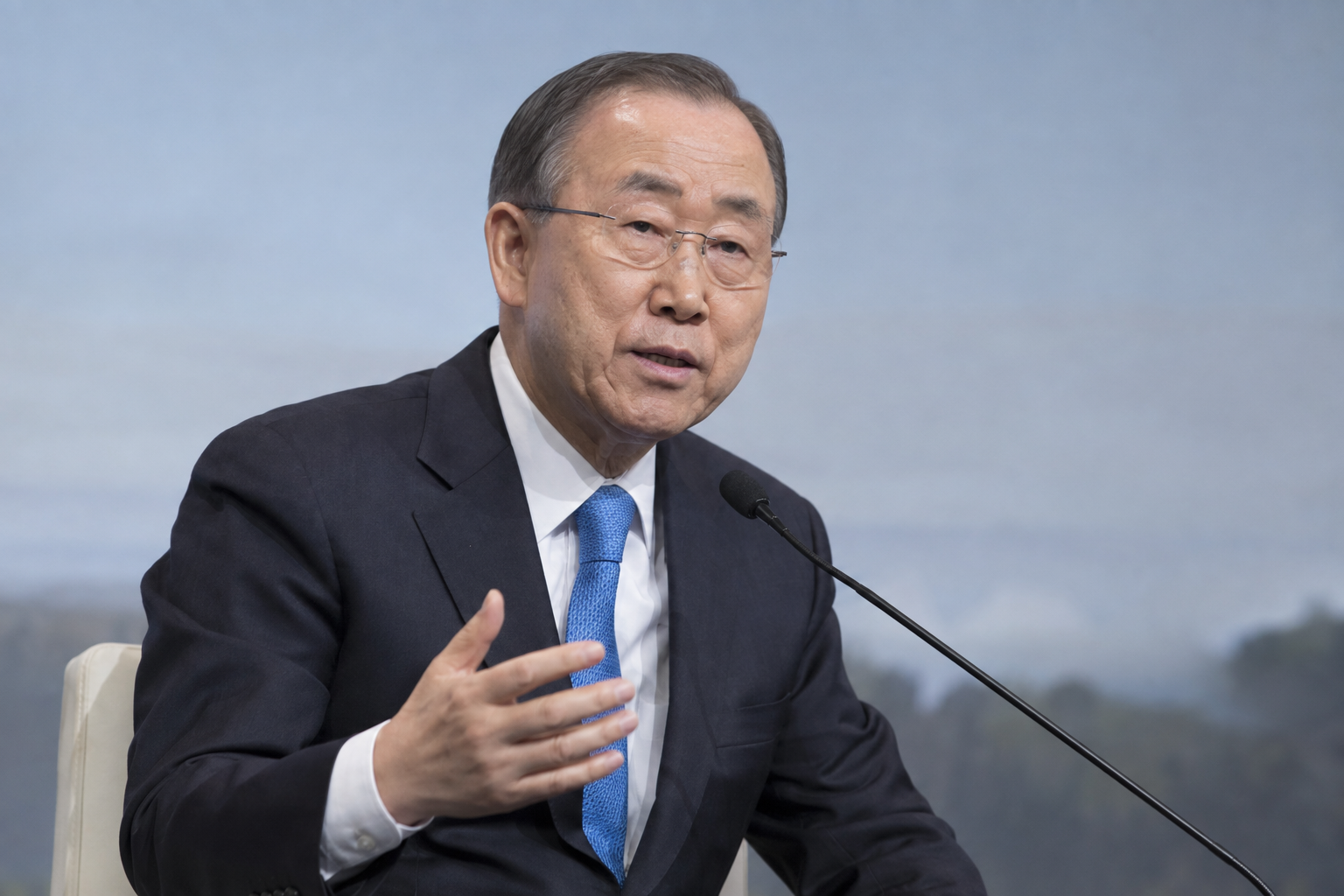
“Saving our planet, lifting people out of poverty, advancing economic growth—these are one and the same fight.”
United Nations Secretary-General Ban Ki-moon used this formulation in his September 21, 2011 address to the General Assembly, during preparations for the Rio+20 conference on sustainable development. Subsequent United Nations records reproduced the wording and its broader instruction to connect climate change, water scarcity, energy, health, food security, and women’s empowerment. The sentence challenged a policy habit of treating environmental protection, poverty reduction, and growth as separate agendas that compete for attention. In Ban’s framing, durable progress required solutions designed across all three, because a gain in one area can be undermined when the others are ignored.
The connection is visible in everyday news. Energy prices affect household budgets and business costs; drought can reduce harvests, raise food prices, and strain public finance; polluted air harms health and productivity; resilient infrastructure can protect both livelihoods and investment. Reporting these links helps readers see why a climate decision is also a labor, housing, health, and development story. It can also reveal who receives benefits and who pays the transition costs. A clean-energy project may lower emissions while creating jobs, but its full record includes land rights, supply chains, electricity access, public subsidies, and the distribution of savings.
Calling the goals “one and the same fight” does not mean every proposed policy produces a win for everyone. Economic growth can increase emissions or displace communities; conservation can restrict local livelihoods; new technology can concentrate profit while leaving service gaps. Trade-offs do not invalidate the integrated approach, but they must be named and measured. Journalists should be wary when leaders use the language of sustainability without disclosing baselines, financing, enforcement, or affected groups. They should also avoid reducing poverty to a single income statistic when security, health, education, mobility, and exposure to environmental risk shape lived conditions.
The quote remains relevant because governments and companies increasingly present climate and development plans as packages of mutual benefit. The reporting test is whether those packages work in practice. That requires following budgets from announcement to expenditure, comparing projected jobs with actual employment, examining who gains reliable services, and tracking environmental results over time. Local testimony should be paired with administrative data and independent research, especially where averages conceal regional or demographic gaps. Ban’s sentence offers a useful map of interdependence, not permission for vague optimism. News coverage makes the map accountable by showing where policies reinforce one another, where costs are shifted, and whose definition of progress controls the story.
Ban framed the idea during the 2011 UN General Assembly as governments prepared for Rio+20 and debated how environmental, social, and economic policy should be integrated.
The goals can reinforce one another, but not automatically. Projects still require scrutiny of emissions, jobs, prices, land rights, access, public finance, and unequal burdens.
Accountability reporting should follow money, timelines, service access, employment, environmental indicators, and community outcomes instead of repeating broad sustainability claims.
Explore more "Quotes of The Day"
Discover more notable quotes from influential voices across politics, science, business, technology, sports, and culture. Each quote offers insight into how ideas, beliefs, and decisions shape the world around us.