

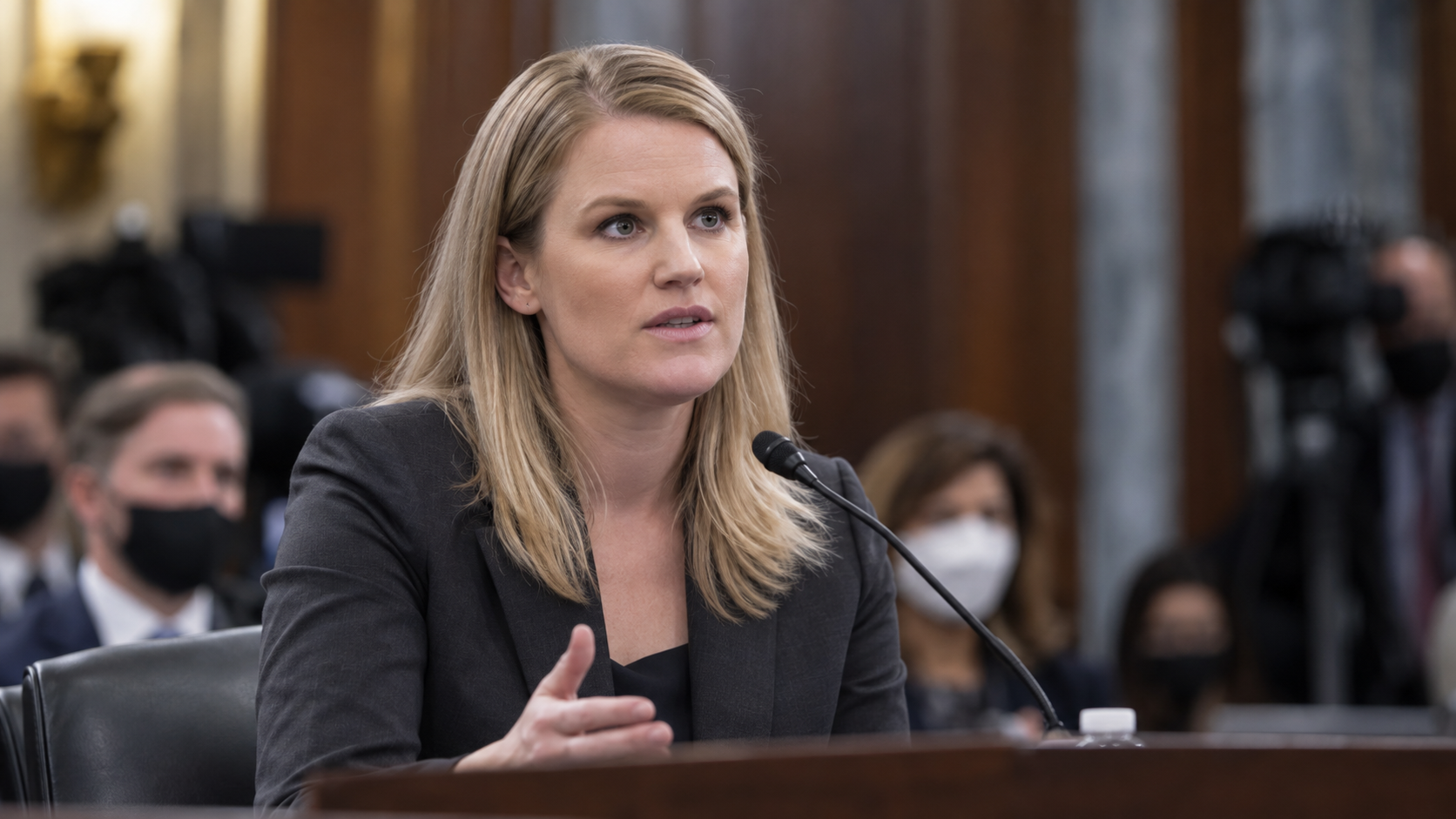
“Facebook chooses profit over safety every day — and without action, this will continue.”
Former Facebook product manager Frances Haugen closed her written testimony to a United States Senate Commerce subcommittee with this warning in October 2021. The committee had convened a hearing on children’s online safety after Haugen disclosed internal company research to regulators and journalists. In the official statement, she argued that Facebook repeatedly resolved conflicts between growth and safety in favor of profit, while outsiders lacked the data needed to evaluate its systems independently. The sentence was therefore not a general complaint about technology. It summarized a whistleblower’s specific allegation about corporate incentives, information asymmetry, and the need for public oversight.
The quote directs attention away from isolated pieces of harmful content and toward the design decisions that determine what billions of people see. Ranking systems, recommendation tools, product testing, and internal performance targets can reward engagement even when the material generating it is divisive or damaging. For newsrooms, that distinction matters. A story about a troubling post may describe a symptom; accountability reporting asks what the platform measured, what employees learned, who approved the response, and whether public assurances matched internal evidence. Haugen’s testimony made transparency central because claims about safety cannot be tested when only the company can inspect the relevant data.
Her formulation should still be handled as an allegation supported by disclosed documents and sworn testimony, not as a substitute for independent proof of every claimed harm. Platform effects vary by country, language, age group, and product feature, while correlation in internal research does not automatically establish causation. Facebook disputed aspects of Haugen’s interpretation and argued that it invested heavily in safety. Responsible coverage should present those responses without treating them as resolution. It should examine the underlying study design, compare testimony with documents, seek outside researchers, and distinguish a company’s legal obligations from broader arguments about ethical responsibility.
The warning remains relevant as social platforms shape elections, public health information, conflict reporting, and young people’s daily lives. Meaningful follow-up requires more than repeating dramatic hearing exchanges. Journalists can track whether researchers receive data access, whether risk assessments cover neglected languages, whether regulators gain auditing authority, and whether promised product changes alter measurable outcomes. They should also report trade-offs: privacy protections can limit data access, poorly designed transparency rules can expose users, and moderation systems can make consequential errors. Haugen’s quote is strongest as a testable proposition about incentives. The continuing news task is to reveal the evidence, decisions, and results that show when safety is protected—and when it is subordinated.
Haugen submitted the statement before an October 2021 Senate hearing on children’s online safety, after providing internal Facebook records to regulators and journalists.
The line concerns institutional incentives and unequal access to evidence. It does not prove every alleged platform effect, which still requires independent research and careful causal analysis.
Accountability reporting should follow data access, audits, product changes, regulatory action, regional disparities, and measurable safety outcomes rather than stopping at hearing testimony.
Explore more "Quotes of The Day"
Discover more notable quotes from influential voices across politics, science, business, technology, sports, and culture. Each quote offers insight into how ideas, beliefs, and decisions shape the world around us.