

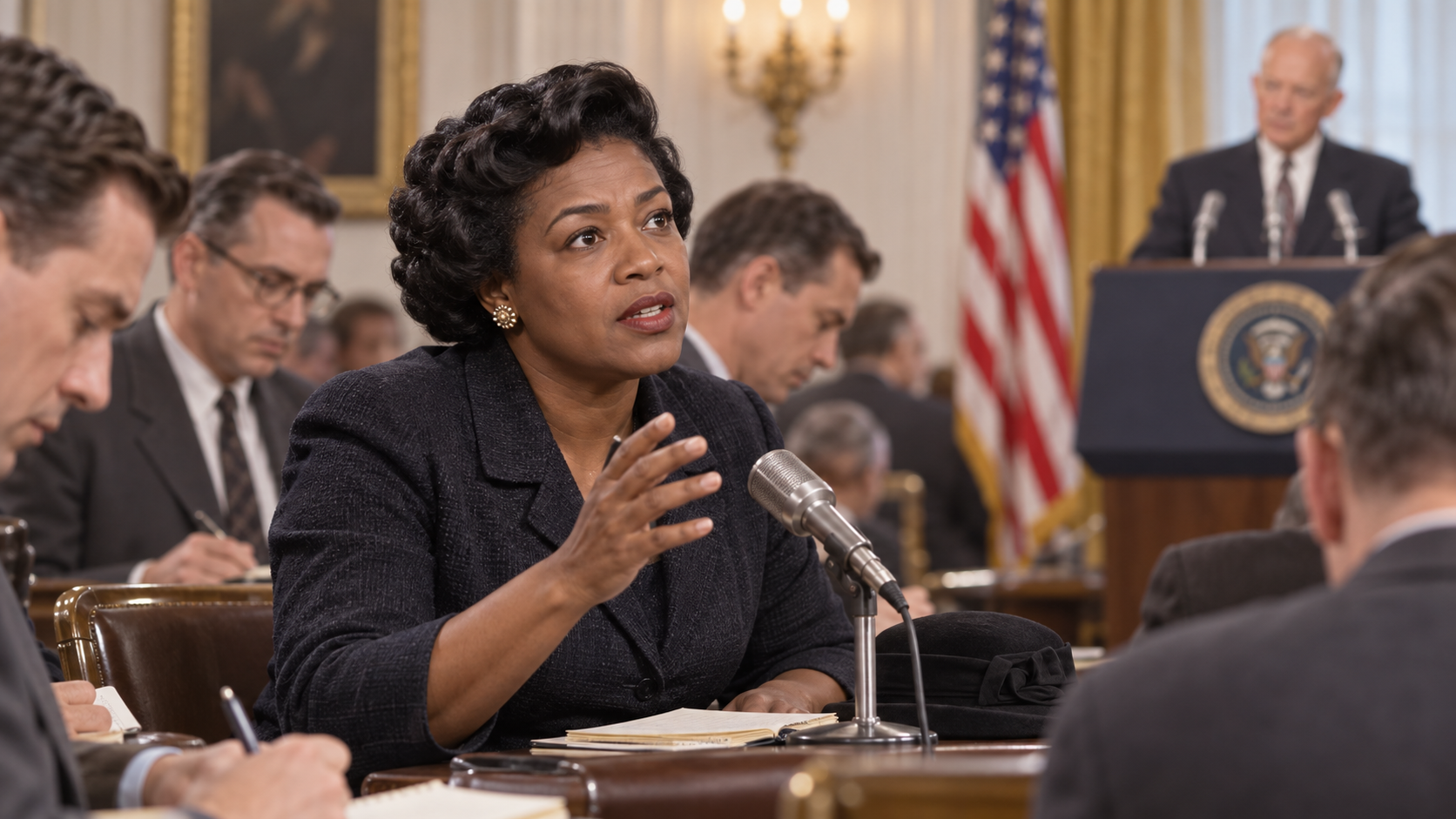
“I would like to know if you plan to use any action to get these bills voted out of committee?”
Chicago Defender correspondent Ethel Payne asked this question at President Dwight D. Eisenhower’s June 16, 1954 news conference. The official transcript identifies Payne and records the longer lead-in: two foreign students in Alabama had faced discrimination on a bus, bills to ban segregation in interstate travel were stalled in congressional committees, and the attorney general had been asked for an opinion. Eisenhower replied that he had not seen the bills, said he generally preferred progress through cooperation when possible, and promised to look at the matter. Payne’s question placed a concrete civil-rights issue into a national forum where it might otherwise have gone unasked.
Its importance lies partly in agenda-setting. Presidential press conferences do not simply collect information; the questions help determine which communities and problems enter the official record. Payne reported for the Black press, whose coverage regularly treated racial discrimination as central national news while many larger white-owned outlets marginalized it. By connecting an incident, pending legislation, and executive responsibility, she moved beyond asking for a reaction. She asked whether the administration would use its influence to advance a decision. That structure remains a model for accountability questions because it identifies both the unresolved problem and the official with power to respond.
The exchange should not be romanticized as a single question that changed policy. Legislation moves through committees, courts interpreted interstate-commerce authority, activists organized across years, and federal agencies acted within contested legal and political limits. A presidential answer at a press conference may reveal priorities without producing an enforceable commitment. Reporters also must avoid building questions on unverified premises or using the microphone primarily to perform a viewpoint. Payne’s question was effective because its premises were specific and its requested action was identifiable. The transcript allows readers to evaluate both her wording and Eisenhower’s answer rather than relying on a later legend.
The episode remains relevant wherever access to power is scarce and the press corps does not reflect the public affected by government decisions. Different professional and community experiences influence which omissions reporters notice, which records they search, and which follow-up questions they recognize. Diversity is therefore not only a matter of representation on camera; it can change the substance of the public agenda. Newsrooms honor Payne’s example by preparing questions from documents, making institutional responsibility explicit, listening for evasions, and continuing the reporting after the briefing ends. A question is not the finished story, but it can force a neglected issue into a record that officials, legislators, and citizens must confront.
Payne asked Eisenhower about stalled bills addressing segregation in interstate travel during his June 16, 1954 news conference, after citing a specific Alabama bus incident.
The question linked evidence, pending legislation, and presidential influence. Its significance should be understood within the broader work of activists, courts, Congress, and the Black press.
Accountability questions are strongest when their premises are verified, the requested action is specific, and reporting continues through records, policy decisions, and measurable outcomes.
Explore more "Quotes of The Day"
Discover more notable quotes from influential voices across politics, science, business, technology, sports, and culture. Each quote offers insight into how ideas, beliefs, and decisions shape the world around us.