

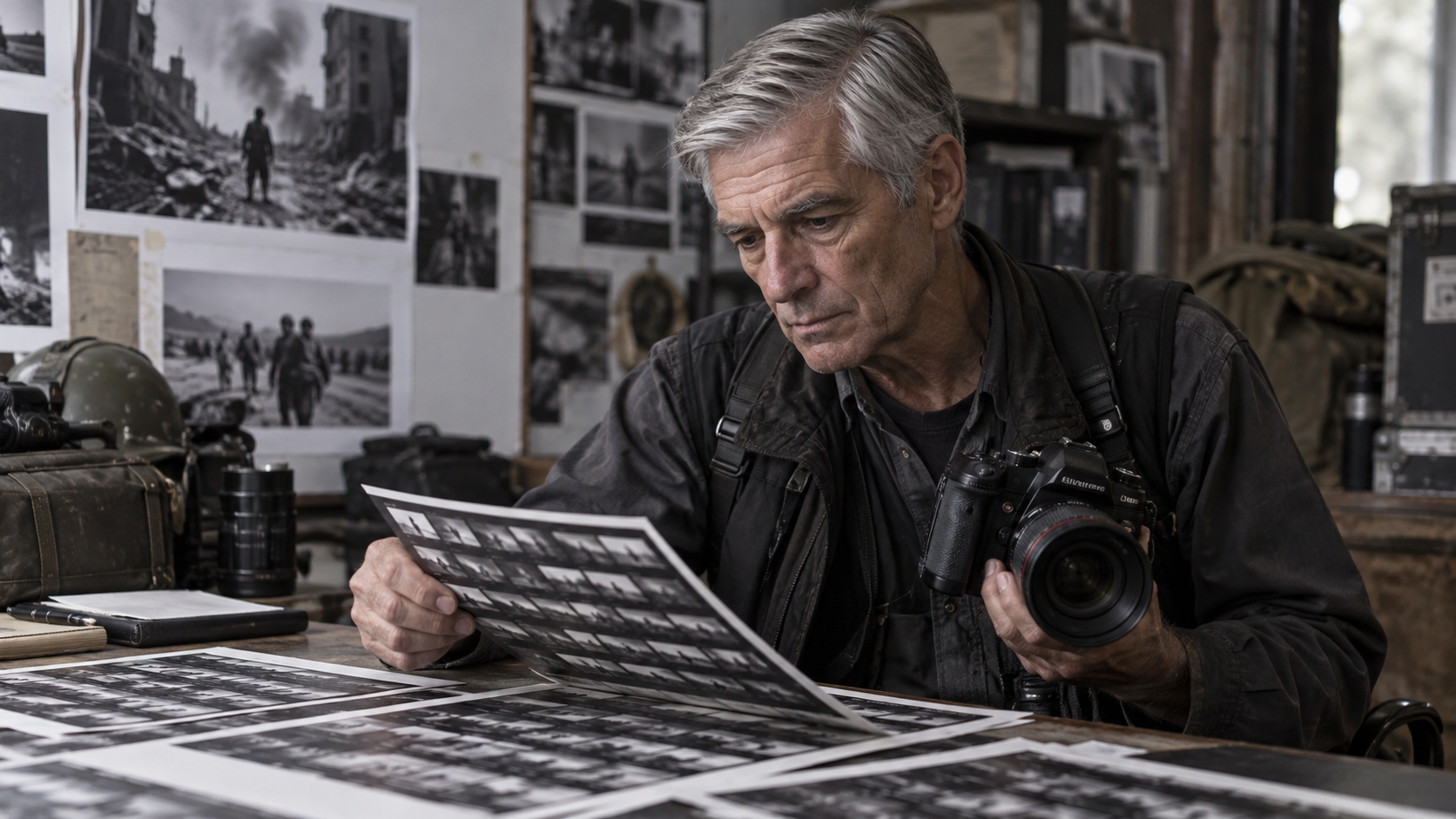
“I have been a witness, and these pictures are my testimony.”
James Nachtwey used this sentence at a 2000 Dartmouth presentation after showing photographs from war, famine, disease, and political violence. Calling the images testimony placed his work closer to evidence than spectacle. A witness is present, observes, and accepts responsibility for describing what was seen. Yet a photograph is never a complete record. It isolates one fraction of time through choices about position, framing, timing, and publication. Nachtwey’s language therefore gives photojournalism moral force while also inviting scrutiny of how visual evidence is made and what remains outside the frame.
Responsible visual testimony begins before the shutter. Photographers need to understand the situation, identify risks to the people pictured, and avoid directing events in ways that falsify them. Captions should establish who, where, and when with the same care applied to written reporting. Editors must verify provenance, sequence, and image integrity, especially when files arrive through social platforms or unknown intermediaries. A powerful composition cannot compensate for a misleading caption. The photograph and its supporting information work together; without context, viewers may respond strongly while misunderstanding the event the image claims to document.
Witnessing also creates obligations toward subjects. People experiencing grief, injury, displacement, or fear do not become raw material simply because their circumstances are newsworthy. Consent may be limited in chaotic public events, but dignity can still guide distance, timing, identification, and distribution. Editors should consider whether naming or showing someone could expose that person to retaliation, whether an image repeats a degrading stereotype, and whether the public value justifies intimate detail. These questions do not require sanitizing suffering. They require showing consequential reality without pretending that visibility has no cost.
The quote has new relevance as synthetic images and decontextualized footage circulate at extraordinary speed. Visual journalists can strengthen testimony by retaining original files, documenting capture details, preserving metadata where safe, and publishing verification notes when authenticity may be questioned. Newsrooms should correct captions prominently and resist using an image merely because it is dramatic. Nachtwey’s formulation is ultimately a standard of responsibility: the photographer sees on behalf of others, but the resulting picture must remain accountable to the event, the subject, and the audience that will treat it as evidence. Visual literacy belongs in this process too. Editors can explain cropping, sequencing, and selection so viewers understand that authenticity does not eliminate interpretation or the need to compare the photograph with other reporting. That comparison often reveals essential causes and consequences beyond the frame.
Nachtwey spoke the sentence at a 2000 Dartmouth presentation while reflecting on a career photographing conflict and humanitarian crises; it later became closely associated with his public description of his work.
A photograph testifies through both image and context. Accurate captions, provenance, sequencing, and disclosure of uncertainty are necessary because framing alone can never provide the entire event.
Synthetic media makes preservation and verification central newsroom tasks. Original files, safe metadata, documented handling, and visible caption corrections help protect visual evidence from manipulation.
Explore more "Quotes of The Day"
Discover more notable quotes from influential voices across politics, science, business, technology, sports, and culture. Each quote offers insight into how ideas, beliefs, and decisions shape the world around us.