

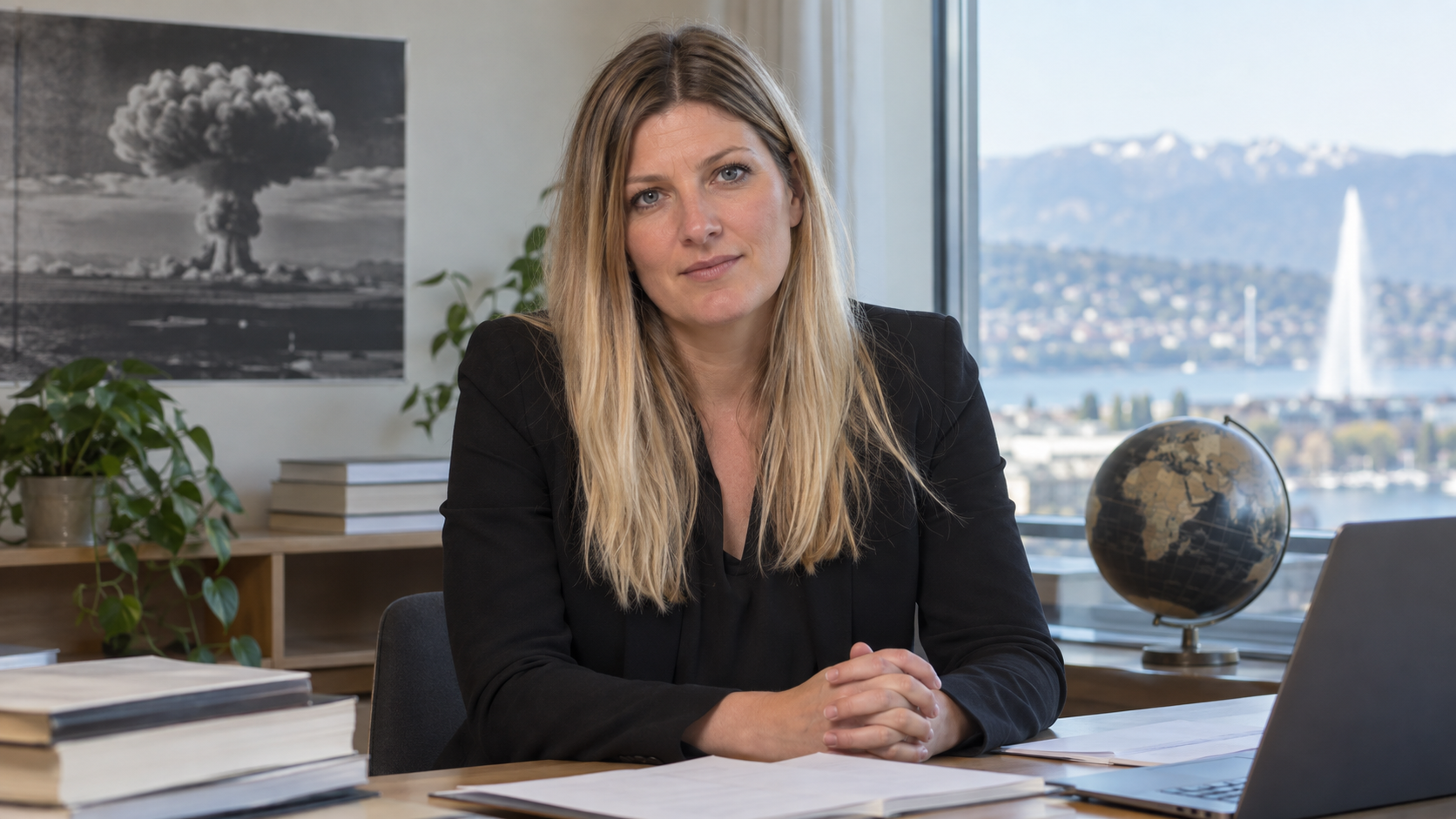
“A moment of panic or carelessness, a misconstrued comment or bruised ego, could easily lead us unavoidably to the destruction of entire cities.”
Beatrice Fihn delivered this warning in her portion of the Nobel lecture for the International Campaign to Abolish Nuclear Weapons on December 10, 2017. She shared the stage with Hiroshima survivor Setsuko Thurlow, representing the organization that received the Peace Prize. The sentence focuses on human fallibility. Political systems may describe destructive power through strategy and technical control, but the people operating those systems can still misunderstand a message, make a hurried judgment, or react emotionally. Fihn’s warning asks whether the possible consequences of those ordinary failures have been taken seriously enough.
The quotation brings the scale of a decision into view. An error that would be manageable in one setting can become catastrophic in another. That makes the design of a system as important as the intentions of the people using it. Citizens should be able to ask what checks exist, how uncertainty is communicated, and whether decision-makers have enough time to examine the information before them. A responsible account of security should explain how a system behaves when something goes wrong. It should not rely only on the reassuring idea that capable people will always remain calm and interpret every signal correctly.
There is also a political question about distance. A small group may control a decision whose effects would reach people who have no role in making it. Public debate can become abstract when the consequences are described through technical language alone. The reference to cities restores a human scale: homes, schools, workplaces, and communities would be involved. That perspective helps citizens examine who bears the risk and how their interests are represented. It also encourages institutions to consider prevention as a public responsibility. A system that exposes others to profound danger needs scrutiny that reaches beyond the people who benefit from its continued operation.
Fihn’s statement is part of an argument for nuclear abolition, and that setting should remain clear. The sentence itself does not settle every debate about deterrence or the details of disarmament. It supplies a challenge that those debates need to address: how can any policy account for the possibility of human error when the consequences would be irreversible? Communication, safeguards, verification, and diplomatic cooperation all matter to that question. The quotation remains effective because it connects the vulnerability of a decision-maker with the vulnerability of an entire population. It asks readers to make that connection before a crisis, while there is still time to examine choices and reduce danger.
Fihn delivered this passage in ICAN’s 2017 Nobel lecture; Setsuko Thurlow delivered the other portion of the shared address.
ICAN received the prize as an organization, and the quotation is attributed to the individual who spoke these words.
The warning focuses on human error, misinterpretation, and emotion within systems capable of catastrophic harm.
It asks how security policy performs under imperfect conditions, rather than assuming that every judgment will be correct.
Public scrutiny should consider who controls a high-risk decision and who would experience its consequences.
The line belongs to an argument for abolition, while also raising practical questions about safeguards, communication, and prevention.
Explore more "Quotes of The Day"
Discover more notable quotes from influential voices across politics, science, business, technology, sports, and culture. Each quote offers insight into how ideas, beliefs, and decisions shape the world around us.