

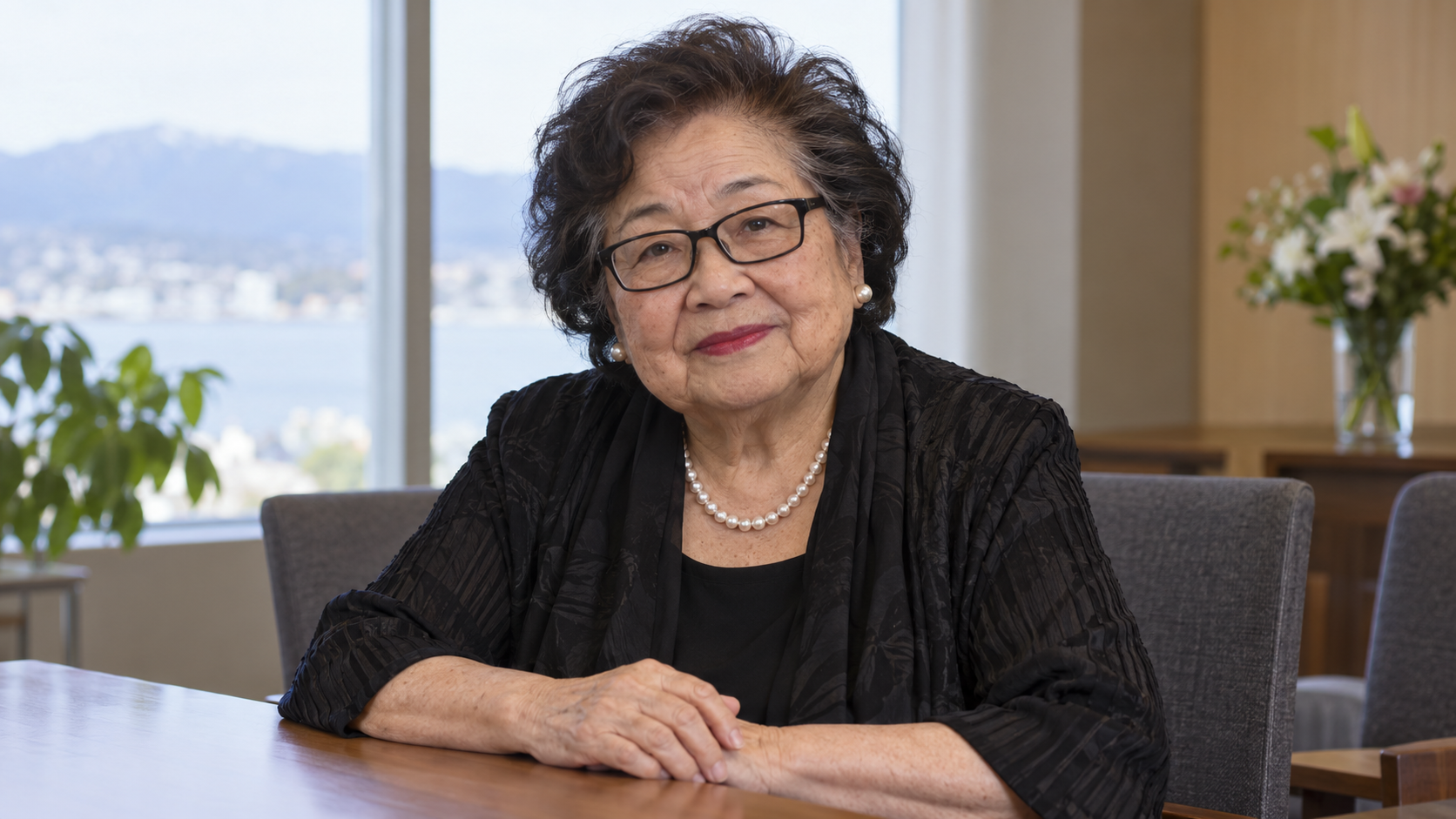
“These weapons are not a necessary evil; they are the ultimate evil.”
Setsuko Thurlow spoke these words during the Nobel Peace Prize ceremony in Oslo on December 10, 2017. A survivor of the atomic bombing of Hiroshima, she shared the lecture with Beatrice Fihn on behalf of the International Campaign to Abolish Nuclear Weapons, the organization receiving that year’s prize. Her statement followed an account of what nuclear destruction meant for people who endured it. The contrast between necessity and evil challenged the language through which governments justify possessing such weapons. Thurlow was speaking as a survivor and campaigner, not as an individual recipient of the award.
The political force of this quotation lies in its refusal to let an abstract category settle a moral question. Calling a weapon necessary can make the discussion seem finished before its victims have been heard. A security doctrine might explain the purpose claimed for a weapon, but explanation alone does not establish that its consequences are acceptable. Thurlow’s words bring the people exposed to those consequences back into the argument. They ask whether the vocabulary of strategy conceals experiences that should instead be central to judgment, especially when decisions made by a few officials could affect entire communities and generations.
Her argument also makes testimony a form of political knowledge. A survivor cannot supply every calculation relevant to international security, yet a technical calculation cannot replace a survivor’s account either. Each reveals something different about what a policy would mean. Serious public deliberation should therefore resist two shortcuts: treating experience as mere emotion, and treating expertise as a complete answer to ethical responsibility. Listening carefully does not oblige a reader to accept every proposed policy. It does oblige that reader to evaluate the proposal with a fuller understanding of the injuries, losses, and human vulnerability that the policy concerns.
The line remains relevant wherever leaders describe an extreme harm as an unavoidable instrument of protection. Its usefulness is to reopen the question of what protection actually includes and whose safety receives attention. Applying that question requires more than adopting a powerful phrase. Citizens can examine the assumptions behind a claim of necessity, ask which alternatives were considered, and notice whose voice is absent from the explanation. Thurlow’s intervention sets a demanding standard for political discussion: a policy defended in the name of human survival must remain answerable to human beings, including those who have already experienced its most devastating consequences. Hearing their testimony is part of assessing what responsible protection demands.
Thurlow delivered her part of the joint ICAN Nobel lecture in Oslo in 2017, drawing on her experience as a Hiroshima survivor.
The award belonged to ICAN. Her role was to accept and speak on behalf of the campaign alongside its executive director.
The quotation rejects the idea that a claim of military necessity can settle the ethical status of nuclear weapons.
Its immediate audience was the Nobel ceremony. The surviving transcript supports the words, but does not establish a single public reaction shared by all listeners.
Survivor testimony can expose human costs that disappear when debate is conducted only through strategic abstractions.
The statement offers a moral challenge to policy makers; assessing a particular disarmament proposal still requires examining its practical terms.
Explore more "Quotes of The Day"
Discover more notable quotes from influential voices across politics, science, business, technology, sports, and culture. Each quote offers insight into how ideas, beliefs, and decisions shape the world around us.