

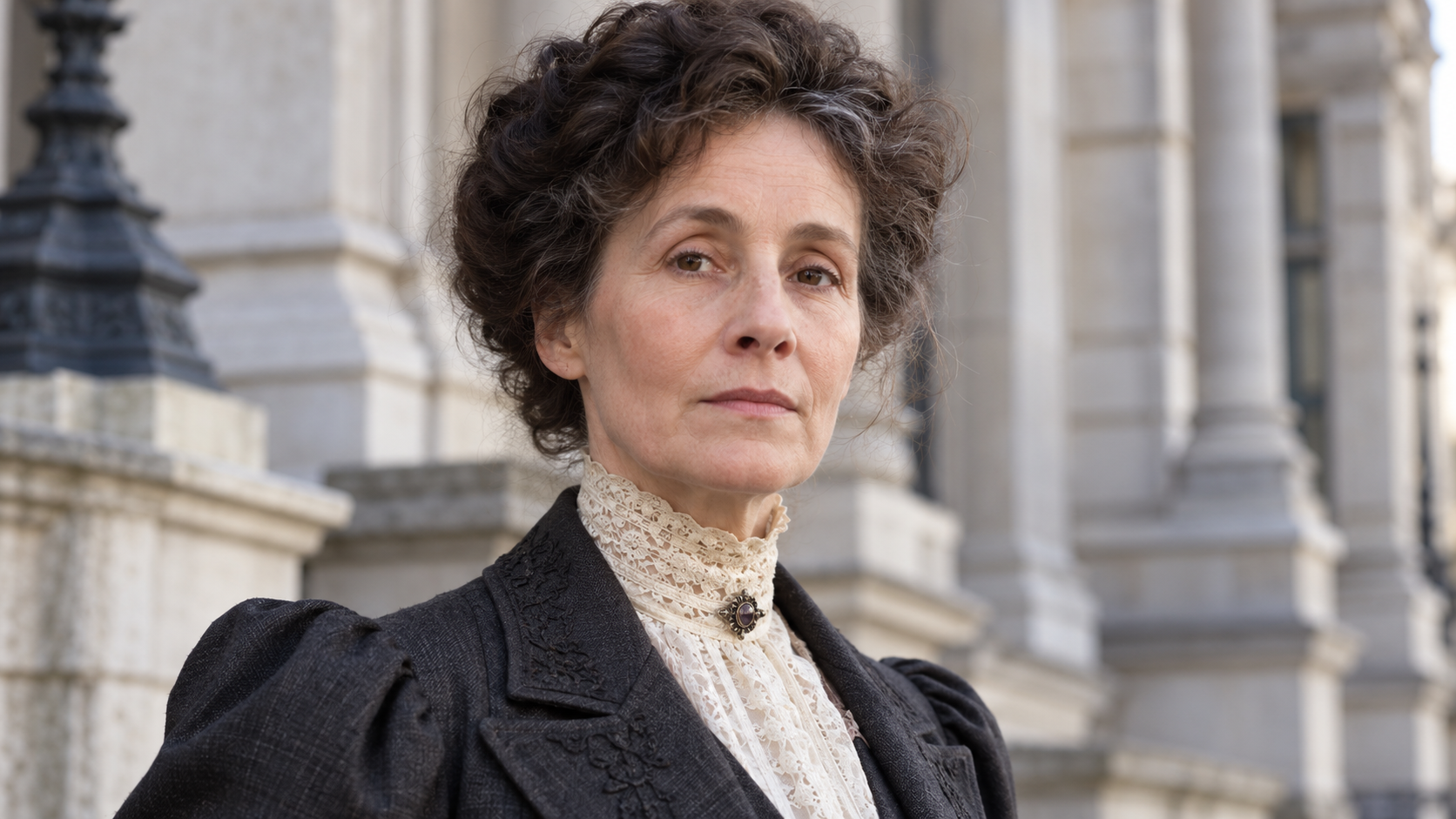
“We are here, not because we are law-breakers; we are here in our efforts to become law-makers.”
In an October 1908 appearance at Bow Street Magistrates’ Court, Emmeline Pankhurst turned the charge against the suffragettes into a question about political authority. Sylvia Pankhurst recorded the statement in The Suffragette, published in 1911. Emmeline’s phrase contrasted being treated as an offender with seeking a voice in legislation. It was spoken during a struggle over women’s exclusion from the parliamentary vote. Reading it in that setting prevents the words from becoming a general excuse for breaking any law. The claim concerned people subject to a political system while denied a direct electoral part in shaping it.
The sentence uses the courtroom’s categories to expose the limits of the courtroom’s answer. A legal proceeding could determine whether an offence had occurred; it could not, by that determination alone, settle the legitimacy of excluding women from representation. Pankhurst asked listeners to consider the political purpose behind the protest. Her point did not make every tactic beyond criticism. The suffrage movement contained serious disagreements about methods, and the Women’s Social and Political Union’s militancy remains part of its contested history. The useful distinction is between evaluating particular conduct and ignoring the demand that brought the protestors into conflict with the authorities.
The shift from law-breakers to law-makers also makes citizenship concrete. Having a vote does not mean personally drafting every statute. It gives people a means of selecting representatives, contesting decisions, and influencing the rules that organize public life. Without such standing, even well-intentioned officials can speak for a group without having to answer to its members at an election. Pankhurst’s wording makes that dependence visible. Readers can apply the insight when considering participation in local government, access to public hearings, or the practical barriers that keep eligible citizens from exercising rights they formally possess. A stated right requires a usable route into decision-making.
The quote’s force rests on the plural pronoun. Pankhurst spoke as part of a movement seeking a change larger than her own case. That collective purpose helps explain why the line outlived the immediate proceeding. It asks who gets to define order and whose participation is missing from that definition. Those questions still require careful answers, including attention to the consequences of protest and the rights of others. Yet a society cannot assess its democracy only by how efficiently it enforces rules. It must also examine whether the people governed by those rules have a fair opportunity to help determine them.
The line comes from Pankhurst’s October 1908 statement at Bow Street Magistrates’ Court. Sylvia Pankhurst’s contemporary chronicle preserves the wording.
Its immediate subject was women’s parliamentary suffrage. The defendants framed their protest as a demand for political representation.
The verbal contrast redirects attention from a prosecution to the structure of citizenship. People could be bound by laws while excluded from the electorate that selected lawmakers.
That argument does not resolve disputes over militant tactics. The claim to representation and the evaluation of particular methods remain distinct questions.
A useful modern question is whether formal political rights can actually be exercised through accessible voting and public participation.
The quote encourages scrutiny of who has a voice in making rules. Democratic legitimacy depends on participation as well as enforcement.
Explore more "Quotes of The Day"
Discover more notable quotes from influential voices across politics, science, business, technology, sports, and culture. Each quote offers insight into how ideas, beliefs, and decisions shape the world around us.