

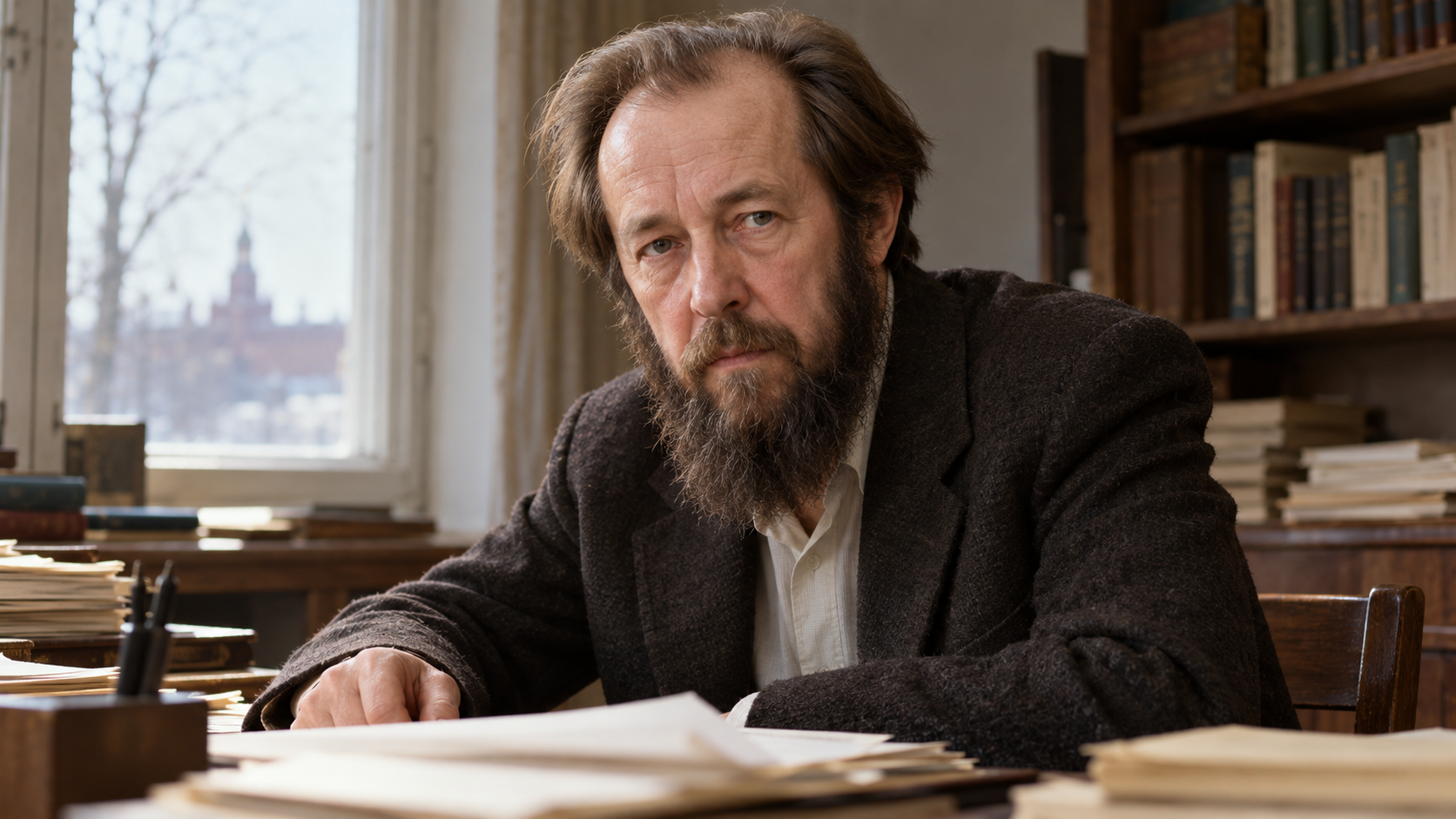
“Violence finds its only refuge in falsehood, falsehood its only support in violence.”
Aleksandr Solzhenitsyn’s written Nobel lecture links coercion with the stories used to justify it. The English wording appears in the Nobel Prize’s published translation of the text associated with his 1970 literature award. The Nobel archive explains that the lecture was submitted to the Swedish Academy rather than delivered as a lecture in person. That is the setting for this quotation. Its sharply balanced clauses describe a relationship: violence needs a protective account of its actions, while falsehood may need force to prevent people from challenging that account. The sentence concerns the maintenance of domination, not simply the existence of an occasional lie.
In the surrounding discussion, Solzhenitsyn describes overt violence seeking a cloak of explanation and demanding allegiance to deception. This is a writer’s diagnosis of power, expressed with deliberate moral intensity. It should not be treated as a statistical claim proving that every act of violence has exactly the same cause. Its value lies in directing attention to the language surrounding coercion. A government or institution can present compulsion as care, turn a victim into a threat, or describe criticism as disloyalty. Those changes in description can make abuses harder to recognize even before evidence is suppressed or witnesses are intimidated.
The two halves of the line also explain why an apparently small refusal to repeat a false account can matter politically. When a system depends on public agreement with something untrue, an accurate record threatens more than a single sentence. It threatens the appearance of consent. Readers can connect that insight with careful reporting, preserved documents, and testimony that distinguishes what was observed from what was inferred. These practices demand patience. A compelling accusation still requires evidence, and repeating an unsupported allegation can damage the very commitment to truth that resistance claims to defend. Accuracy is part of the work, rather than a reward for choosing the right side.
Solzhenitsyn placed literature within this struggle because stories can restore the human reality that official language erases. His confidence in art belongs to his argument; the quotation does not guarantee that a book or a truthful statement will immediately stop brutality. What it offers is a reason to protect independent witness. Citizens need room to investigate, question explanations, and hear accounts that power would prefer to exclude. That room can be lost gradually through fear and habitual self-censorship. The practical lesson is to examine both the force being exercised and the narrative that asks the public to accept it without further inquiry.
The quotation is reproduced in the Nobel archive’s English translation of Solzhenitsyn’s written lecture associated with the 1970 literature prize.
The archive notes that the text was submitted to the Swedish Academy. It was not a lecture he delivered in person at the award ceremony.
The surrounding passage concerns violence concealing itself behind false explanations and requiring public acceptance of those explanations.
The paired clauses portray a reinforcing relationship. Coercion protects an official fiction, and that fiction helps present coercion as legitimate.
Readers can examine the evidence behind language that justifies force. Accurate documentation and independent testimony help keep that examination possible.
Truthful resistance also needs discipline. Unsupported claims should not be repeated merely because they target an institution one already distrusts.
Explore more "Quotes of The Day"
Discover more notable quotes from influential voices across politics, science, business, technology, sports, and culture. Each quote offers insight into how ideas, beliefs, and decisions shape the world around us.