

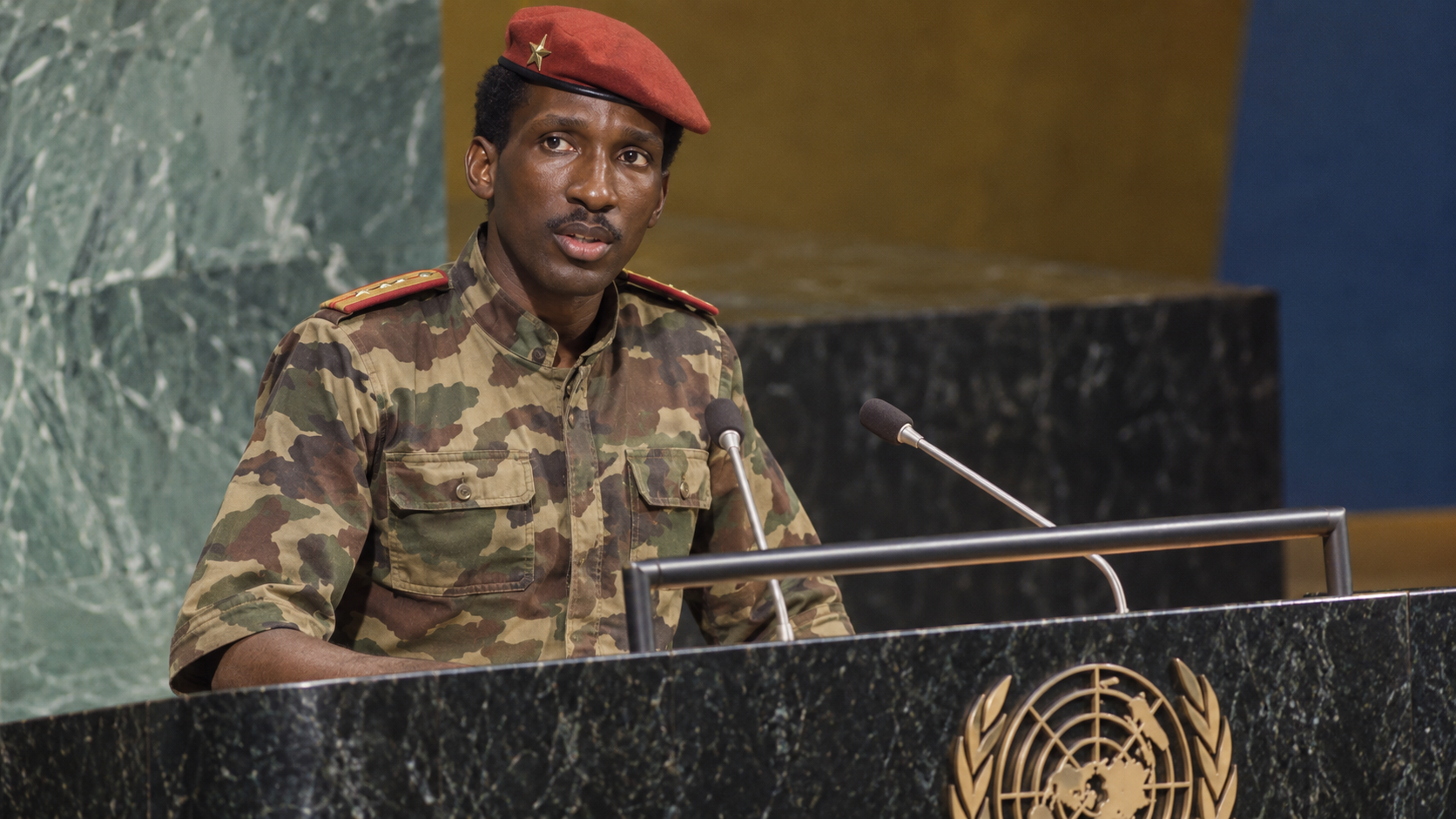
“We reiterate our determination to work actively for peace”
Thomas Sankara included this appeal in his address to the United Nations General Assembly on October 4, 1984. The displayed excerpt follows the official English record of a speech delivered in French. As the leader of Burkina Faso, he used the international platform to connect the concerns of his country with those of people facing poverty and unequal power elsewhere. The sentence continues into an appeal for disarmament and independent action in international affairs. Peace, in this passage, is something a government undertakes to work for. The verb makes the pledge more demanding than a general statement that peace is desirable.
The address placed peace within a larger argument about the position of poorer countries. Sankara criticized forms of dependence and asked whether the international order served people whose basic needs remained unmet. His disarmament appeal formed part of that argument rather than standing apart from it. Military competition, resources, national independence, and human development were presented as connected political choices. Quoting this passage does not establish that every policy of his government served those aims, nor endorse his entire political program. It identifies a particular commitment expressed in a particular forum, which can be examined through the actions and responsibilities that such a commitment would entail.
The phrase about working actively invites a useful distinction between a preferred result and a course of conduct. An institution may announce that it supports peace while failing to explain how it will participate in achieving it. Active work might include sustained dialogue, practical cooperation, and efforts to reduce conditions that make confrontation more likely. Those examples are applications of the principle, not a complete list supplied by Sankara’s excerpt. The key is whether a pledge produces identifiable obligations. A public promise becomes easier to assess when citizens can see who is responsible, what steps are being taken, and how those steps relate to the stated objective.
There is also a question of whose participation counts. International politics can appear to be a conversation dominated by the strongest states, while others experience the consequences of decisions they scarcely influence. Sankara’s appeal asserted a role for his country in shaping that conversation. Its continuing interest lies in the idea that seeking peace need not mean passively accepting choices made elsewhere. Yet independence does not eliminate the need to cooperate, and strong language does not guarantee peaceful outcomes. Readers can hold both points together. The promise to work for peace deserves attention because it creates a standard against which conduct can be judged, not because the promise alone fulfills that standard.
The excerpt comes from Sankara’s October 4, 1984 General Assembly address. Its English wording follows the UN record of a speech delivered in French.
The surrounding passage calls for disarmament and independent participation in international affairs.
Peace is framed as an undertaking that requires work. A declared preference becomes meaningful through the conduct attached to it.
The passage should be assessed on its own terms; quoting it does not endorse every aspect of Sankara’s government.
Citizens can ask how a peace commitment becomes dialogue, cooperation, or other identifiable action. These are present-day applications.
A pledge is easier to judge when authorities explain responsibilities and allow their conduct to be compared with their stated aims.
Explore more "Quotes of The Day"
Discover more notable quotes from influential voices across politics, science, business, technology, sports, and culture. Each quote offers insight into how ideas, beliefs, and decisions shape the world around us.