

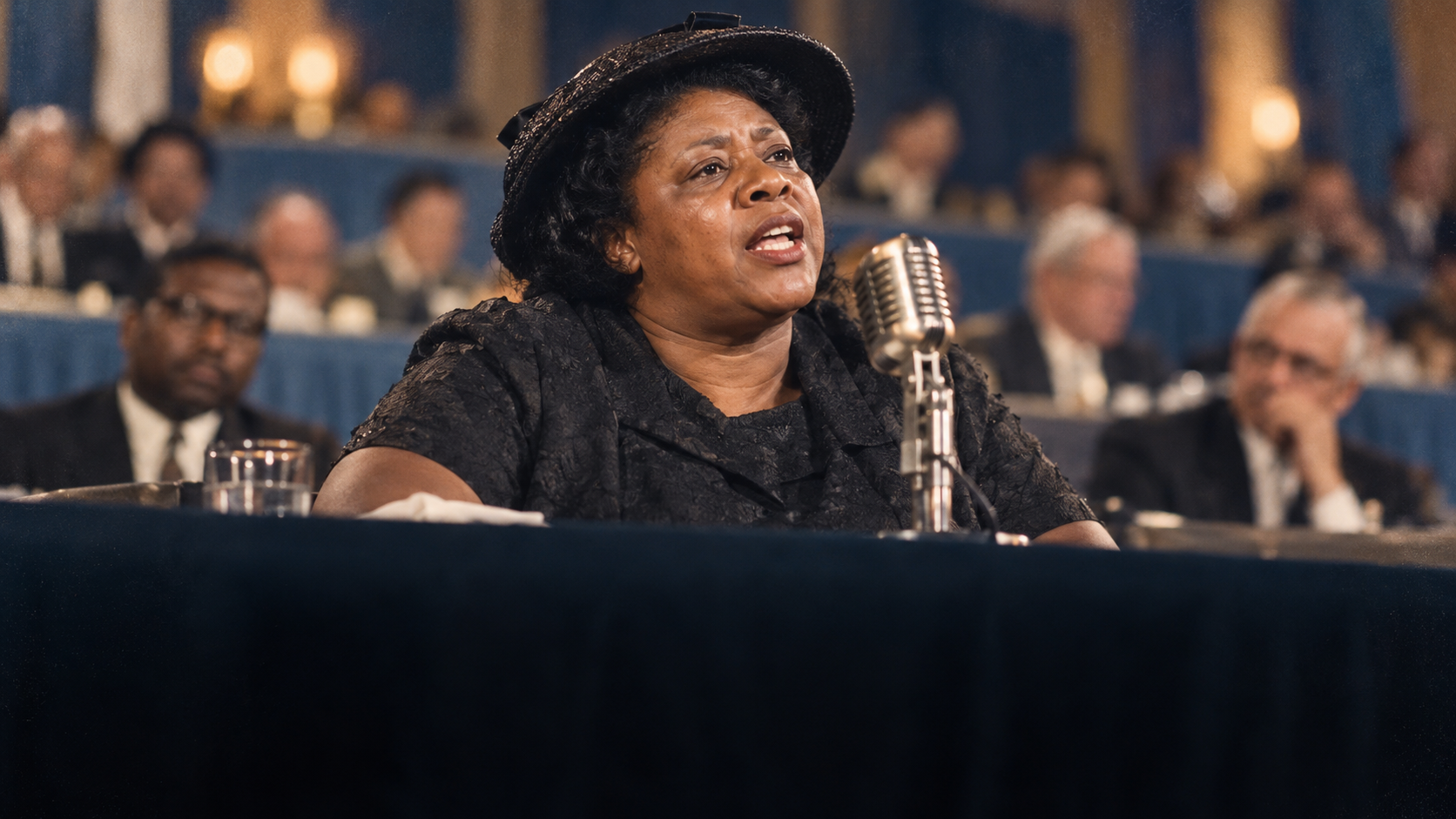
“I question America, is this America, the land of the free and the home of the brave…”
Fannie Lou Hamer posed this question while testifying before the Democratic National Convention's Credentials Committee in Atlantic City on August 22, 1964. She represented the Mississippi Freedom Democratic Party, which challenged the seating of the state's all-white regular delegation. Hamer described efforts to register Black voters, the retaliation that followed, and the brutal beating she endured after returning from a voter-registration workshop. The featured words are a brief continuous excerpt from her final sentence; the original continues with the daily threats faced by people seeking to live as full citizens. September 20 marks the quotation's place in this series, not the testimony's anniversary.
Her question made a national promise answerable to lived experience. The familiar language of freedom and bravery usually closes patriotic ceremonies with confidence. Hamer used it as an examination. If citizens could lose work, safety, or bodily security for attempting to register to vote, the country's self-description required more than repetition. The force of the line comes from that movement between ideal and evidence. Hamer did not reject the promise of America; she insisted that it be measured against the conduct of political institutions. Her voice also altered who could author that measurement. A sharecropper and local organizer stood before party officials and judged the legitimacy of their rules.
The excerpt can be weakened if it is separated from the testimony around it. Hamer was not asking a vague philosophical question or offering a slogan detached from policy. She was supporting a specific challenge to a delegation selected through a system that excluded Black participation. Her account included economic punishment, official violence, and fear inside private homes. The credentials process did not give the Freedom Democratic Party the full recognition it sought. Reading only the patriotic phrase risks turning her confrontation into general inspiration. The complete setting shows that her moral appeal was tied to representation, voting access, and the consequences borne by named communities.
For current politics, the quotation offers a disciplined way to discuss democratic credibility. Laws and public statements matter, but participation can also be constrained by registration procedures, unequal access, intimidation, information gaps, or weak remedies. Hamer's testimony suggests starting with the person required to navigate those conditions rather than with an institution's description of itself. That approach does not settle every disagreement over election administration. It does demand evidence about who can participate, what obstacles recur, and whether complaints receive meaningful review. A political system earns confidence when its practices make its stated rights usable. Her question remains powerful because it asks the nation to demonstrate the answer.
Hamer testified for the Mississippi Freedom Democratic Party, an interracial organization formed to challenge a regular state party that had excluded Black voters from meaningful participation.
Before asking the featured question, she recounted losing work after trying to register and being jailed and beaten after a voter-registration workshop. The patriotic language therefore followed detailed evidence.
The line uses the country's own civic vocabulary as a standard of accountability. Freedom becomes a claim that public institutions must make real for people whose participation carries personal risk.
Hamer also changed the direction of political judgment. Instead of waiting for national leaders to assess Mississippi organizers, she assessed the national party by its response to their experience.
The quotation is an excerpt, and the omitted continuation describes threats faced by people seeking decent lives and first-class citizenship. That context should remain part of any responsible interpretation.
Its continuing relevance lies in method: examine democratic rules from the standpoint of those who must use them, then compare formal rights with the practical conditions of participation.
Explore more "Quotes of The Day"
Discover more notable quotes from influential voices across politics, science, business, technology, sports, and culture. Each quote offers insight into how ideas, beliefs, and decisions shape the world around us.