

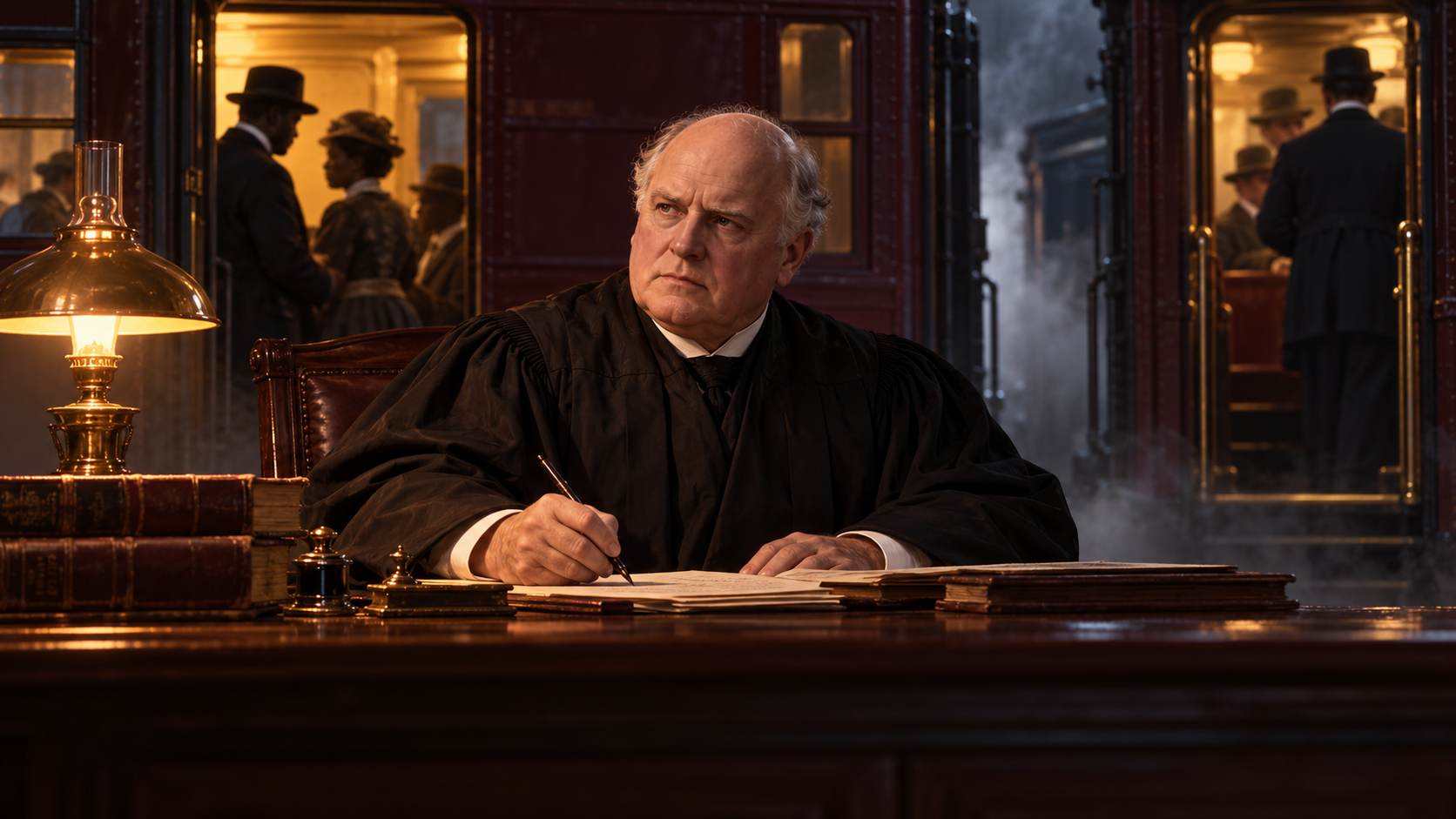
“Our Constitution is color-blind, and neither knows nor tolerates classes among citizens.”
Justice John Marshall Harlan wrote this sentence in his lone dissent in Plessy v. Ferguson, decided on May 18, 1896. The Supreme Court's majority upheld a Louisiana law requiring separate railway accommodations for white and Black passengers. Homer Plessy had challenged that system after being arrested for sitting in a coach reserved for white riders. Harlan rejected the law's claim to constitutional legitimacy and argued that civil rights could not be distributed by racial caste. The featured line appears within his account of equal citizenship before law. September 21 is the assigned calendar date for this post and has no claimed connection to the decision's historical date.
The sentence compresses a demanding idea: government should not sort citizens into superior and inferior legal classes because of race. Harlan's surrounding paragraphs emphasized that the humblest citizen is the peer of the most powerful when civil rights are at stake. In a period when segregation was being built into public institutions, that principle directly challenged the majority's acceptance of supposedly equal separation. The dissent also recognized the social meaning of the statute. A rule about railway seating was not a neutral arrangement of space; it placed the authority of the state behind a hierarchy. Formal language could not remove the badge of subordination created by the law.
Responsible use of the quotation also requires confronting the dissent's limits. Elsewhere in the same opinion, Harlan described the white race as dominant and used disparaging reasoning about Chinese people. Those passages cannot be reconciled with a fully modern commitment to equal citizenship. The phrase "color-blind" has also acquired competing political uses, including arguments over whether government may consider race when trying to remedy documented discrimination. Harlan was opposing a law designed to impose racial separation, and his sentence does not by itself resolve later disputes with different histories, purposes, and evidence. Admiring the core principle should not turn its author or every present application into something uncomplicated.
The dissent remains politically significant because it illustrates how constitutional disagreement can preserve an alternative account of citizenship before that account commands a majority. Its practical lesson extends beyond quoting a memorable phrase. Citizens can ask whether a rule distributes public benefits, burdens, safety, or voice along a hierarchy that officials describe as ordinary administration. They can also examine outcomes and history rather than assuming neutral wording produces neutral treatment. Harlan's strongest claim was that legal equality must be visible in the way government treats actual people. His own contradictions make the work harder, not less necessary: principles gain credibility when they are applied beyond the boundaries accepted by the person who first expressed them.
Plessy concerned a Louisiana railway-segregation law and an arrest arranged to test it. The Court upheld the statute, while Harlan alone dissented from the judgment.
His featured sentence appears amid an argument that civil rights cannot depend on a state-created racial caste. It was a rejection of the legal structure behind supposedly equal separation.
The phrase connects citizenship to equal legal standing. Harlan treated segregation as a public declaration of hierarchy rather than a harmless decision about where passengers sat.
A dissent can matter even when it does not govern the immediate case. It records a competing constitutional principle that later readers, advocates, and courts can examine against the majority's reasoning.
Other language in Harlan's opinion reflects racial prejudices of his era, including a claim of white dominance and a disparaging comparison involving Chinese people. The full document should not be idealized.
Modern uses of "color-blind" also differ sharply. Applying the quote responsibly requires attention to the purpose, history, and effects of the policy being debated, not reliance on the phrase alone.
Explore more "Quotes of The Day"
Discover more notable quotes from influential voices across politics, science, business, technology, sports, and culture. Each quote offers insight into how ideas, beliefs, and decisions shape the world around us.