

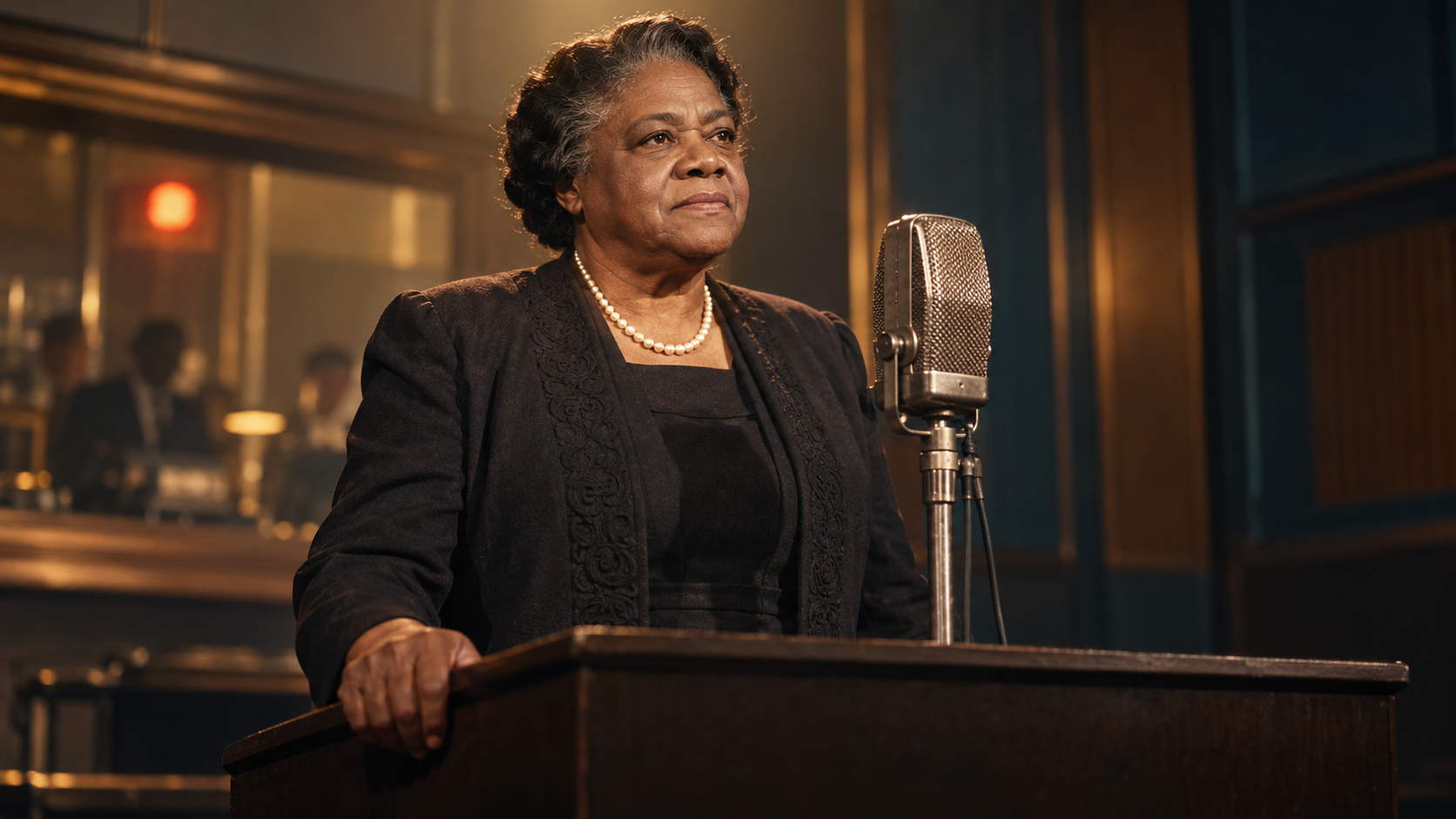
“Democracy is for me, and for 12 million black Americans, a goal towards which our nation is marching.”
Mary McLeod Bethune opened a national radio address with these words on November 23, 1939. She was speaking on America's Town Meeting of the Air in a program that asked what American democracy meant to its participants. Bethune answered from the position of an educator, civil-rights organizer, college founder, and adviser in Franklin D. Roosevelt's administration. Her sentence described democracy as a destination rather than a completed possession. The reference to 12 million Black Americans reflected the population language of the period and placed people routinely excluded from equal citizenship inside the nation's democratic story. September 24 is this post's calendar assignment, not the anniversary of the broadcast.
The word "marching" carries both confidence and judgment. Bethune named progress in literacy, property ownership, culture, and participation, yet she refused to confuse partial change with arrival. In 1939, segregation remained embedded in law and custom, disfranchisement restricted Black political power across much of the South, and racial violence shaped ordinary life. Her democratic faith therefore operated as a standard that could expose the country's distance from its own claims. She did not treat loyalty as silence. In the same speech, she connected Black military service and labor to a demand for equality under law, equality of opportunity, and equality at the ballot box.
The sentence should not be turned into a simple story of inevitable national improvement. Bethune's optimism depended on organized work through schools, civic groups, federal programs, churches, and political pressure. She also worked within institutions whose gains were uneven and whose policies sometimes preserved discrimination. The phrase "12 million black Americans" came from a historical moment with different demographic conventions, while the barriers she described varied by region, class, and gender. Her address offered a broad public argument rather than a detailed legislative plan. Its promise cannot substitute for examining which rules expanded participation and which left unequal power intact.
For modern politics, Bethune's sentence suggests a practical test for democratic language. A country can celebrate elections and constitutional ideals while asking whether people can use them safely and effectively. Registration, representation, education, economic security, public information, and equal administration all affect whether citizenship exists in practice. Progress matters, but measuring it requires evidence from communities still bearing the cost of exclusion. Bethune's formulation leaves room for hope without allowing hope to certify the present. Democracy becomes a continuing public task: identify the distance between the national promise and daily experience, then build institutions capable of closing it.
Bethune delivered the address on NBC radio's America's Town Meeting of the Air on November 23, 1939. The program asked speakers to define American democracy during a period shaped by the Depression, segregation, and approaching war.
By then she had founded the school that became Bethune-Cookman College, led the National Council of Negro Women, and advised the federal government. Her public role joined education, administration, and political organizing.
Calling democracy a goal allowed Bethune to affirm the ideal while judging the country's performance. She acknowledged gains but placed them beside disfranchisement, unequal opportunity, and the unfinished demand for equality under law.
The collective subject matters. The sentence does not present advancement as an individual exception; it asks whether national institutions are moving millions of citizens toward usable rights and meaningful participation.
The speech expresses faith in progress, but it does not prove that progress is automatic. Bethune's own career shows the organized effort, coalition building, education, and political pressure that the word "marching" can otherwise conceal.
Its lasting value is a democratic audit: compare public ideals with access to the ballot, schools, public office, economic opportunity, and equal administration, then judge whether movement is broad enough to count as national progress.
Explore more "Quotes of The Day"
Discover more notable quotes from influential voices across politics, science, business, technology, sports, and culture. Each quote offers insight into how ideas, beliefs, and decisions shape the world around us.