

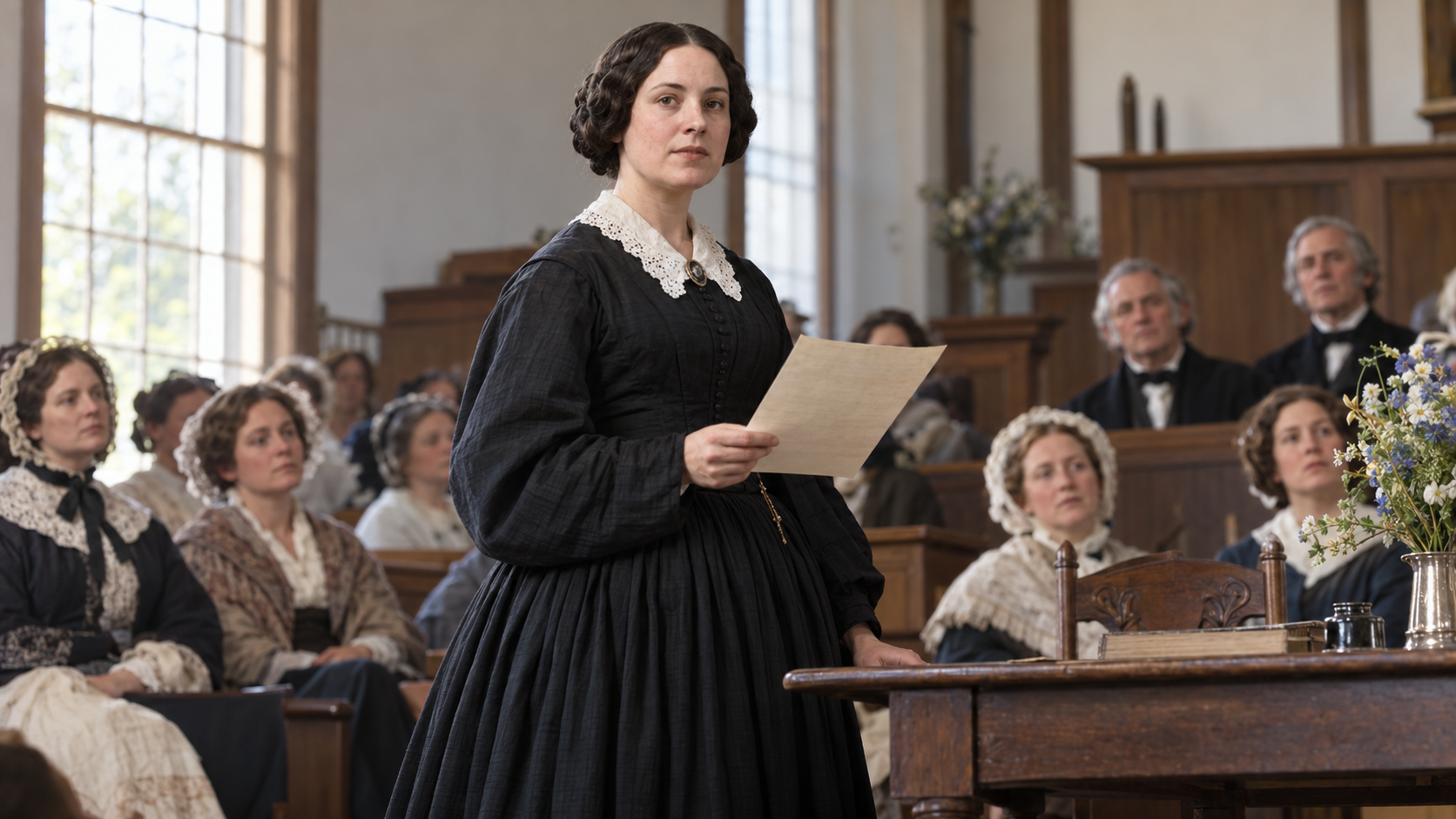
“We hold these truths to be self-evident; that all men and women are created equal.”
This sentence appears near the beginning of the Declaration of Sentiments presented at the Seneca Falls Convention in July 1848. Elizabeth Cady Stanton drafted the document, drawing deliberately on the structure and language of the Declaration of Independence. Convention participants debated its resolutions, and 100 women and men ultimately signed the adopted text. The added words "and women" changed a familiar founding claim into an explicit challenge to law, custom, education, work, religion, and political representation. September 27 is the quotation's assigned date in this series, not the anniversary of the convention.
The revision demonstrates how political language can be contested from within. Stanton did not discard the country's founding vocabulary. She exposed the gap between a universal statement and the institutions that had treated women as dependents rather than full citizens. The declaration listed grievances involving property, wages, education, professions, marital authority, public voice, and the vote. That list kept equality from remaining an abstract compliment. If the premise applied to women, laws and practices built on unequal status required justification or change. The sentence therefore joins a moral claim to a method of institutional criticism.
Attribution and scope require care. Stanton was the principal drafter, but the declaration became a convention document through debate, adoption, and signatures. The movement it helped advance did not immediately represent every woman equally, and later suffrage politics included racial exclusions and arguments that caused lasting harm. The phrase "all men and women" broadened one boundary while leaving other structures of race, class, and citizenship to be confronted through additional struggle. The convention also did not deliver immediate voting rights. Its importance lies in public argument and organizing, not in a sudden legal transformation.
In current politics, the sentence shows why inclusive wording matters and why wording alone is insufficient. Adding a group to a principle can reveal contradictions, but the next step is to trace that principle through rules governing representation, work, family, bodily autonomy, education, and public safety. The Declaration of Sentiments made that move by pairing its opening claim with specific grievances and resolutions. Modern reform efforts face the same discipline: identify who is missing from a supposedly universal rule, document the effects, and propose changes that can be tested. Public language can open a debate, while durable rights require enforcement, participation, and continuing review. Stanton's revision endures because it turns inherited civic language into a demand for accountable inclusion.
Stanton drafted the Declaration of Sentiments for the Seneca Falls Convention in July 1848. Its structure intentionally echoed the Declaration of Independence, allowing participants to measure national principles against women's legal and civic status.
The convention debated the document and its resolutions before adoption. One hundred women and men signed, so the text carries both Stanton's authorship and the authority of a collective political gathering.
Adding "and women" made an implied universal claim explicit. The document then connected that claim to property, wages, education, professions, marriage, religion, public voice, and voting.
This sequence matters: the declaration did not ask readers to admire equality in the abstract. It used equality to evaluate institutions that distributed rights and authority unequally.
The convention did not produce immediate legal equality, and the wider movement contained exclusions and racial conflicts that an inclusive phrase did not solve. Its scope and effects should not be overstated.
The lasting method is to test universal language against specific rules and lived outcomes. Inclusion becomes politically consequential when a revised principle leads to organized demands and enforceable change.
Explore more "Quotes of The Day"
Discover more notable quotes from influential voices across politics, science, business, technology, sports, and culture. Each quote offers insight into how ideas, beliefs, and decisions shape the world around us.