

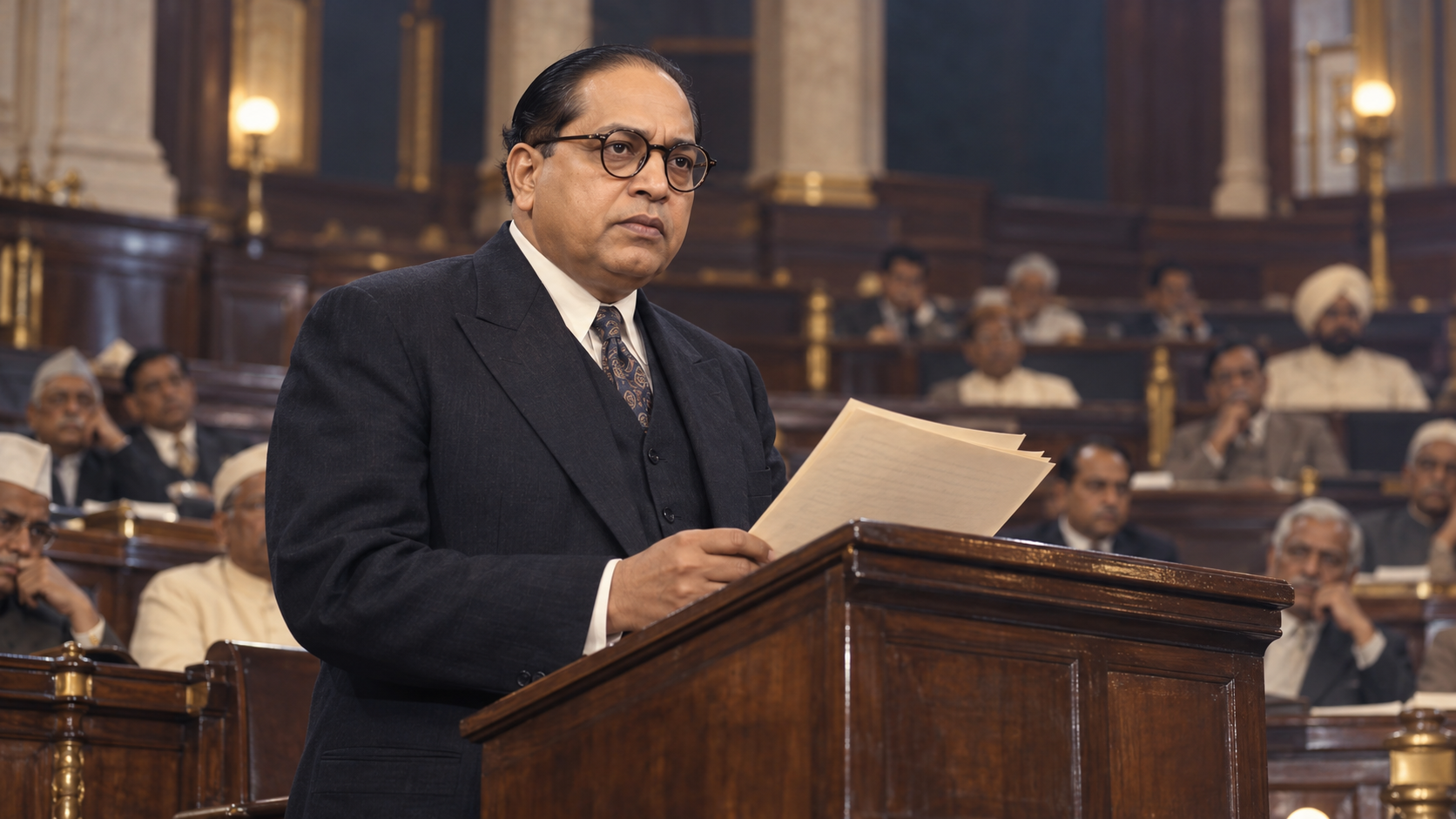
“Political democracy cannot last unless there lies at the base of it social democracy.”
B. R. Ambedkar delivered this warning to India's Constituent Assembly on November 25, 1949, one day before the Constitution was adopted. As chair of the Drafting Committee, he was assessing more than the legal document's design. He asked what conditions would allow its democratic institutions to survive. Immediately after the featured sentence, Ambedkar defined social democracy as a way of life recognizing liberty, equality, and fraternity. He treated those principles as interdependent rather than as separate promises. September 25 is the quotation's place in this series; it is not the date of the speech.
The distinction between political and social democracy is central. Political democracy can establish elections, equal votes, representative offices, and constitutional procedures. Social democracy asks how people encounter one another beyond the ballot: whether status, caste, wealth, or inherited power denies some citizens the standing that formal law announces. Ambedkar feared a contradiction in which India would recognize one person, one vote in politics while continuing deep social and economic inequality. If that contradiction endured, democratic form could remain visible while democratic substance weakened. His sentence therefore links constitutional endurance to the everyday distribution of dignity and power.
The quotation does not reduce democracy to one policy or promise that complete social equality can be enacted at once. Ambedkar's address also defended constitutional methods, warned against political hero worship, and emphasized fraternity as a difficult social achievement. Those arguments can create tensions in periods when lawful institutions themselves fail to protect people. His formulation should also remain connected to his sustained challenge to caste oppression, not generalized into a context-free appeal for civility. Liberty without equality, he argued, could produce domination by a few; equality without liberty could suppress initiative; both needed fraternity to become a shared practice.
In contemporary politics, the warning provides a way to evaluate institutions after their formal rules are written. Who can enter public office, obtain education, secure fair treatment, organize at work, or expect equal protection? Do large differences in status make some voices easier to ignore even when every vote is counted? These questions do not make elections secondary. They explain why elections require a social foundation capable of sustaining consent and accountability between campaigns. Ambedkar's standard asks citizens to protect constitutional procedure while also confronting the hierarchies that can hollow it out. A democracy lasts when equal political membership becomes a lived relationship, not only a clause on paper.
Ambedkar spoke on November 25, 1949, at the close of the Constituent Assembly's work. The Constitution was adopted the following day and came into effect on January 26, 1950.
His final address reviewed several dangers to the new republic, including abandonment of constitutional methods, political hero worship, and the contradiction between political equality and social or economic inequality.
For Ambedkar, social democracy meant a way of life grounded in liberty, equality, and fraternity. He argued that separating those principles would defeat democracy's purpose.
The sentence therefore reaches beyond election machinery. Equal votes need social conditions in which citizens possess dignity, opportunity, and the practical standing to hold institutions accountable.
The quotation is not a complete program for resolving caste, poverty, or exclusion. It is a durability test that identifies conditions under which constitutional forms may survive while their democratic meaning erodes.
Its continuing relevance lies in examining the gap between equal legal membership and unequal lived power, then asking whether public institutions are narrowing or reproducing that gap.
Explore more "Quotes of The Day"
Discover more notable quotes from influential voices across politics, science, business, technology, sports, and culture. Each quote offers insight into how ideas, beliefs, and decisions shape the world around us.