

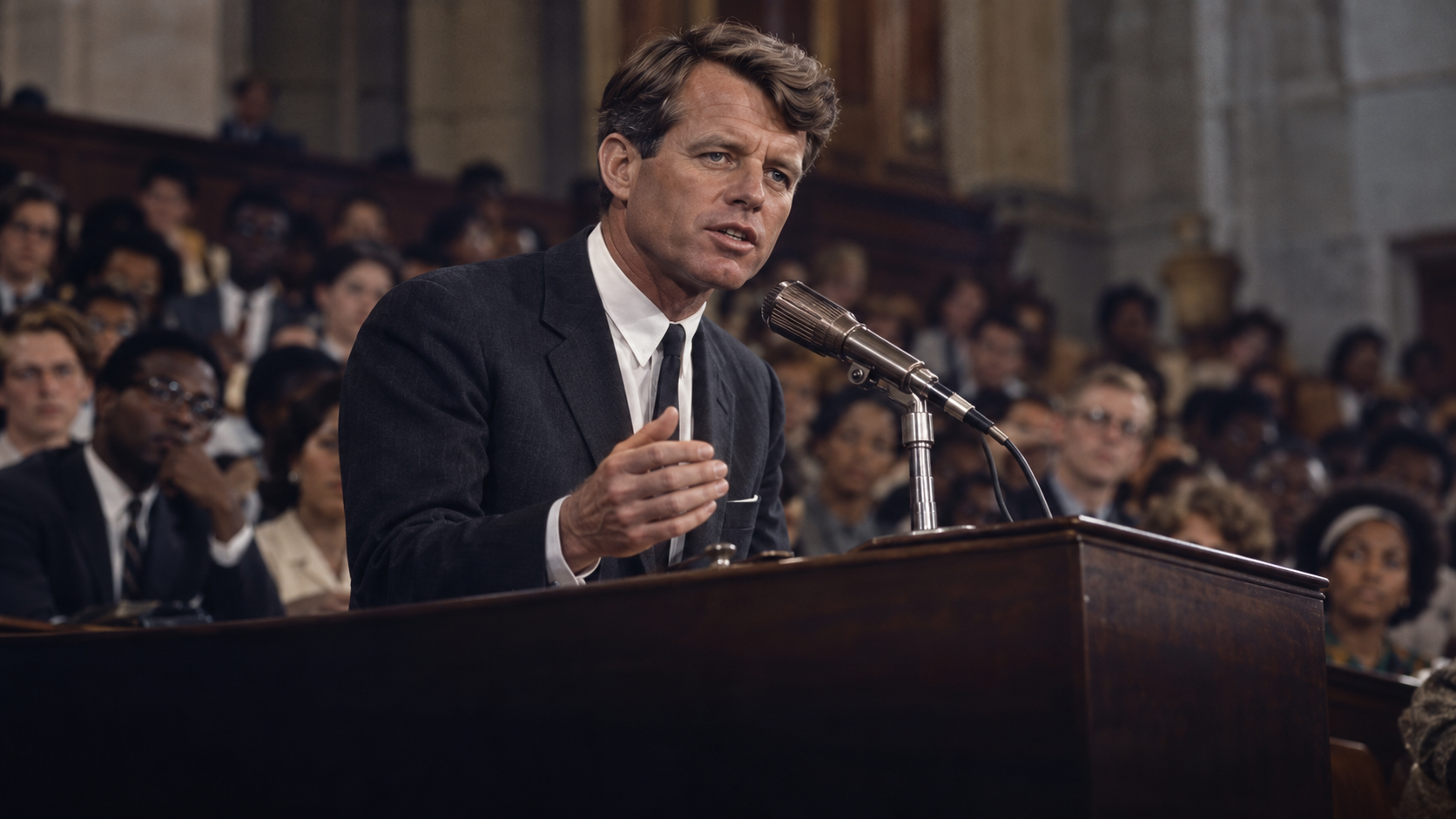
“Each time a man stands up for an ideal… he sends forth a tiny ripple of hope.”
Robert F. Kennedy spoke these words at the University of Cape Town on June 6, 1966, during apartheid rule in South Africa. Invited by the National Union of South African Students, the U.S. senator addressed a hall where the politics of race, censorship, and state power were immediate realities. The featured quotation is a shortened excerpt marked by an ellipsis. In the full sentence, Kennedy also named efforts to improve the lives of others and to strike out against injustice, then described many ripples joining into a current capable of sweeping down walls of oppression. September 26 is the post's calendar assignment rather than the speech's anniversary.
The ripple metaphor gives political agency a scale between solitary heroism and mass inevitability. One act may be small, incomplete, and difficult to see. Its significance grows when it crosses other acts arising from many centers of energy and courage. Kennedy's structure matters because it does not require every participant to command an institution or foresee the final result. Speaking, organizing, protecting another person, challenging a rule, or preserving evidence can alter what others believe is possible. The line makes history cumulative: public change emerges when dispersed choices create relationships, examples, and pressure that no single gesture could produce alone.
The quotation can become sentimental if its setting and limits disappear. Kennedy was an American visitor speaking under apartheid, and his moral authority did not erase the leadership or risk carried by South Africans. The speech also did not make every symbolic action effective. Some gestures remain isolated; others can expose vulnerable people without building durable capacity. The omitted portion of the sentence is therefore important because it names action for others and resistance to injustice, not hope as a mood by itself. Courage needs judgment about strategy, accountability, and the consequences for people closest to repression.
For modern politics, the image is useful wherever citizens face institutions that appear too large for individual influence. It rejects the idea that only a famous leader or immediate majority can begin change. At the same time, the crossing of ripples points toward coordination. Local campaigns, legal challenges, journalism, mutual aid, voting, and workplace organization become stronger when participants exchange knowledge and reinforce one another. Kennedy's line offers no guarantee that a current will form or that resistance will fall quickly. It identifies a credible path: many bounded acts, joined across distance and difference, can create public force. Hope becomes politically meaningful when it travels through action.
Kennedy delivered the Day of Affirmation Address at the University of Cape Town on June 6, 1966. Apartheid governed South Africa, and the student hosts had faced restrictions on political expression and association.
The featured line shortens a longer sentence. The omitted words refer to improving the lot of others and striking out against injustice before the image expands from one ripple to a current.
The metaphor explains how small actions gain force through connection. An individual example can change expectations, encourage another participant, preserve a fact, or add pressure to a wider campaign.
Kennedy located historical agency in many centers rather than in one celebrated figure. That makes organization and mutual reinforcement essential parts of the hopeful image.
The speech should not overshadow South African leadership or turn courage into a symbol detached from consequence. People living under apartheid bore risks that a visiting senator did not share in the same way.
The line remains relevant when hope is treated as a result of disciplined action: connect local efforts, protect vulnerable participants, learn from failed tactics, and build the relationships that allow scattered acts to become public power.
Explore more "Quotes of The Day"
Discover more notable quotes from influential voices across politics, science, business, technology, sports, and culture. Each quote offers insight into how ideas, beliefs, and decisions shape the world around us.