

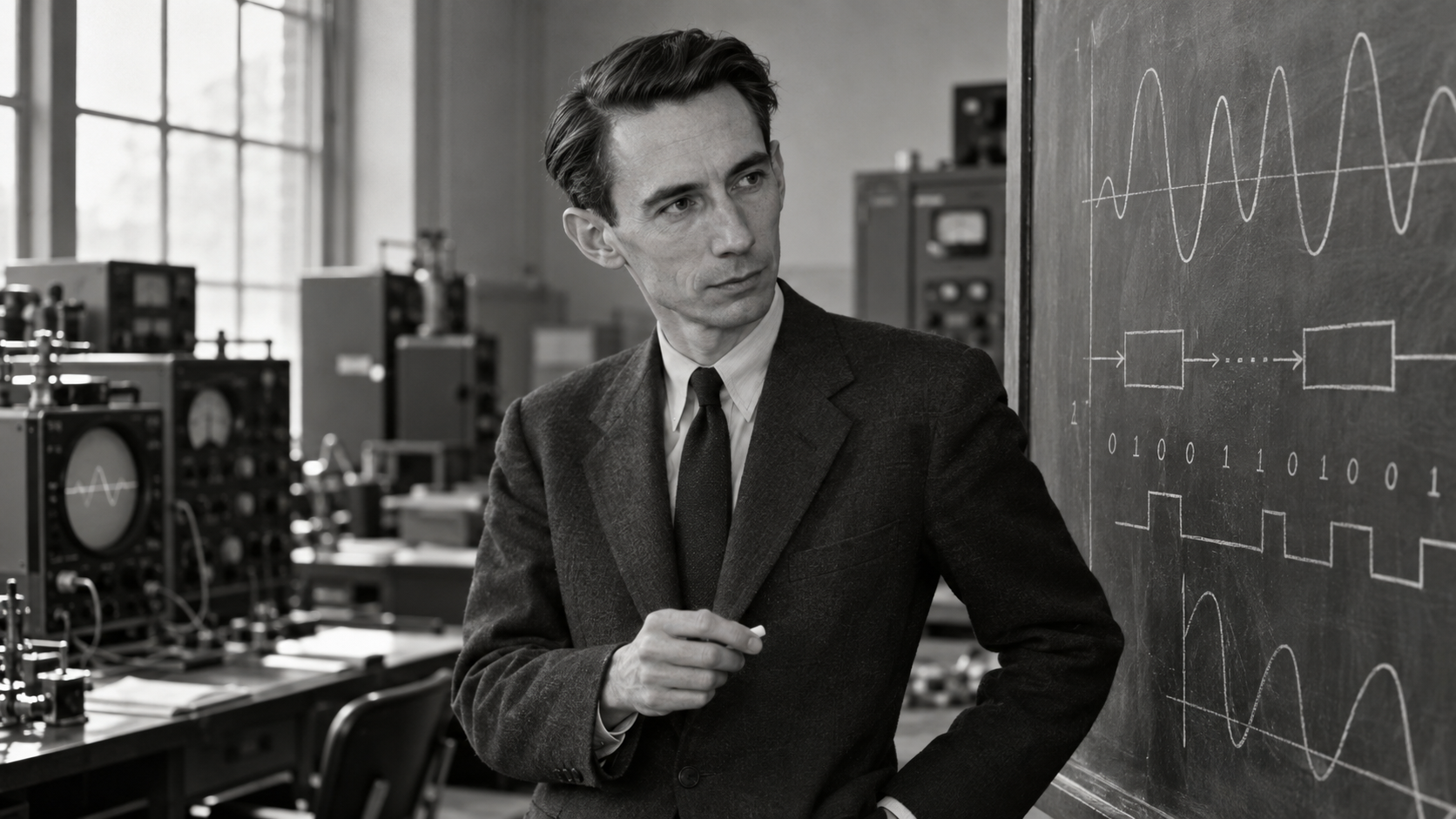
“The fundamental problem of communication is that of reproducing at one point either exactly or approximately a message selected at another point.”
Claude Shannon opened his 1948 paper “A Mathematical Theory of Communication” by defining an engineering problem with unusual precision. A source selects a message, a transmitter converts it into a signal, a channel carries that signal, and a receiver reconstructs the message at another point. The message might be text, speech, an image, or any other sequence of choices. Shannon’s sentence deliberately allows the reproduction to be exact or approximate, because different systems tolerate different kinds of loss. A bank transfer demands exact digits; a telephone call can survive small variations in sound. By describing communication this way, he created a framework broad enough to cover media that had previously seemed unrelated.
The power of the definition comes from what it leaves out. Shannon noted that the semantic meaning of a message is not the engineering concern addressed by his theory. That did not mean meaning was unimportant. It meant that a communication system first needs a measurable way to represent possible messages, transmit a selection, and estimate how uncertainty or noise changes the result. This abstraction made it possible to discuss information in bits, compare the capacity of channels, and reason about efficient coding without knowing whether the symbols carried a poem, a weather report, or a command. The separation of meaning from transmission became one of the conceptual foundations of digital communication.
Modern technology repeatedly applies the distinction. Compression removes predictable redundancy while preserving the information needed to reconstruct a file. Error-correcting codes add carefully designed redundancy so a receiver can recover data damaged in transit or storage. Wi-Fi, fiber-optic links, cellular networks, hard drives, and spacecraft communications all manage the same tension between signal, noise, capacity, and acceptable error. Even streaming video is a practical negotiation between exact reproduction and approximation: some detail may be discarded so the experience can arrive smoothly through a limited channel. Shannon’s language remains useful because it describes the common structure beneath these very different systems.
The quote also sets a boundary around what a successful connection guarantees. A network can reproduce a message perfectly while the message is false, misleading, confusing, or harmful. Technical fidelity is not the same as truth or understanding. Those questions belong to people, institutions, and the contexts in which messages are interpreted. Shannon’s achievement was not to reduce communication to machinery, but to isolate a problem that could be solved rigorously. Once the path from selection to reproduction could be measured, engineers gained tools to build reliable digital systems at extraordinary scale. The sentence endures because it shows how progress often begins: define one difficult problem clearly enough that its hidden structure becomes visible.
Shannon published the sentence at the opening of his 1948 paper “A Mathematical Theory of Communication,” written while he was at Bell Telephone Laboratories.
The paper models a source, transmitter, channel, receiver, and destination so many forms of communication can be analyzed with one framework.
“Exact or approximate” recognizes that different messages and media have different tolerances for loss, delay, and distortion.
Shannon temporarily separates transmission from semantics; the theory measures reliable reproduction, not whether a message is true or understood.
Compression, error correction, storage, mobile networks, and streaming all rely on tradeoffs between information, channel capacity, and noise.
The quote also reminds us that technical delivery can be perfect even when human meaning and judgment remain unresolved.
Explore more "Quotes of The Day"
Discover more notable quotes from influential voices across politics, science, business, technology, sports, and culture. Each quote offers insight into how ideas, beliefs, and decisions shape the world around us.