

On This Day in Science: January 16, 1969
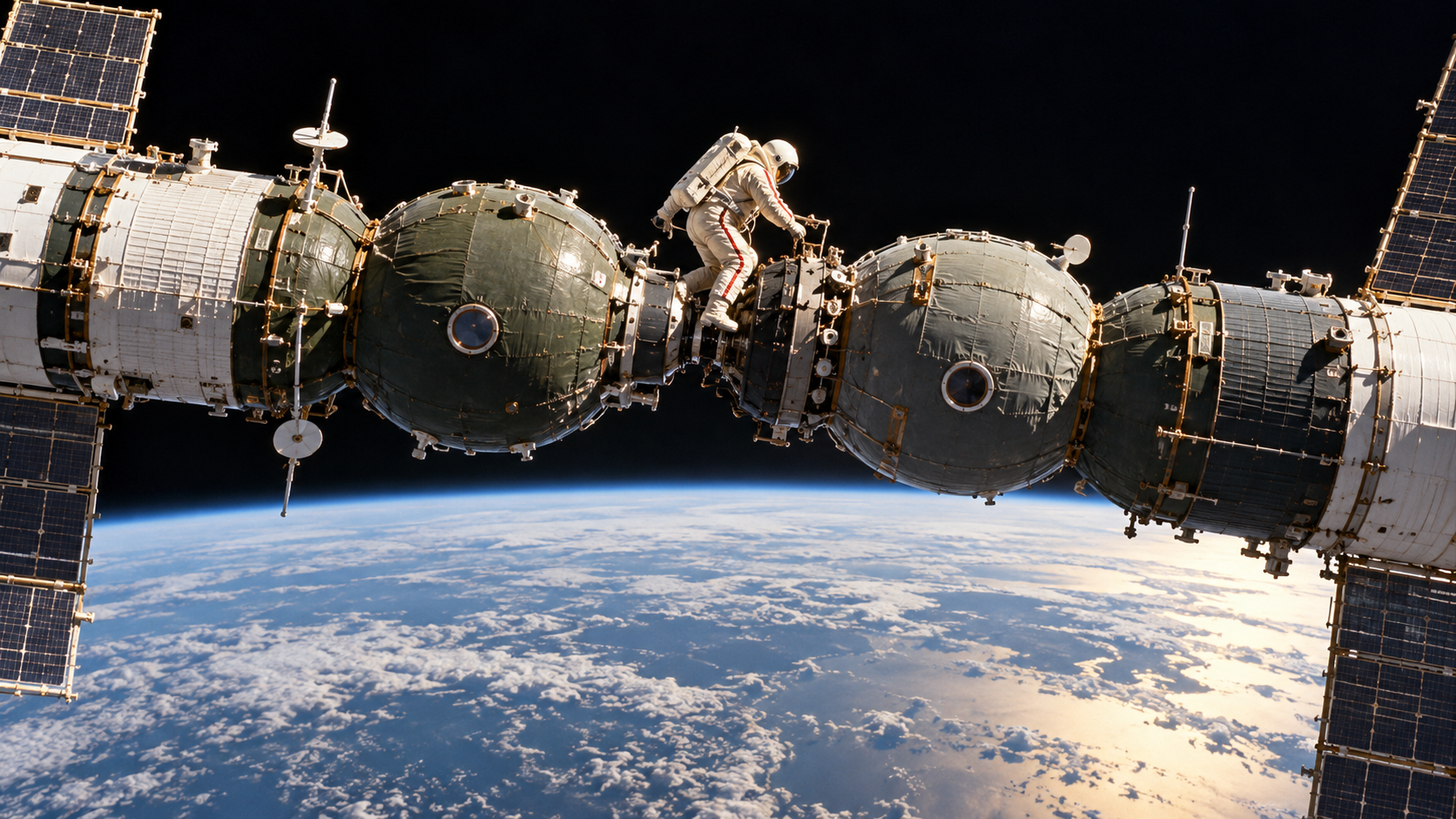
On January 16, 1969, the Soviet spacecraft Soyuz 4 and Soyuz 5 docked in Earth orbit and formed what officials described as the first experimental space station. Soyuz 4 had launched with Vladimir Shatalov on January 14; Soyuz 5 followed the next day carrying Boris Volynov, Aleksei Yeliseyev, and Yevgeny Khrunov. Automatic systems brought the vehicles close before Shatalov completed the final approach manually. Their docking mechanisms joined at the forward ends, mechanically locking the ships and connecting electrical circuits while the combined craft circled Earth.
The early Soyuz design did not provide a pressurized tunnel through the docking system. To transfer, Yeliseyev and Khrunov put on spacesuits, sealed Volynov inside Soyuz 5, depressurized its orbital module, and went outside. They moved along handrails and entered Soyuz 4 through its external hatch. The operation took about an hour and effectively made a spacewalk into a ship-to-ship passage. After repressurization, Shatalov greeted the two travelers, who carried newspapers and letters as ceremonial proof that people and items had moved between independently launched spacecraft.
The docked flight lasted four hours and thirty-five minutes before the vehicles separated. Soyuz 4 returned on January 17 with three cosmonauts, demonstrating that a crew could launch in one spacecraft and land in another. Soyuz 5 came back the next day with Volynov alone. Its service module failed to separate at first, causing a dangerous nose-first entry before aerodynamic forces tore the modules apart and the descent capsule righted itself. Volynov survived a hard landing. The success of the transfer therefore sat beside a serious reminder of how little margin early crewed spacecraft possessed.
The January 16 operation tested skills essential to later orbital stations: rendezvous, docking, extravehicular movement, crew exchange, and coordinated control of multiple vehicles. Future Soyuz models added internal transfer tunnels, eliminating the need for a spacewalk during routine station arrivals. The 1969 mission was not a long-lived station and the transfer method was cumbersome, but it proved that orbiting spacecraft could become connected parts of a larger mission. That concept now underpins continuous laboratory operations, international crews, assembly in orbit, rescue planning, and the regular movement of people and supplies between Earth and space stations. It was an early demonstration that architecture in space could be modular rather than launched as one complete machine. The distinction matters because modular systems can be repaired, expanded, and supplied over many flights. Modern station operations make that once-experimental idea routine.
Soyuz 4 and 5 could connect mechanically and electrically, but their docking units did not contain a pressurized passage.
The design forced two cosmonauts to treat the transfer as an EVA rather than walking directly between cabins.
Yeliseyev and Khrunov launched aboard Soyuz 5, entered Soyuz 4 through space, and landed with Shatalov.
That sequence proved a crew did not have to return in the same spacecraft that carried it to orbit.
Rendezvous, docking, and crew transfer became routine requirements for Salyut, Mir, and the International Space Station.
Later Soyuz docking systems added internal tunnels, making transfers safer and far less complicated.
Explore more of "On This Day ..."
Discover more events from the same date across news, politics, technology, sports, and other fields. Each link highlights significant moments that shaped history on different fronts.