

On This Day in Science: February 6, 2018
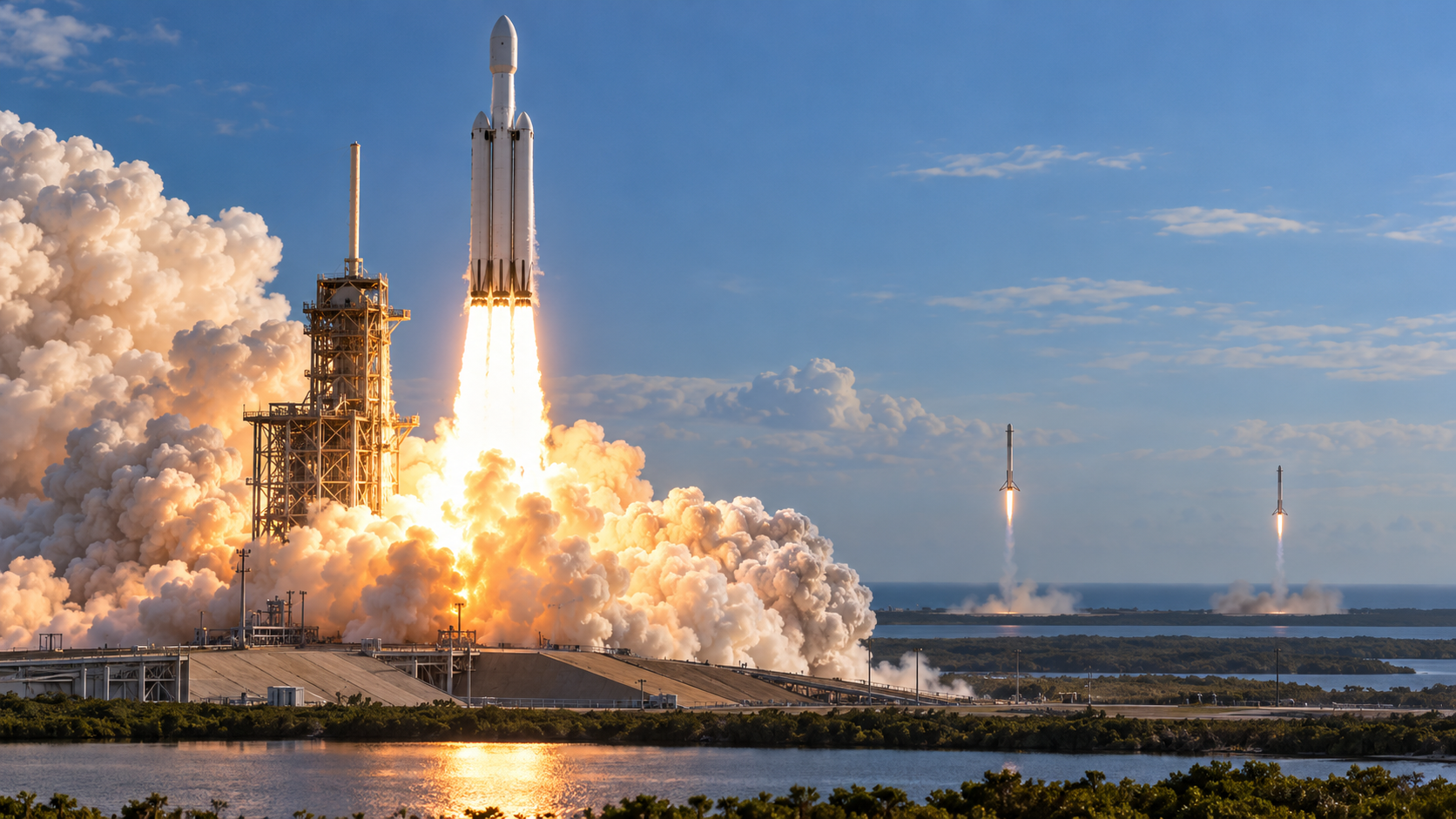
On February 6, 2018, SpaceX launched Falcon Heavy for the first time from Kennedy Space Center’s Launch Complex 39A. The rocket combined three modified Falcon 9 first-stage cores and ignited twenty-seven Merlin engines at liftoff. It was the most powerful operational launch vehicle of its day, and its debut drew attention not only for its scale but for the uncertainty surrounding a new configuration. Test flights expose interactions that computer models and ground tests cannot fully reproduce, especially when multiple stages, separation events, and guidance systems must work within minutes.
After climbing through a bright Florida sky, the two side boosters separated and turned back toward Cape Canaveral. They performed nearly synchronized landings at neighboring zones, producing one of the flight’s most memorable demonstrations of reusable-rocketry operations. The center core continued longer and attempted to land on a drone ship in the Atlantic. It missed after two engines failed to relight as planned and struck the ocean nearby. The mixed result was technically useful: the launch and side-core recoveries succeeded, while the center-core attempt revealed a problem for engineers to address.
The demonstration payload was a Tesla Roadster carrying a pressure-suited mannequin nicknamed Starman. The upper stage placed it into a heliocentric orbit extending beyond Mars’ path, a whimsical choice that also served the practical role of a mass simulator. Cameras returned views of the car against Earth, but the fundamental test concerned rocket performance. Falcon Heavy showed that existing booster hardware could be clustered, guided, separated, and partially recovered to create a vehicle for heavier commercial, scientific, and national-security missions.
Later Falcon Heavy flights used refinements derived from the demonstration and carried operational payloads. The vehicle’s development also helped normalize the sight of boosters returning under their own power, turning recovery from a novelty into an expected part of some launch campaigns. Its debut illustrates why experimental flights are judged by objectives rather than perfection. Engineers gained evidence about loads, staging, propulsion, and recovery across the full mission. The two landing boosters offered a dramatic symbol, but the deeper achievement was the conversion of a complex architecture from drawings and tests into a system that had survived flight. Seen across a longer timeline, the event also shows that scientific milestones are junctions rather than isolated beginnings. Earlier experiments, tools, and institutions made the work possible, while later teams tested its limits and carried the result into new settings. What survives is more than an anniversary fact: it is a traceable chain of evidence, correction, and application that allows one moment to remain relevant as knowledge and technology continue to change.
Falcon Heavy's first stage combined three cores and twenty-seven Merlin engines for liftoff from Pad 39A.
The clustered design increased payload capability while drawing on hardware developed for Falcon 9.
The side cores landed almost simultaneously at separate landing zones near Cape Canaveral.
The center core missed its drone-ship landing after its planned engine relight was incomplete.
The Roadster payload served as a mass simulator while the flight tested launch, separation, and upper-stage performance.
Subsequent missions applied lessons from the debut to operational commercial and government launches.
Explore more of "On This Day ..."
Discover more events from the same date across news, politics, technology, sports, and other fields. Each link highlights significant moments that shaped history on different fronts.