

On This Day in Science: March 7, 1962
On March 7, 1962, NASA launched the first Orbiting Solar Observatory, OSO 1, from Cape Canaveral. The satellite was built to study radiation from the Sun that Earth’s atmosphere blocks or distorts, including ultraviolet, X-ray, and gamma-ray emissions. Earlier rockets could observe for minutes; an orbiting platform promised repeated measurements across months. OSO 1 became the first successful spacecraft in a series devoted to sustained solar physics.
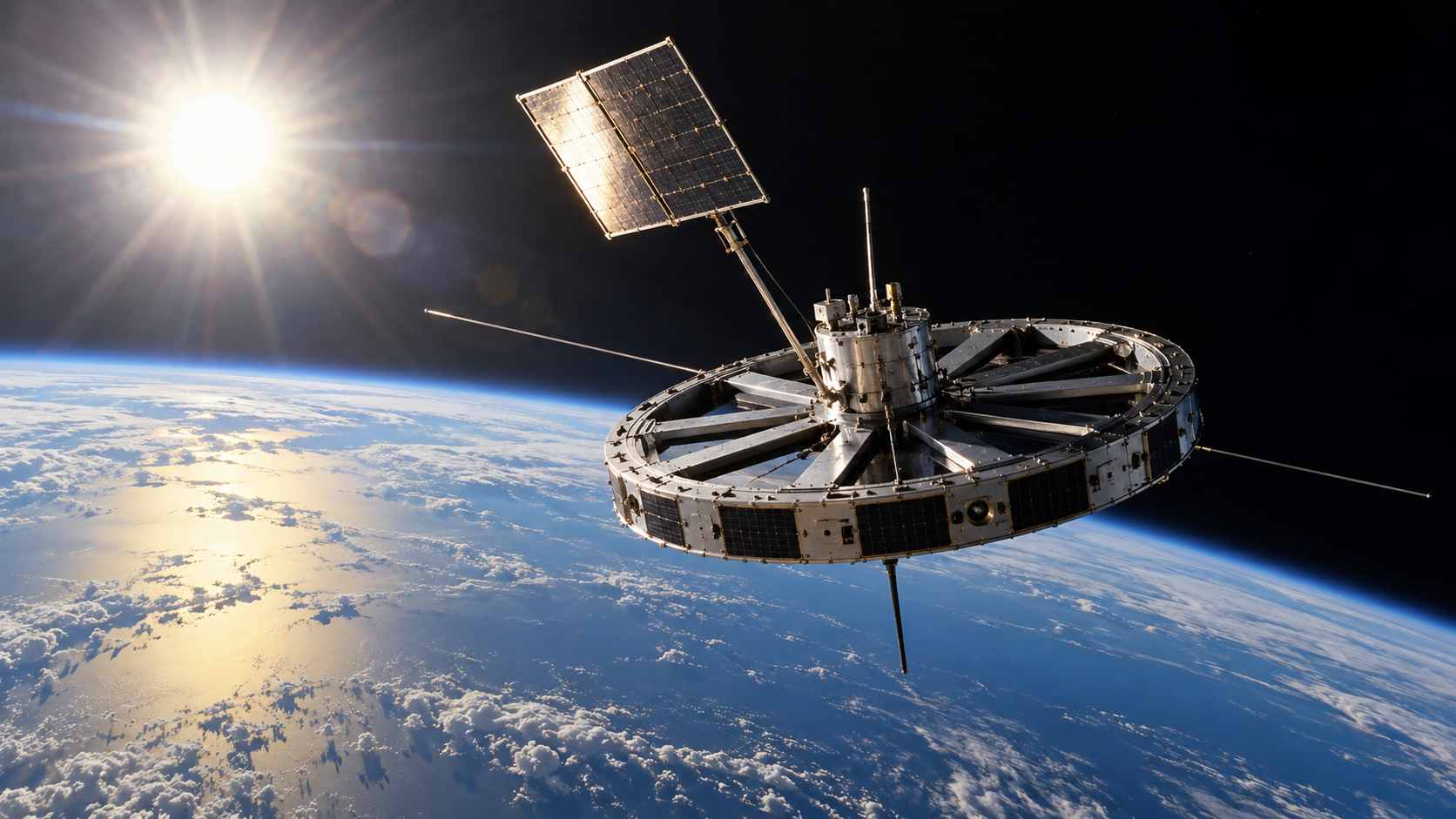
Its design solved a difficult pointing problem. A wheel-shaped lower section spun for stability and carried experiments that could scan the sky, while an upper sail section remained pointed toward the Sun. Servomechanisms used solar sensors to maintain alignment as the spacecraft orbited Earth. That combination let delicate instruments observe a bright moving target while the main body retained the reliability of spin stabilization.
OSO 1 recorded solar X-rays, gamma rays, ultraviolet light, and energetic particles. Its observations included the early development of an X-ray flare and helped establish how rapidly the high-energy Sun could change. The mission also tested how detectors, electronics, thermal control, and attitude systems behaved during long exposure to the space environment, engineering knowledge reused by later observatories.
The OSO program eventually covered much of an eleven-year solar cycle and delivered new views of the corona and solar eruptions. Modern missions return far sharper images and continuous data, but they inherit the basic idea demonstrated in 1962: place specialized instruments above the atmosphere and keep them accurately trained on the star. The launch made the Sun an orbital-observatory target rather than a series of brief rocket experiments. The anniversary also highlights the difference between a first result and a finished understanding. A successful observation can settle one question while opening several harder ones, and even a failed objective can return measurements that reshape later designs. Preserved data, specimens, photographs, and hardware allow new generations to revisit the work with better tools. Science advances through that continuity, where a specific date marks progress without pretending that inquiry stopped there. Its place on the calendar is therefore useful as an entry point, not an endpoint. The people involved worked with the instruments, assumptions, and social conditions of their time, and later research has both extended and corrected their conclusions. Reconstructing the event carefully means separating what was known that day from what became clear afterward. That distinction protects the history from myth while showing how cumulative evidence turns a memorable episode into lasting scientific knowledge. For science history, the episode is also a case study in how evidence moves from an observation or engineered test into a durable body of knowledge. Instruments supplied measurements, specialists debated interpretation, and later work refined what the first result could mean. Archives preserve the early record while new methods let researchers ask different questions of it. That continuing revision is not a weakness in the original achievement; it is the process through which a dated milestone remains scientifically useful.
OSO 1 observed ultraviolet and high-energy solar radiation that cannot be measured fully from the ground.
Orbit extended viewing time from minutes to months.
The lower body spun for stability while a separate upper section tracked the Sun with dedicated sensors.
That architecture combined reliable motion with precise pointing.
OSO 1 measured flares, particles, and changing solar radiation while testing long-duration space instruments.
Later solar observatories built on the techniques its mission helped prove.
Explore more of "On This Day ..."
Discover more events from the same date across news, politics, technology, sports, and other fields. Each link highlights significant moments that shaped history on different fronts.