

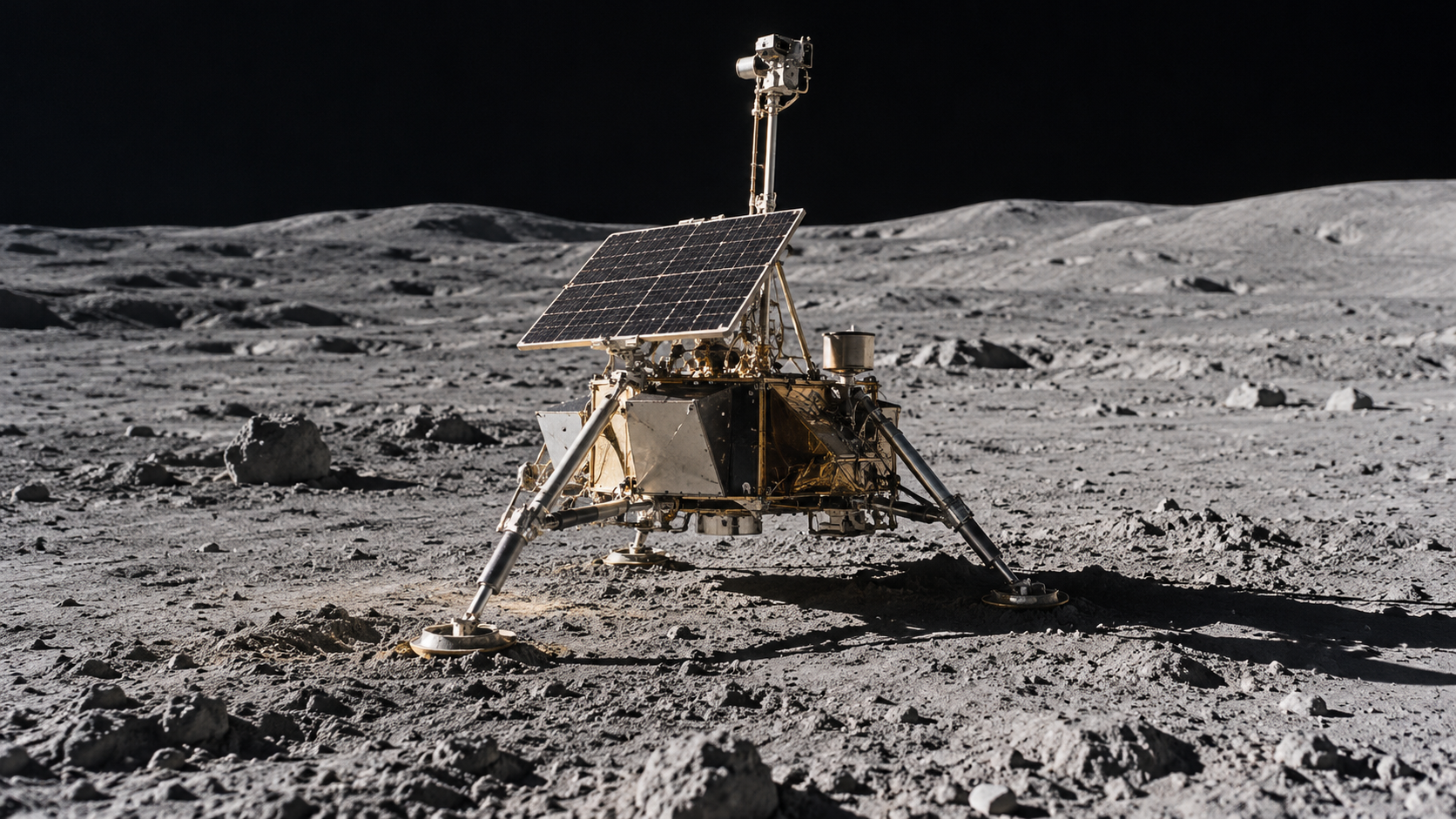
On This Day in Science: June 2, 1966
On June 2, 1966, NASA’s Surveyor 1 touched down in Oceanus Procellarum and became the first United States spacecraft to make a controlled soft landing on the Moon. Launched three days earlier, the robotic probe used a main retrorocket to remove most of its speed and three throttleable engines for the final descent. It reached the surface upright and communicating.
Surveyor carried a television camera and engineering sensors rather than a rover. During its first lunar day it transmitted thousands of images, including views of its footpads, nearby rocks, and the horizon. The landing gear left shallow impressions, evidence that the surface could support a spacecraft instead of swallowing it in deep dust as some earlier speculation had suggested.
The spacecraft also demonstrated radar-guided terminal descent, propulsion, communications, thermal control, and survival through the harsh lunar night. Surveyor 1 later responded after local sunrise, extending a mission originally focused on the first landing and strengthening confidence in the design.
Apollo crews would land much heavier vehicles in different regions, but Surveyor 1 reduced a central uncertainty: a machine could descend autonomously and stand securely on lunar soil. Its pictures and telemetry turned the Moon’s surface from a remote target into a tested operating environment. Seen across a longer timeline, scientific milestones are junctions rather than isolated beginnings. Earlier experiments, tools, and institutions made the work possible, while later teams tested limits and carried the result into new settings. What survives is a traceable chain of evidence, correction, and application that allows one moment to remain relevant as knowledge and technology continue to change. The anniversary highlights the difference between a first result and a finished understanding. A successful observation can settle one question while opening several harder ones, and even a failed objective can reshape later designs. Preserved data, specimens, photographs, and hardware allow new generations to revisit the work with better tools. Science advances through that continuity rather than stopping on a memorable date. Its calendar date is an entry point, not an endpoint. The people involved worked with the instruments, assumptions, and social conditions of their time, and later research has both extended and corrected their conclusions. Separating what was known that day from what became clear afterward protects the history from myth and shows how cumulative evidence turns an episode into lasting scientific knowledge. For science history, the event also shows how evidence moves from an observation or engineered test into a durable body of knowledge. Instruments supplied measurements, specialists debated interpretation, and later work refined what the first result could mean. Archives preserve the early record while new methods let researchers ask different questions of it. That continuing revision is the process through which a dated milestone remains scientifically useful.
A solid retrorocket performed the largest braking maneuver before throttleable liquid engines took over.
Radar measurements guided the final approach until the landing legs contacted the surface.
Images of the footpads and shallow impressions helped engineers judge the soil's bearing strength.
The feared possibility of an extremely deep dust layer was not supported at the landing site.
Surveyor verified communications, thermal survival, landing dynamics, and surface operations.
Those results reduced risk for the crewed lunar landings that followed.
Explore more of "On This Day ..."
Discover more events from the same date across news, politics, technology, sports, and other fields. Each link highlights significant moments that shaped history on different fronts.