

On This Day in Science: August 8, 1989
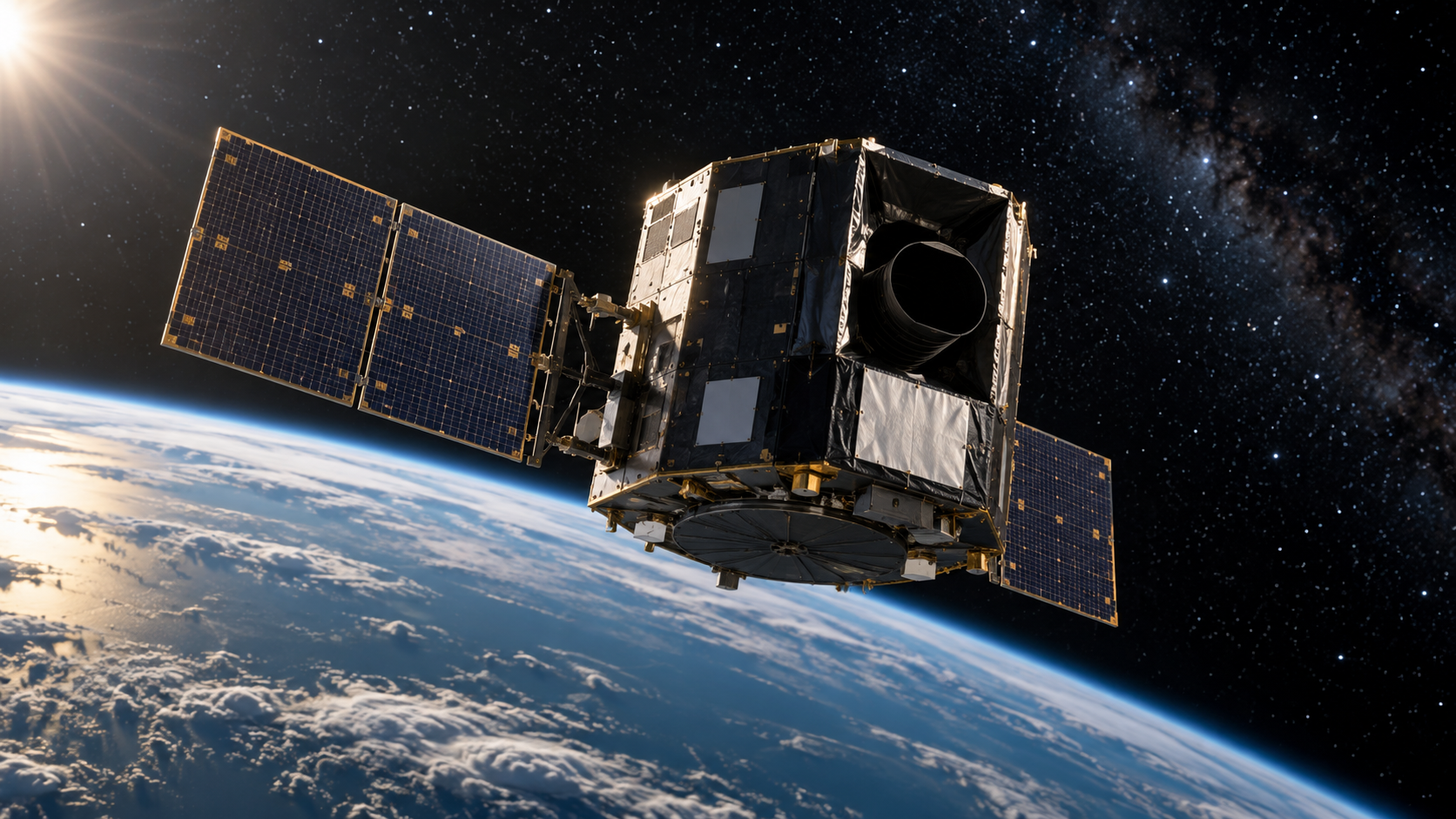
On August 8, 1989, the European Space Agency launched Hipparcos aboard an Ariane 4 from Kourou, French Guiana. It was the first satellite designed specifically for astrometry: the precise measurement of stellar positions, distances, motions, and brightness. Its name honored the ancient astronomer Hipparchus and also abbreviated High Precision Parallax Collecting Satellite.
Hipparcos repeatedly scanned the sky while comparing stars in two widely separated fields of view. Combining many angular measurements over time allowed scientists to determine parallax, the apparent annual shift caused by Earth’s orbit, and proper motion across the sky. The method produced a connected geometric framework rather than isolated measurements.
An apogee-boost motor failure left the satellite in an unintended elliptical orbit that crossed radiation belts. Engineers redesigned operations, expanded the ground network, and revised software and observing plans. Despite the hazardous orbit, Hipparcos gathered more than three years of high-quality data.
The resulting Hipparcos Catalogue measured more than 118,000 stars with unprecedented precision, while the Tycho Catalogue covered more than a million at lower precision. Those distances and motions reshaped stellar astronomy and established the space-astrometry approach later extended dramatically by ESA’s Gaia mission. Its calendar date is an entry point, not an endpoint. The people involved worked with the instruments, assumptions, and social conditions of their time, and later research has both extended and corrected their conclusions. Separating what was known that day from what became clear afterward protects the history from myth and shows how cumulative evidence turns an episode into lasting scientific knowledge. For science history, the event also shows how evidence moves from an observation or engineered test into a durable body of knowledge. Instruments supplied measurements, specialists debated interpretation, and later work refined what the first result could mean. Archives preserve the early record while new methods let researchers ask different questions of it. That continuing revision is the process through which a dated milestone remains scientifically useful. Seen across a longer timeline, scientific milestones are junctions rather than isolated beginnings. Earlier experiments, tools, and institutions made the work possible, while later teams tested limits and carried the result into new settings. What survives is a traceable chain of evidence, correction, and application that allows one moment to remain relevant as knowledge and technology continue to change. The anniversary highlights the difference between a first result and a finished understanding. A successful observation can settle one question while opening several harder ones, and even a failed objective can reshape later designs. Preserved data, specimens, photographs, and hardware allow new generations to revisit the work with better tools. Science advances through that continuity rather than stopping on a memorable date.
Hipparcos repeatedly compared stars in two fields of view.
The global pattern turned tiny angular shifts into positions, distances, and motions.
The satellite never reached its planned geostationary orbit.
New ground stations and operational software recovered the science program.
The final catalogue improved distances for nearby stars and clusters.
Its methods and results became a foundation for Gaia.
Explore more of "On This Day ..."
Discover more events from the same date across news, politics, technology, sports, and other fields. Each link highlights significant moments that shaped history on different fronts.