

On This Day in Science: August 13, 1913
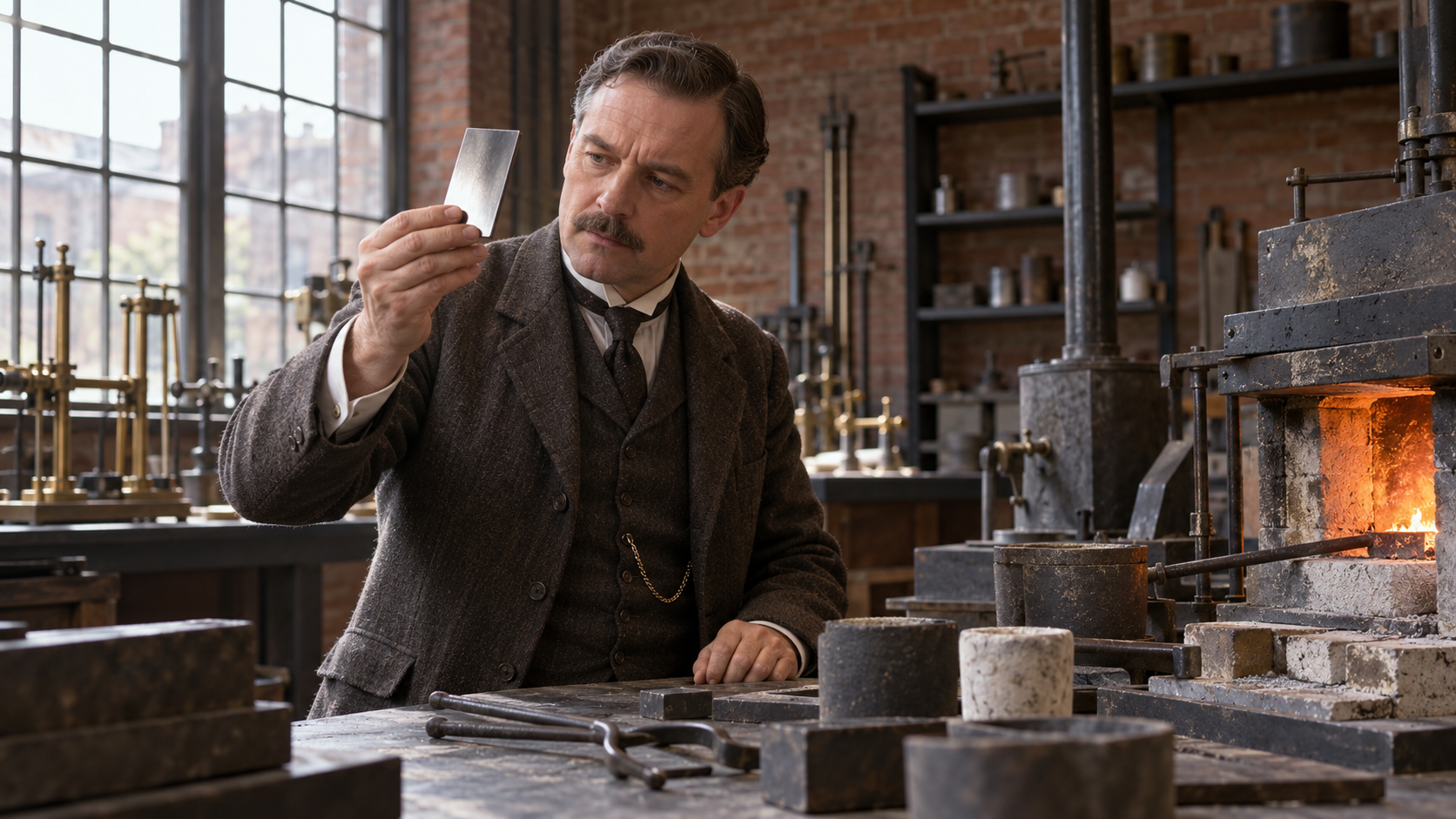
On August 13, 1913, metallurgist Harry Brearley produced an experimental steel containing roughly thirteen percent chromium at the Brown Firth Research Laboratories in Sheffield, England. He had been investigating alloys that could resist erosion in gun barrels, but the chromium-rich sample showed a different advantage: it resisted rust and chemical attack.
Iron normally corrodes when oxygen and moisture drive reactions at its surface. Enough chromium changes that behavior by forming an extremely thin, adherent oxide layer that limits further attack. If scratched in the presence of oxygen, the protective film can reform. Carbon content, heat treatment, and manufacturing still strongly affect performance.
Brearley initially called the material rustless steel. Sheffield cutlery makers recognized its value for blades and utensils, and the name stainless steel became established. Other researchers in Britain, Germany, the United States, and elsewhere were also developing chromium and chromium-nickel steels, so the modern alloy family did not arise from one melt alone.
The 1913 casting represents a practical turning point between laboratory alloy experiments and durable products. Stainless steels now serve in kitchens, architecture, medicine, chemical plants, transportation, and energy systems, with many grades tailored for corrosion, strength, temperature, and fabrication. For science history, the event also shows how evidence moves from an observation or engineered test into a durable body of knowledge. Instruments supplied measurements, specialists debated interpretation, and later work refined what the first result could mean. Archives preserve the early record while new methods let researchers ask different questions of it. That continuing revision is the process through which a dated milestone remains scientifically useful. Seen across a longer timeline, scientific milestones are junctions rather than isolated beginnings. Earlier experiments, tools, and institutions made the work possible, while later teams tested limits and carried the result into new settings. What survives is a traceable chain of evidence, correction, and application that allows one moment to remain relevant as knowledge and technology continue to change. The anniversary highlights the difference between a first result and a finished understanding. A successful observation can settle one question while opening several harder ones, and even a failed objective can reshape later designs. Preserved data, specimens, photographs, and hardware allow new generations to revisit the work with better tools. Science advances through that continuity rather than stopping on a memorable date. Its calendar date is an entry point, not an endpoint. The people involved worked with the instruments, assumptions, and social conditions of their time, and later research has both extended and corrected their conclusions. Separating what was known that day from what became clear afterward protects the history from myth and shows how cumulative evidence turns an episode into lasting scientific knowledge.
A chromium-rich alloy forms a passive oxide film only nanometers thick.
That barrier slows the electrochemical reactions that produce rust.
Brearley’s original assignment concerned erosion-resistant steel.
Sheffield manufacturers quickly saw value in knives and food equipment.
Modern stainless grades vary chromium, nickel, carbon, molybdenum, and other elements.
Composition and heat treatment tune corrosion resistance and mechanical behavior.
Explore more of "On This Day ..."
Discover more events from the same date across news, politics, technology, sports, and other fields. Each link highlights significant moments that shaped history on different fronts.