

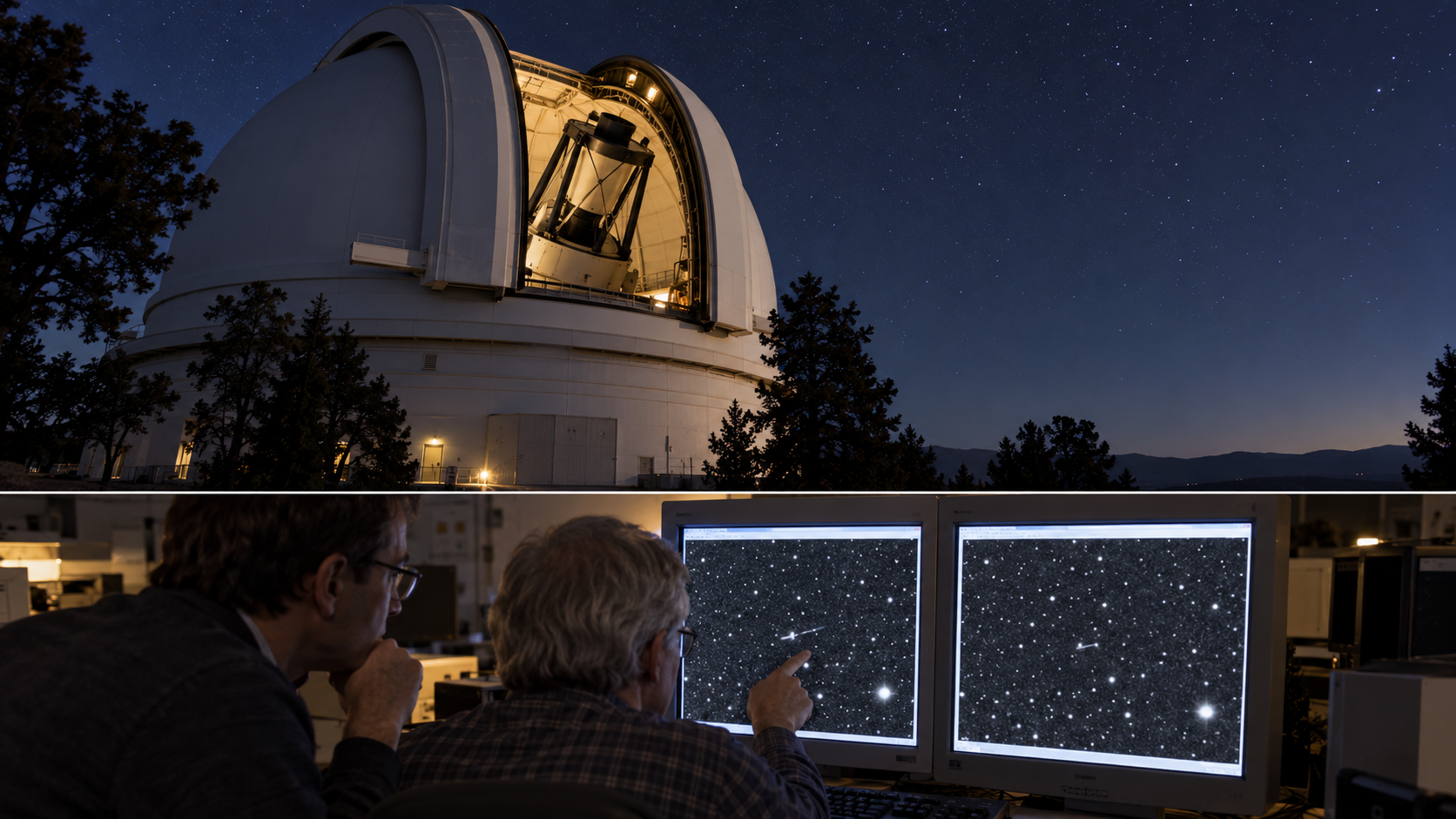
On This Day in Science: October 21, 2003
On October 21, 2003, the 48-inch Samuel Oschin Telescope at Palomar Observatory recorded survey images containing a faint distant object later named Eris. Astronomers Mike Brown, Chad Trujillo, and David Rabinowitz did not identify its motion in the data until January 2005 because it moved unusually slowly.
Follow-up observations showed that Eris travels on a highly elongated orbit far beyond Neptune and takes more than five centuries to circle the Sun. It is slightly smaller than Pluto in diameter but more massive, and it has a moon named Dysnomia.
Early estimates suggested Eris might be larger than Pluto, intensifying the question of whether it should be called the tenth planet. In 2006, the International Astronomical Union adopted a definition that placed both Pluto and Eris in the new dwarf-planet category.
The date marks the collection of the discovery images rather than the later recognition and announcement. Eris showed how digital sky surveys can preserve unnoticed objects for later analysis and helped force astronomy to clarify the language used for the Solar System’s many small worlds. The episode also separates a first demonstration from mature understanding. A successful observation or flight can settle one question while exposing harder problems in reliability, interpretation, safety, and scale. Preserved data allow later generations to revisit the achievement without confusing what was known on the date with what became clear afterward. Its calendar date is an entry point rather than an endpoint. The people involved worked with the tools, assumptions, institutions, and social conditions of their time. Later research has extended some conclusions and corrected others, showing how science advances by keeping evidence open to comparison instead of treating a memorable event as final. What makes the event scientifically important is not only priority, but the ability of others to check, repeat, compare, or build on the result. That process can reveal limitations hidden by the excitement of a first success. It also explains why careful archives and transparent measurements matter as much as the date remembered by the public. Modern interpretations benefit from evidence that the original participants did not possess. New instruments and analytical methods can recover additional detail, while historical scholarship clarifies questions of credit, context, and consequence. Holding the original achievement and those later corrections together produces a more accurate account than either celebration or dismissal alone. The anniversary also illustrates how a scientific milestone becomes useful through records that later researchers can inspect. Instruments, notebooks, images, specimens, and engineering reports preserve more than a celebratory date: they show what was actually measured, what remained uncertain, and how conclusions changed as better methods became available.
The telescope recorded Eris long before the team recognized it.
Slow motion between frames allowed the distant object to evade the first automated search.
Eris is more massive than Pluto and follows a much longer, more eccentric orbit.
Its moon let astronomers estimate the system's mass through orbital dynamics.
The discovery sharpened a debate about adding many new planets.
Pluto and Eris ultimately became leading members of the dwarf-planet category.
Explore more of "On This Day ..."
Discover more events from the same date across news, politics, technology, sports, and other fields. Each link highlights significant moments that shaped history on different fronts.