

NFC Data Exchange Explainer
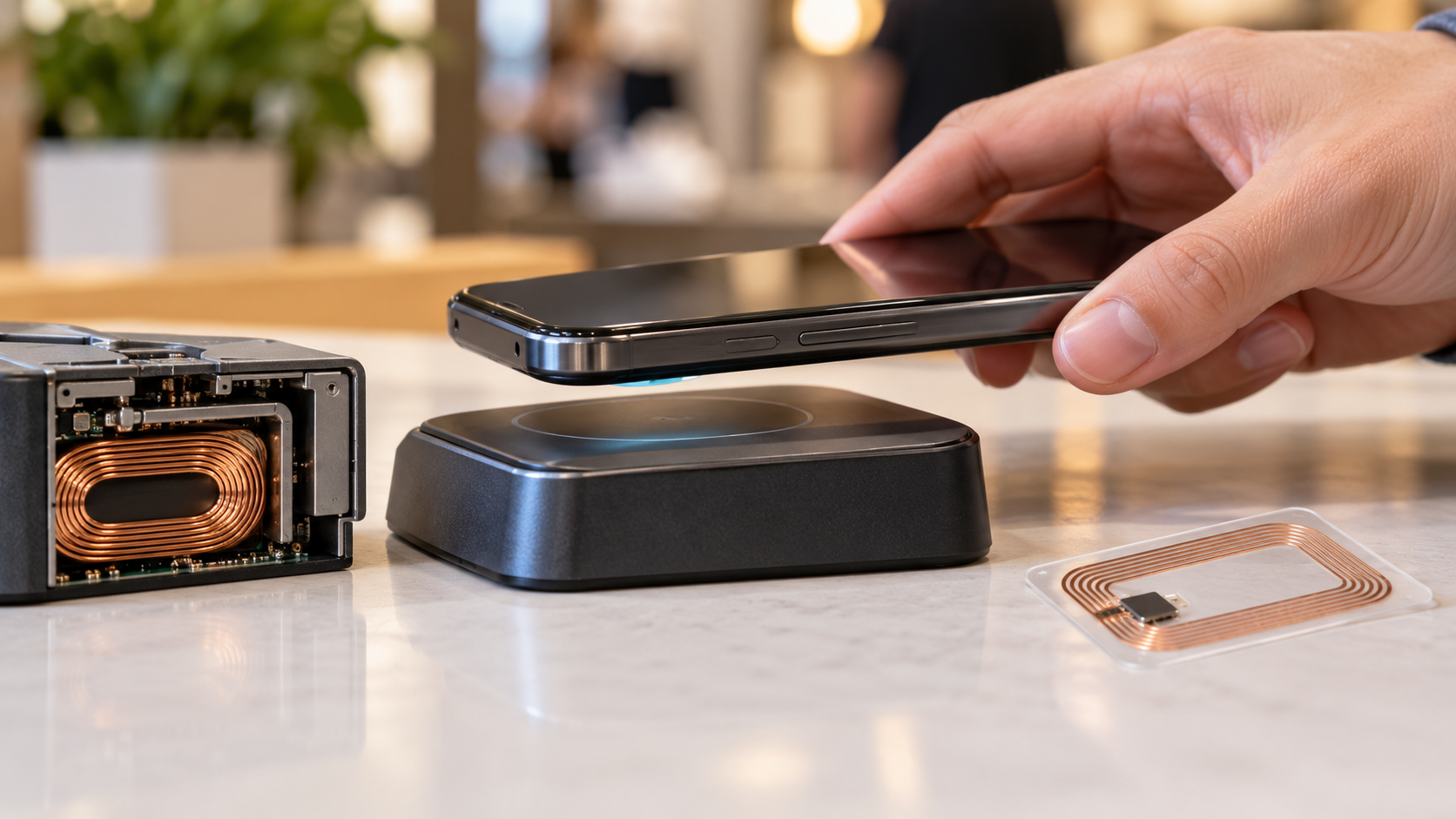
Near Field Communication, or NFC, exchanges data when two compatible devices are brought within a few centimeters. It operates at 13.56 megahertz and relies mainly on magnetic coupling between small loop antennas. One device creates an alternating field; the other antenna intercepts part of that field. The deliberately short range makes a tap an intuitive way to choose the intended object. NFC supports payments, transit passes, access badges, product tags, device setup, and many other interactions, but proximity alone does not guarantee that every exchange is secure.
An active reader or phone drives current through its antenna coil, producing the changing magnetic field. A passive tag has no battery and harvests enough energy from that field to power its tiny chip. The reader sends commands by changing, or modulating, its field. The tag cannot generate a strong field of its own, so it changes the electrical load on its antenna. Those changes slightly affect the field seen by the reader, a method called load modulation. The reader detects the pattern and reconstructs the tag’s reply.
Two powered NFC devices can also communicate, and a phone can emulate a contactless card. Reader/writer mode accesses tags; card-emulation mode lets a device behave like a credential; peer communication can exchange data between active devices. A controller inside the phone manages the radio timing and can route sensitive transactions to a secure element or trusted software environment. The application processor receives higher-level events rather than generating every radio waveform. Which modes are available depends on the hardware, operating system, and application.
Messages often use the NFC Data Exchange Format, known as NDEF. It packages application information into records with a defined type and payload. A tag might hold a web address, a small text value, a device-pairing record, or an application-specific identifier. When the phone reads the message, software decides what action is appropriate. NDEF makes the data portable across compliant devices, but it is only a format. It does not authenticate the author of an ordinary tag or make a malicious destination safe.
The tap must complete several steps quickly. Devices detect the field, select a target when necessary, choose a compatible communication technology, exchange commands with error detection, and end the session cleanly. Antenna size, alignment, metal, nearby electronics, and the reader’s field strength affect reliability. A payment terminal may have a marked tap area because that location aligns its coil with a phone or card. Moving too quickly or holding the antennas far apart can interrupt power to a passive tag and force the transaction to restart.
NFC’s short range reduces accidental connections and makes long-distance interception harder, but it is not a complete security boundary. An attacker may replace a tag, relay messages, exploit an application opened by a tag, or observe communication with specialized equipment. Sensitive systems therefore use cryptographic authentication, transaction counters, secure key storage, user confirmation, and backend risk checks. The radio supplies a convenient local channel; the payment, identity, or access protocol supplies the stronger guarantees.
The defining achievement of NFC is that discovery, power, and data exchange can happen during a deliberate tap. Magnetic coupling lets a powered device energize a passive object, load modulation provides a return path, and standardized commands and records give the bits useful meaning. Because the communication window is small, NFC excels at brief interactions rather than continuous high-bandwidth transfer. It often hands a larger task to Bluetooth or Wi-Fi after carrying the trusted setup information needed to start that connection.
Near-field communication, or NFC, lets devices exchange small pieces of data when they are brought very close together. Phones, cards, readers, and tags use magnetic-field coupling rather than a long-range radio link.
One device creates a changing magnetic field that can power a passive tag or communicate with another active device. The devices follow a shared protocol to identify each other and exchange a short message.
The very short range reduces accidental connections and helps make tapping intentional. It also limits speed and distance, so NFC usually starts an action or shares a small record instead of moving large files.
Explore more "Explainers"
Discover additional explainers across politics, science, business, technology, and other fields. Each explainer breaks down a complex idea into clear, everyday language—helping you better understand how major concepts, systems, and debates shape the world around us.