

Mini-LED Backlighting Explainer
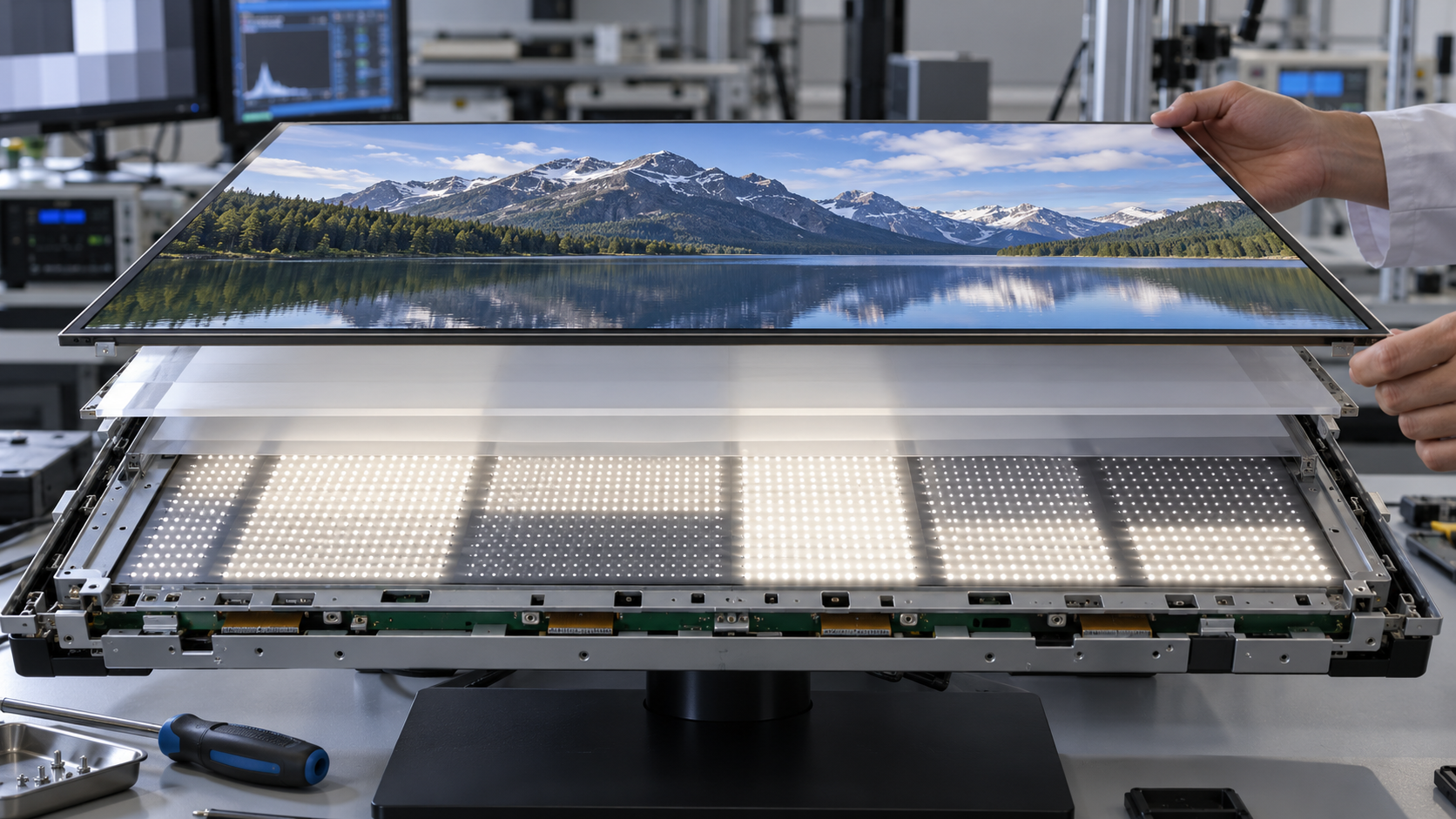
A Mini-LED display is still a liquid-crystal display. Its pixels do not emit light on their own; they control how much light from a rear illumination system passes through color filters. The difference is the backlight. Instead of a small number of larger edge or direct-lit LEDs, a Mini-LED panel uses hundreds or thousands of much smaller light sources spread behind the screen. Those LEDs are grouped into local-dimming zones whose brightness can be adjusted separately. More, smaller zones let the backlight approximate the shape of the image more closely.
An LCD stack contains the LED array, optical films that mix and spread light, a liquid-crystal layer, color filters, polarizers, and drive electronics. The backlight controller analyzes each frame and estimates how much illumination different regions require. A bright window in one part of the picture can receive strong backlight while zones behind a dark area are reduced. The liquid-crystal pixels then provide the fine spatial detail within every zone. Backlight and pixel values must be coordinated because neither layer alone represents the complete image.
Local dimming improves contrast by reducing unwanted illumination behind dark content. Traditional LCD pixels cannot block every photon from an always-bright backlight, so blacks can look gray, especially in a dark room. Dimming a zone lowers the amount of light that must be blocked. Small LEDs also allow high peak brightness over limited areas, which is useful for high-dynamic-range highlights. A display may sustain a lower full-screen brightness than its small-window peak because power delivery, LED heating, and panel temperature impose limits.
Zones remain much larger than individual pixels. If a small bright object sits against black, the necessary backlight can illuminate neighboring dark pixels in the same zone. The result is blooming or a halo. More zones, carefully designed optical films, faster control, and better algorithms reduce the effect but do not eliminate the basic mismatch. Subtitles and stars are demanding examples because they contain sharp bright details surrounded by darkness. Viewing angle can also change how leakage and halos appear through the LCD layers.
The controller must predict and time the backlight precisely. LEDs and liquid crystals have different response characteristics, and a rapidly moving highlight can reveal lag, pumping, or brightness changes if the layers are not synchronized. Algorithms may limit a highlight to avoid visible blooming or raise surrounding zones to hide a boundary, trading absolute black for consistency. Manufacturers also balance LED current, heat, power consumption, flicker behavior, and panel uniformity. Zone count alone therefore does not determine picture quality.
Mini-LED technology does not define the color gamut or pixel resolution. Quantum-dot films, phosphors, color filters, panel type, and calibration determine much of the color performance. The same backlight idea can appear in televisions, monitors, tablets, and laptops with very different results. Compared with self-emissive OLED, Mini-LED LCDs can offer high brightness and avoid organic-pixel wear, but they cannot control light at every individual pixel. Each approach has characteristic strengths rather than one universal winner.
The improvement comes from adding a coarse light image behind the fine liquid-crystal image. Thousands of small LEDs give the controller far more places to brighten or dim than a conventional backlight. The LCD still draws the detailed edges and color, while local zones reduce leakage and provide intense highlights. When optical design, timing, thermal management, and algorithms are well matched, the combination produces brighter HDR and darker scenes. Its remaining halos reveal the physical truth that many front pixels still share each rear light zone.
Mini-LED is an LCD backlighting approach that uses many smaller LEDs arranged in zones behind the panel. It gives an LCD more control over which parts of the image receive light.
The display analyzes the image and brightens or darkens groups of backlight LEDs behind different regions. This can improve contrast because dark scenes do not require the entire backlight to stay equally bright.
Mini-LED still shines light through an LCD layer, so each zone controls many pixels rather than one pixel at a time. Bright objects against dark backgrounds can sometimes reveal blooming around the zone boundaries.
Explore more "Explainers"
Discover additional explainers across politics, science, business, technology, and other fields. Each explainer breaks down a complex idea into clear, everyday language—helping you better understand how major concepts, systems, and debates shape the world around us.