

On This Day in Tech: December 5, 2014
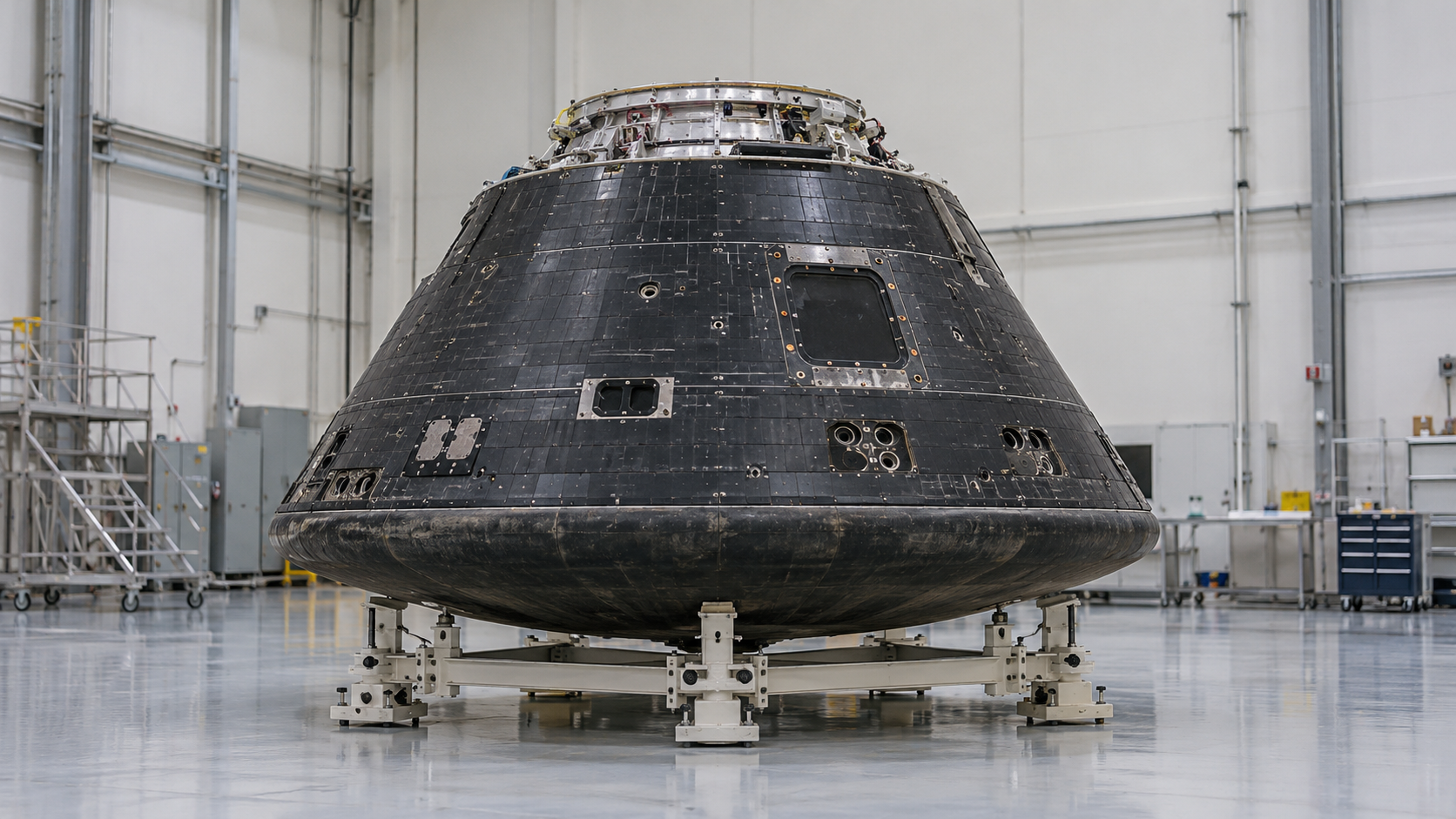
On December 5, 2014, NASA’s Orion spacecraft completed its first flight into space during Exploration Flight Test-1. A United Launch Alliance Delta IV Heavy launched the uncrewed vehicle from Cape Canaveral Air Force Station in Florida, and the crew module splashed down in the Pacific Ocean after a flight lasting about four and a half hours. NASA, prime contractor Lockheed Martin, and supporting teams used the mission to examine systems important to returning a future crew safely to Earth. No astronauts traveled aboard the spacecraft, and this was not a mission to the Moon or Mars.
The test placed Orion on a two-orbit trajectory with a high point well above ordinary low Earth orbit. That profile allowed a faster atmospheric return than a simple low-altitude orbital test would have provided, making it useful for studying heat protection and other entry systems. Ground testing and computer models remained essential, but an actual flight exposed equipment to conditions that could not be combined completely in a laboratory. Engineers wanted measurements that could help them compare predicted behavior with observed performance. The purpose was to reduce uncertainty about the design, not to treat one successful test as proof that every future mission requirement had been satisfied.
Orion’s heat shield, separation events, guidance, avionics, attitude control, parachutes, and recovery arrangements all formed parts of the experiment. Many sensors recorded conditions during the flight, providing information for later analysis rather than relying solely on the fact that the capsule returned intact. The launch vehicle was the Delta IV Heavy, not the Space Launch System associated with later Orion missions. The test configuration also differed from the complete spacecraft arrangements planned for those flights. Keeping the vehicle and mission configurations separate helps explain what this particular demonstration could establish and which capabilities still required additional development and testing.
After splashdown, recovery personnel brought the capsule aboard the USS Anchorage for transport and examination. Engineers then had to reconstruct the flight, study the recorded measurements, inspect hardware, and decide how the findings should influence the evolving spacecraft. A successful recovery therefore began another important phase of work rather than ending the technical investigation. December 5 marks a transition from predictions and ground tests to evidence gathered during an actual spaceflight. Its significance lies in testing several linked safety functions together while deliberately flying without a crew. The result contributed to a longer development program, with later flights carrying different equipment, objectives, and levels of risk.
Exploration Flight Test-1 was uncrewed. It tested hardware for a future crewed spacecraft without carrying astronauts.
The launch used a Delta IV Heavy from Cape Canaveral. Later Orion flights on the Space Launch System were different missions.
The higher-energy trajectory supported a demanding atmospheric return. Heat protection was one part of a wider set of test objectives.
Sensors supplied evidence for analysis after the mission. An intact recovered capsule alone could not answer every engineering question.
The USS Anchorage supported recovery in the Pacific. Inspection and flight-data reconstruction followed the return.
One successful flight reduced some uncertainties but did not complete the entire development program. Later configurations still required their own evaluation.
Explore more of "On This Day ..."
Discover more events from the same date across news, politics, technology, sports, and other fields. Each link highlights significant moments that shaped history on different fronts.