

Automatic Pet Feeder Explainer
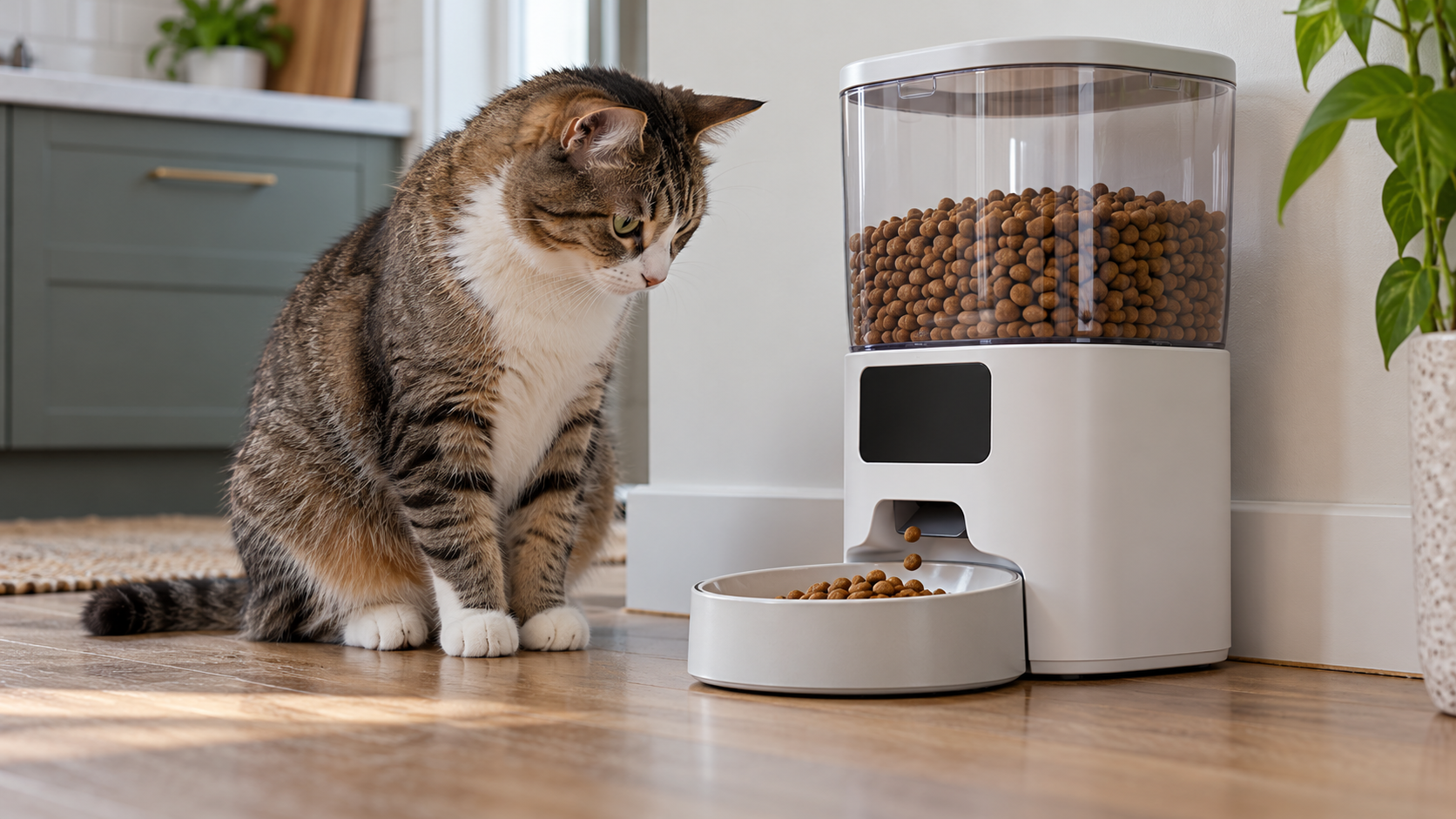
An automatic dry-food feeder stores kibble in a hopper above a metering mechanism. At a programmed time, a small motor turns an auger, paddle wheel, or rotating gate for a set distance. The moving cavities carry a limited volume from the hopper to a chute, where gravity drops it into the bowl. Some products instead rotate a covered tray to reveal a prefilled compartment. The clock decides when to move; the mechanism’s geometry determines how much volume moves each cycle.
A “portion” is not a universal mass. Different kibble shapes, sizes, coatings, and densities pack differently into the same pocket or screw space. Broken pieces can also settle more tightly. Owners should collect several test dispenses, weigh them on a kitchen scale, and average the result before relying on the programmed count. Nutritional needs and daily ration belong with veterinary guidance; the feeder only repeats a mechanical quantity and cannot judge body condition.
Bridging occurs when pieces interlock above the outlet and form an arch, leaving an empty space beneath even though the hopper looks full. Very large, irregular, moist, or oily food can jam an auger or adhere to the walls. Agitators, tapered hoppers, flexible paddles, and motor-current sensing reduce these failures but cannot eliminate them. A clear inspection window and occasional observation are more reliable than assuming every motor sound produced a meal.
Electronics typically use a low-power clock, stored schedule, motor driver, and control buttons or an app. Battery backup can preserve time or complete feedings during a power failure, depending on the design. A lid latch helps prevent a determined animal from opening the hopper. Sensors may report an empty bin or blocked motor, but alerts depend on power and connectivity. The feeder should fail safely without continuously dumping food if a switch or software process resets.
Food oils and crumbs accumulate in the hopper, chute, wheel, and bowl. Removable food-contact parts need regular washing and complete drying before refill to avoid residue, mold, or clumping. The motor housing is usually not immersible. Perishable wet food requires a system specifically designed to keep it at safe temperature; an ordinary dry hopper does not refrigerate. Insect control and sealed storage remain necessary even when the lid looks closed.
An automatic feeder is useful for consistent timing, small divided meals, or supervised schedule support, but it is not an unattended pet-care system. Animals still require fresh water, health observation, social care, and a human backup if food jams or power fails. Mechanically, the device combines storage, volumetric metering, and a clock. Its reliability comes from food compatibility, calibration, cleaning, and verification—not from the timer alone.
At scheduled times, a motor rotates an auger, paddle, gate, or compartment to move a fixed volume from a hopper into the bowl. Key terms include hopper, auger, paddle, chute, volumetric portion, bridging, motor-current sensing, and backup power.
The mechanism meters volume, but kibble density and shape vary. Several weighed test dispenses reveal the actual average mass delivered.
No. Jams, empty hoppers, power loss, illness, and water needs require human observation and a reliable backup plan.
Explore more "Explainers"
Discover additional explainers across politics, science, business, technology, and other fields. Each explainer breaks down a complex idea into clear, everyday language—helping you better understand how major concepts, systems, and debates shape the world around us.