

Stand Mixer Planetary Motion Explainer
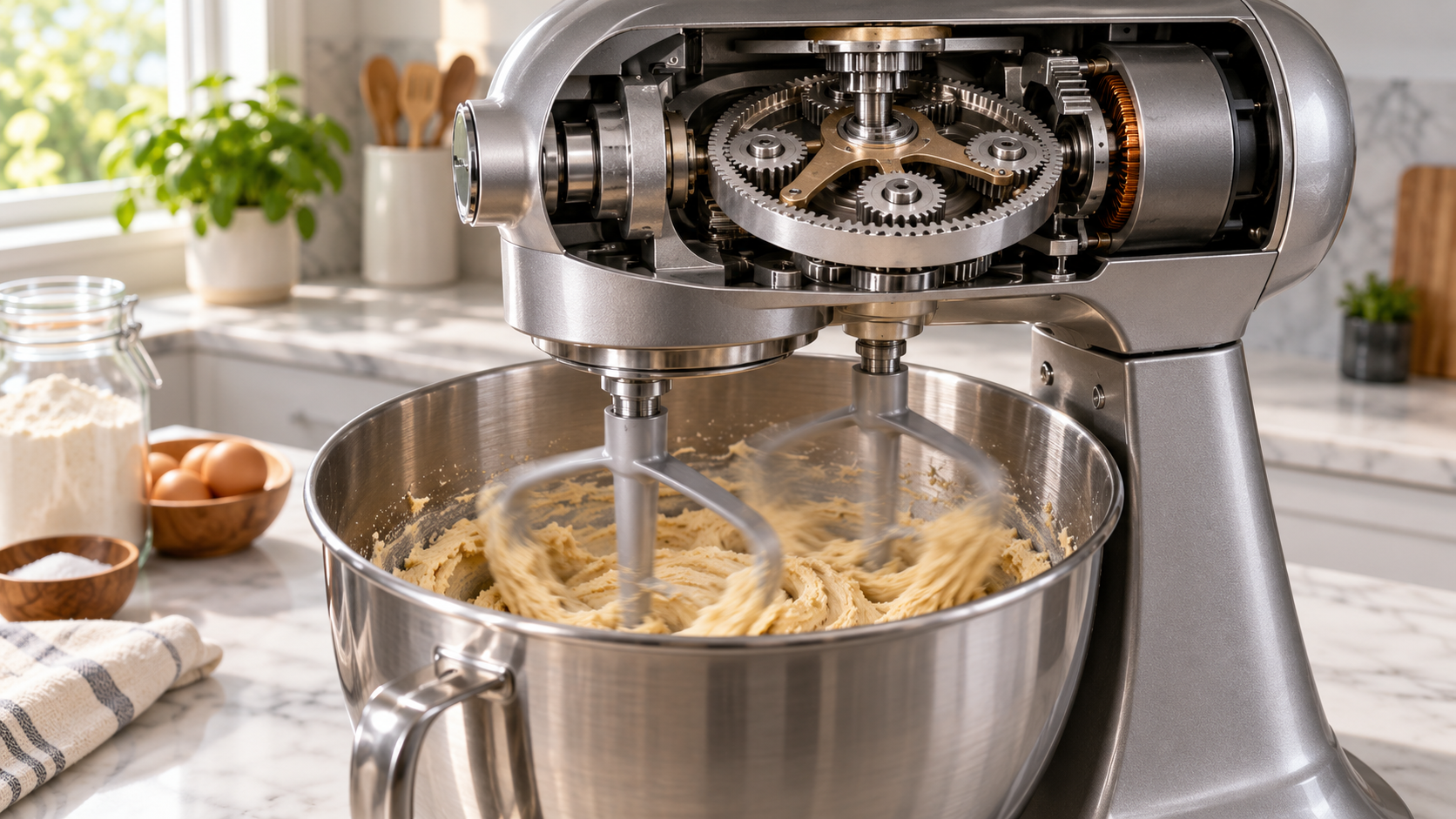
A planetary stand mixer gives its beater two simultaneous motions. The attachment rotates around its own shaft while the shaft itself travels in a circle around the center of the bowl. The path resembles a planet turning while orbiting, which gives the system its name. Because the beater faces different parts of the bowl on every revolution, it sweeps a much broader region than an attachment spinning in one fixed position and repeatedly folds material toward the center.
An electric motor drives the motion through reduction gears. The reduction lowers speed and increases available torque for dough or thick batter. In a common arrangement, the planetary carrier revolves around a central axis while a pinion connected to the beater rolls around a fixed ring gear. The gear relationship forces the beater to rotate as the carrier orbits. Manufacturers choose tooth counts and direction so the attachment path approaches the bowl wall without striking it.
Different tools use the same outlet but interact with food differently. A flat beater pushes and smears mixtures, a wire whisk divides liquid into many thin films to incorporate air, and a dough hook stretches and folds gluten-forming dough. Bowl shape is matched to the path. The attachment should clear the bottom by a small specified distance; contact can damage coating and bearings, while excessive clearance leaves unmixed ingredients below the working zone.
Load changes what the gearbox and motor experience. A light foam offers little resistance, but stiff dough produces high cyclic torque as the hook meets and releases the mass. Speed limits for attachments protect gears, motor windings, and the food structure. Too large a batch can climb the hook, stall the motor, or force the head and bowl supports. Some models use electronic control to maintain speed as load changes, while others slow naturally under heavy resistance.
The bowl, guard, head latch, and attachment connection are safety-critical. Power should be off and the beater fully stopped before scraping, changing tools, or reaching into the bowl. A loose bowl or poorly seated attachment can wobble into the moving path. Gear noise, oil leakage, unusual head movement, or repeated thermal shutoff suggests service rather than continued overloading. Flour should be started slowly so it stays in the bowl instead of becoming airborne.
Planetary action solves coverage mechanically. The motor supplies rotation, reduction gears trade speed for torque, and the ring-and-pinion arrangement turns one drive into spin plus orbit. That compound path brings the tool near the side, across the middle, and through new material on each pass. Correct tool choice and batch size then let the same basic motion cream butter, whip foam, mix batter, or knead dough without the bowl itself needing to rotate.
Gears make the attachment rotate on its shaft while the shaft orbits the bowl center, sweeping ingredients through a wide path. Key terms include planetary carrier, ring gear, pinion, orbit, rotation, reduction, torque, and clearance.
A pinion associated with the beater travels around a fixed gear as the planetary carrier revolves, forcing the beater to spin during its orbit.
Dough hooks and heavy mixtures create high torque and impact loads. Lower speed protects the gearbox and produces the intended mixing action.
Explore more "Explainers"
Discover additional explainers across politics, science, business, technology, and other fields. Each explainer breaks down a complex idea into clear, everyday language—helping you better understand how major concepts, systems, and debates shape the world around us.