

Sous Vide Immersion Circulator Explainer
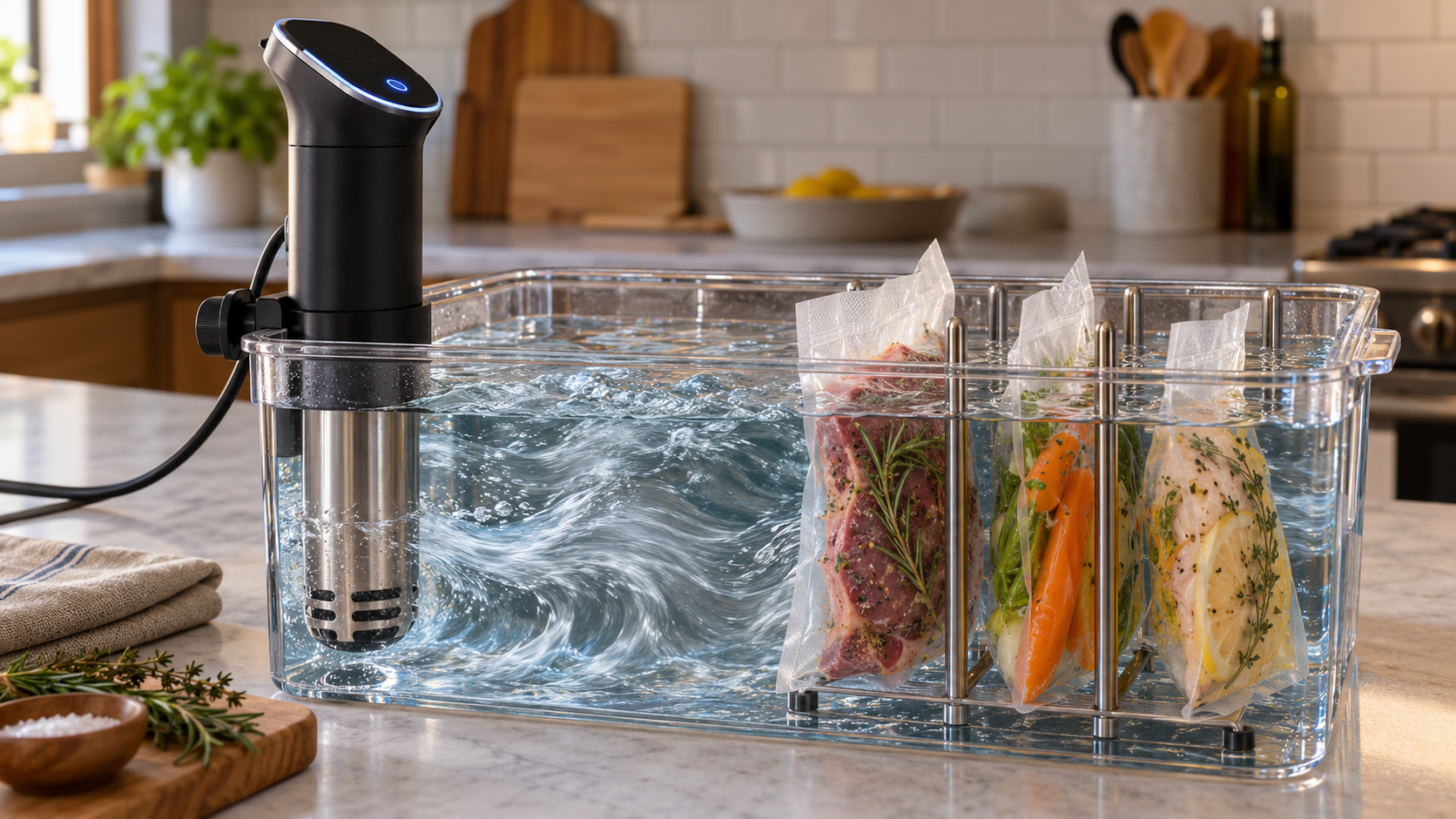
A sous vide immersion circulator is a compact feedback-controlled water heater. Clipped to a suitable container, it draws water past an electric heating element and pushes the warmed water back into the bath. A temperature sensor continually measures the circulating water. The controller compares that reading with the chosen set point and adjusts heater power. Because water surrounds the sealed food closely, its stable temperature places a practical upper limit on how hot the food surface can become.
Circulation is essential. Without movement, warm water would rise around the heater while cooler pockets remained near the container walls or food bags. An impeller mixes the bath and repeatedly carries water across the sensor and element. The control algorithm anticipates how the system responds, applying strong power when far below the set point and smaller corrections near it. Good tuning limits overshoot and avoids a wide cycle of heating and cooling around the target.
The bag separates food from the bath while allowing heat to conduct through a thin barrier. Removing most trapped air improves contact and prevents the bag from floating, but vacuum strength and packaging must suit the food and temperature. Water transfers heat far more effectively than still air, yet the center of a thick item still takes time to approach bath temperature. Precision does not make heating instantaneous, and cooking time remains a food-safety and texture variable.
Container volume, insulation, evaporation, and starting temperature affect performance. A lid or cover reduces heat loss and keeps the water level from falling during long cooks. The bath must remain between the unit’s minimum and maximum marks so the pump and heater stay submerged. Too many cold bags can block flow and overwhelm the heater temporarily. Spacing or racks allow water to reach every surface instead of leaving packages pressed together in an insulating stack.
Low-temperature cooking requires careful food-safety control. Pathogen reduction depends on the combination of temperature and time, not temperature alone, and quick chilling is needed when cooked food will not be served promptly. Bags, ingredients, and recipes should be appropriate for sous vide, with current official guidance followed for vulnerable diners. The circulator is unplugged before cleaning, and scale on the heater or impeller is removed using the manufacturer’s procedure.
The circulator’s precision comes from a closed loop: sense the water, compare it with the target, add heat, mix, and measure again. The pump makes the sensor reading representative of the whole bath, while the controller meters energy rather than simply running the heater continuously. When water level, spacing, time, and sanitation are managed, the system can hold a repeatable environment that cooks evenly without the large temperature gradients of a pan or hot oven.
A sensor measures circulating water, a controller compares it with the set point, and a heater adds only the needed energy while an impeller mixes the bath. Key terms include set point, probe, feedback, heater, impeller, circulation, overshoot, and equilibrium.
Circulation removes hot and cold pockets and keeps water moving past the heater, sensor, container, and food bags so the bath stays more uniform.
No. Safety depends on the food, thickness, temperature, time, handling, and cooling. Use tested guidance rather than relying on the display alone.
Explore more "Explainers"
Discover additional explainers across politics, science, business, technology, and other fields. Each explainer breaks down a complex idea into clear, everyday language—helping you better understand how major concepts, systems, and debates shape the world around us.