

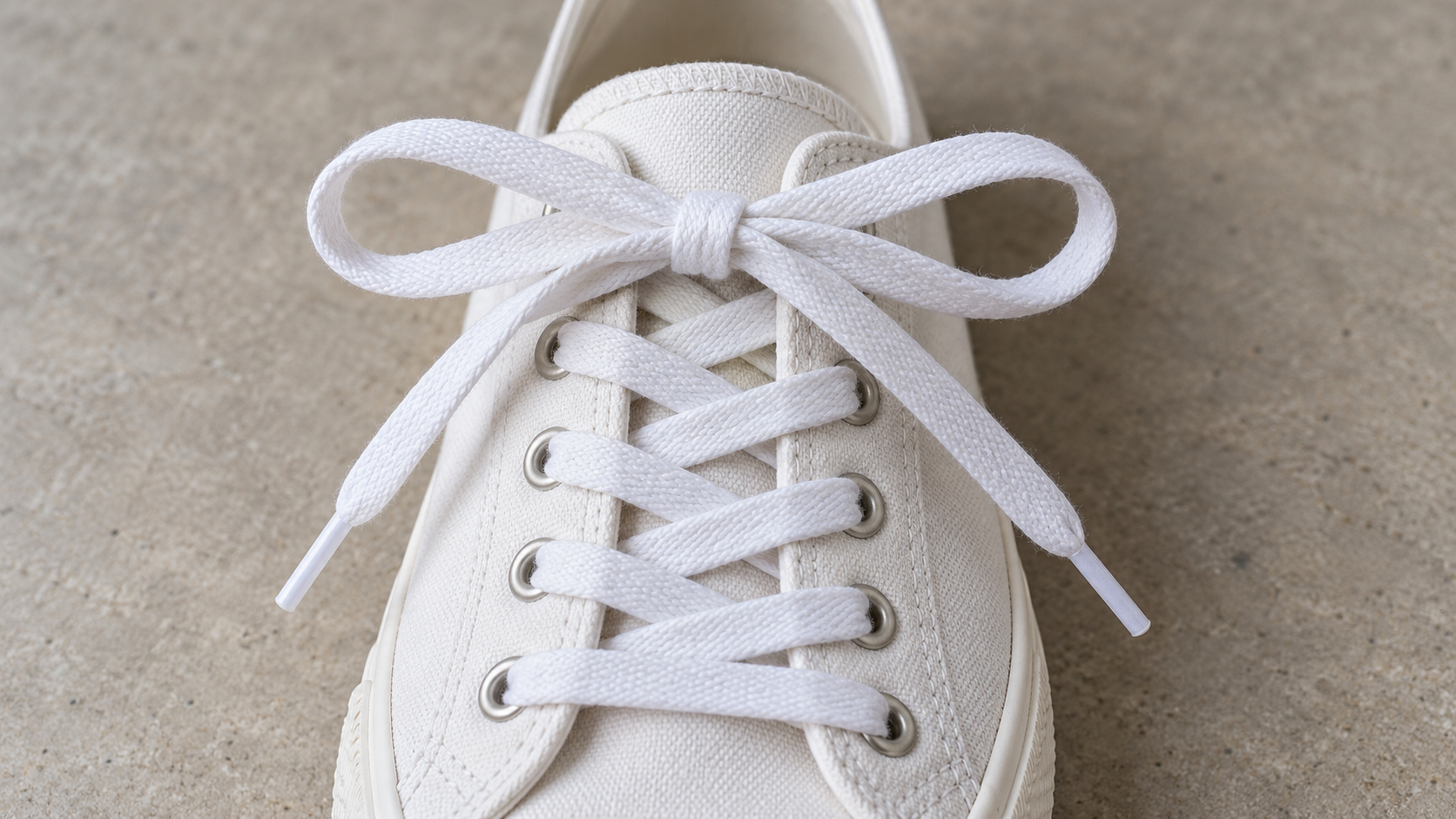
Shoelace Knot Friction Explainer
A common shoelace bow starts with an overhand crossing that pulls the two sides of the shoe together. A second knot is then formed using folded sections, or bights, instead of feeding the entire lace ends through. The finished bow has two loops and two free ends. Load on the standing lace tightens curved contact zones, and friction at those contacts resists sliding.
The knot stays compact because lace tension squeezes one segment against another. Every bend redirects force and increases normal contact between the fibers, allowing friction to oppose movement. The bights are long enough to act like full ends within the knot, but they preserve an accessible route for release. Pulling a free end withdraws its bight and rapidly converts the bow back into a simple overhand structure.
Orientation matters. If the first and second tying steps twist in opposite senses, they form a balanced square-style bow whose loops tend to lie across the shoe. Repeating the same sense creates a granny-style bow that often sits lengthwise and may distort under load. Geometry does not eliminate movement, but a balanced knot distributes tension more symmetrically and is generally more stable.
Walking repeatedly shocks and swings the system. Foot impact can loosen the knot, while the moving free ends develop inertia that pulls lace through the relaxed contacts. Research using high-speed observation has shown that failure can become sudden after gradual loosening. Smooth round synthetic laces, short loops, uneven end lengths, or a loosely dressed knot can make the process happen sooner.
Firmly setting both stages increases contact pressure. A double bow adds another crossing of the loops, trading quick release for security. Laces should still allow circulation and comfortable foot movement; excessive tightness is not the same as a sound knot. Worn, frayed, or unusually slippery laces may need replacement, and loose ends should be retied before they create a trip or machinery hazard.
The bow is a deliberately releasable friction lock. It redirects tensile force through several bends, uses that force to create clamping pressure, and substitutes loops for ends so the structure can be undone easily. Its performance depends on topology, material friction, and motion. A correctly oriented, well-dressed bow holds ordinary walking loads because slipping would require several compressed lace segments to move together.
Crossed lace segments bend and squeeze one another, creating friction that blocks sliding, while slipped loops make the knot easy to release. Key terms include overhand knot, bight, loop, standing part, free end, friction, normal force, and dressing.
Opposite-sense tying stages make a balanced square-style bow; same-sense stages make a granny-style bow that tends to rotate and distort.
Repeated foot impacts loosen contact while swinging ends tug through the knot. Once friction falls enough, the remaining structure can unravel in a few steps.
Explore more "Explainers"
Discover additional explainers across politics, science, business, technology, and other fields. Each explainer breaks down a complex idea into clear, everyday language—helping you better understand how major concepts, systems, and debates shape the world around us.