

Self-Watering Planter Capillary Explainer
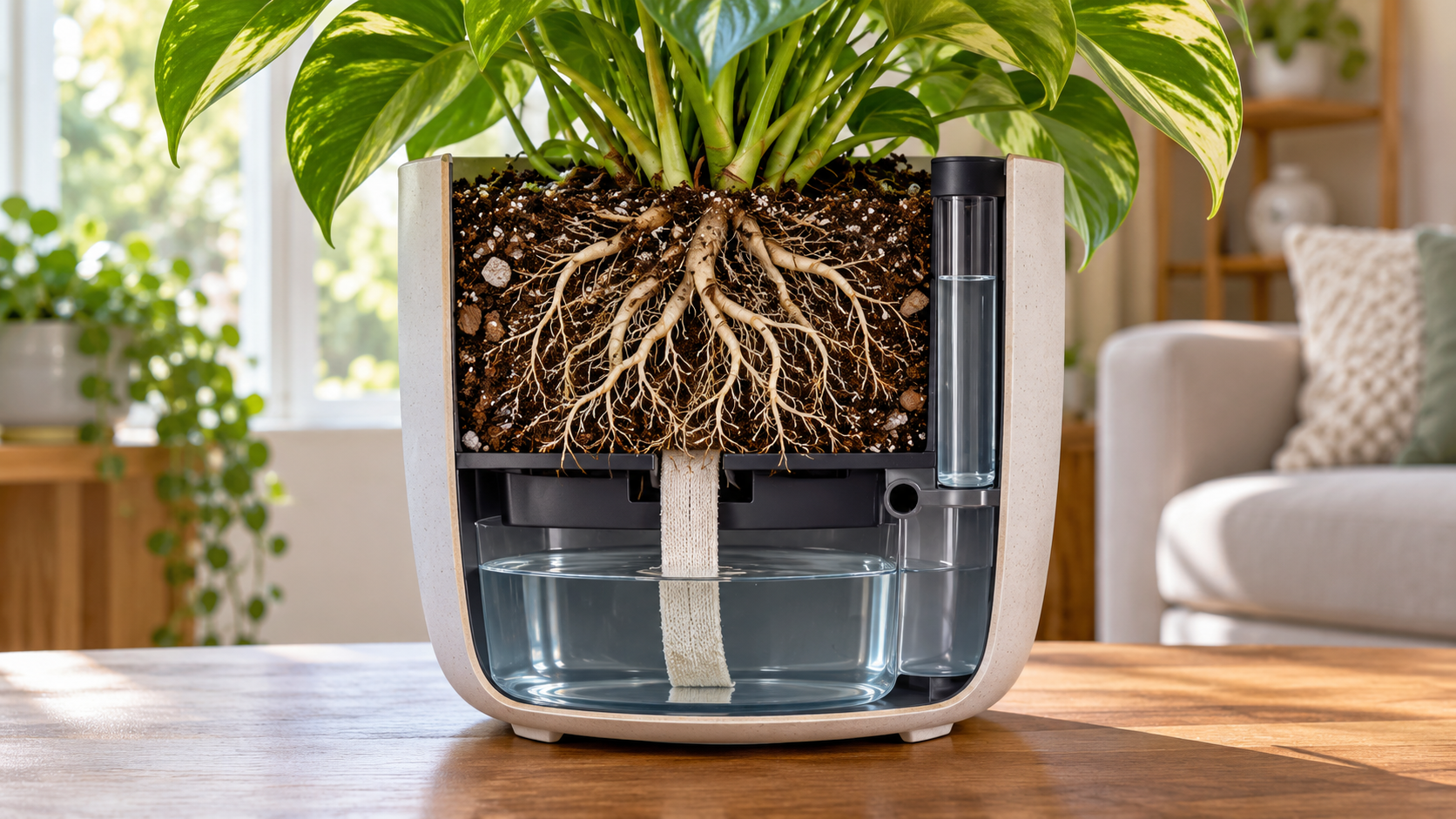
A self-watering planter separates a lower water reservoir from most of the potting mix. A wick, absorbent mat, porous insert, or narrow column of mix connects the two zones. Water wets the tiny spaces within that material. Adhesion attracts water to the pore walls, and cohesion links neighboring water molecules, allowing a continuous film to rise against gravity through capillary action.
The growing medium draws from the moist wick when its water potential becomes lower through evaporation and root uptake. As water leaves pores near the roots, more moves along connected pathways from the reservoir. The device is not sensing thirst in a mechanical way; the soil-plant-atmosphere system creates the pressure differences that regulate flow. A finer pore network can lift water higher but may transmit it more slowly.
A fill tube lets water reach the reservoir without saturating the whole surface. An overflow hole limits maximum depth and preserves an air gap beneath the root zone. Some planters include a float indicator, but it measures reservoir level rather than soil moisture. At initial planting, top watering may be needed to settle mix and establish a continuous moist connection before the wick can supply established roots.
Potting mix must balance capillary continuity with aeration. Dense garden soil can stay waterlogged, while a very coarse mix may not bridge moisture far enough upward. Root systems and plants also differ in water demand. A reservoir that works for a leafy plant in shade may empty quickly for a large plant in sun. Fertilizer salts can accumulate because less water drains through the pot.
The reservoir still needs cleaning and periodic monitoring. Stagnant water, blocked overflow, algae, mosquitoes, root intrusion, and failed wicks can cause trouble. Allowing an appropriate dry interval may matter for some plants. The planter does not make every species impossible to overwater; if the mix remains saturated and airless, roots can be damaged even though water arrived from below.
The planter extends watering intervals by storing liquid where evaporation is limited and delivering it through small pores. Capillary adhesion lifts the water, connected films carry it into the mix, and root uptake keeps the gradient active. The system succeeds when reservoir height, wick area, pot depth, mix texture, and plant demand are matched, providing steady access without flooding the entire root volume.
A wick or porous soil column connects a lower reservoir to the root zone, where capillary forces pull water upward as plants and evaporation remove moisture. Key terms include reservoir, wick, pore, adhesion, cohesion, capillary action, overflow, and aeration.
Not with a sensor. Drying soil creates a stronger water-potential gradient that draws moisture through connected pores from the reservoir.
It limits reservoir height and protects an air space below the root zone, reducing the chance that all the potting mix stays submerged.
Explore more "Explainers"
Discover additional explainers across politics, science, business, technology, and other fields. Each explainer breaks down a complex idea into clear, everyday language—helping you better understand how major concepts, systems, and debates shape the world around us.