

Retractable Garden Hose Reel Explainer
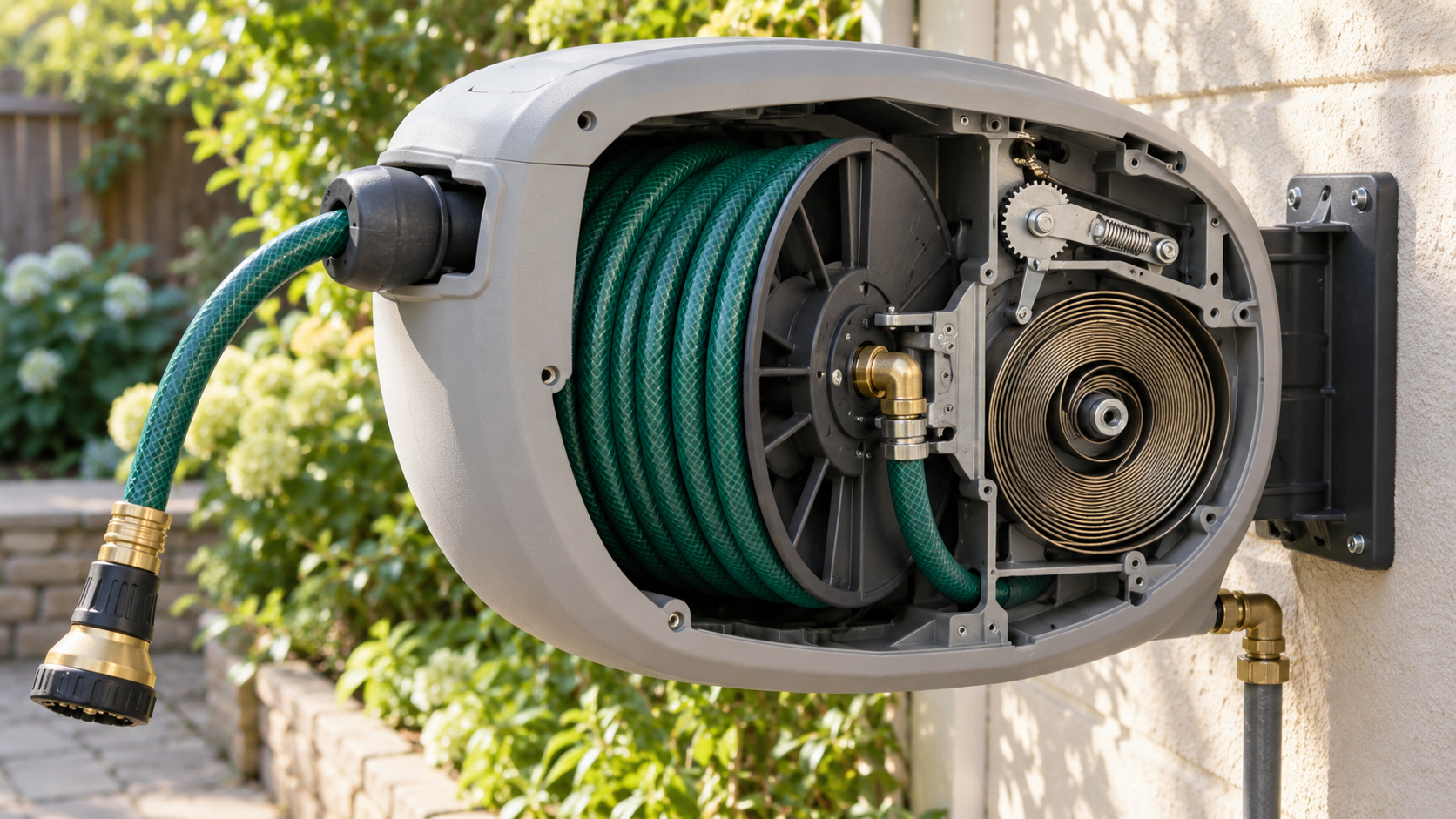
A retractable garden hose reel combines a rotating spool with a spring that stores energy while the hose is pulled out. The hose wraps around the spool inside the housing, while one end of a flat recoil spring is anchored to the stationary case and the other is connected to the spool. Unwinding the hose rotates the spool and winds the spring more tightly, much like pulling out a retractable cord.
The reel needs a way to remain extended instead of immediately pulling the hose back. A ratchet wheel and pawl provide that temporary lock. As the spool turns, the pawl rides over a sequence of teeth and can drop into a holding position at selected lengths. A short extra pull or a separate release lets the pawl clear the tooth so the spring can rotate the spool in the rewinding direction.
Water must pass through the rotating assembly without twisting the supply connection. A swivel coupling joins the stationary inlet to the hose wound on the spool. Seals inside the swivel allow the two parts to rotate relative to each other while containing water pressure. A guide at the housing opening keeps the hose aligned and reduces rubbing as it leaves or returns, and some reels move the guide side to side for even winding.
Retraction is controlled by the spring torque, friction, spool diameter, and the mass of hose still outside. The spring pulls most strongly when it is tightly wound and has the greatest stored energy. As the hose returns, the reel should be guided at a walking pace so the nozzle does not whip or strike the housing. Dirt on the hose and tight bends can add drag, while crossed wraps may jam the spool.
The mechanism has practical limits. Pulling beyond the marked hose length can overstress the spring or create a latch-out condition. A leaking swivel may need seals specified by the manufacturer, and a slow rewind can result from grit, a weak spring, or tangled layers. The spring enclosure should not be opened casually because a preloaded strip spring can release energy suddenly. Water should be shut off and pressure relieved before inspection.
A retractable reel therefore coordinates storage, fluid flow, and one-way locking in a compact case. The user supplies energy while extending the hose, the spring preserves that energy, and the ratchet holds the chosen length. Releasing the latch converts the stored energy back into spool rotation. The swivel keeps water flowing during rotation, while the guide and controlled hand tension help the hose settle into orderly layers for the next use.
Pulling out the hose rotates a spool and winds a recoil spring. A ratchet holds the extension until released, then the spring rewinds the spool. Key terms include spool, recoil spring, ratchet, pawl, swivel, seal, guide, and torque.
The clicking usually comes from a pawl passing over ratchet teeth. At selected positions, the pawl can engage a tooth and prevent immediate rewind.
Guiding controls speed, prevents the nozzle from whipping, and helps the hose form even layers instead of crossing or bunching on the spool.
Explore more "Explainers"
Discover additional explainers across politics, science, business, technology, and other fields. Each explainer breaks down a complex idea into clear, everyday language—helping you better understand how major concepts, systems, and debates shape the world around us.