

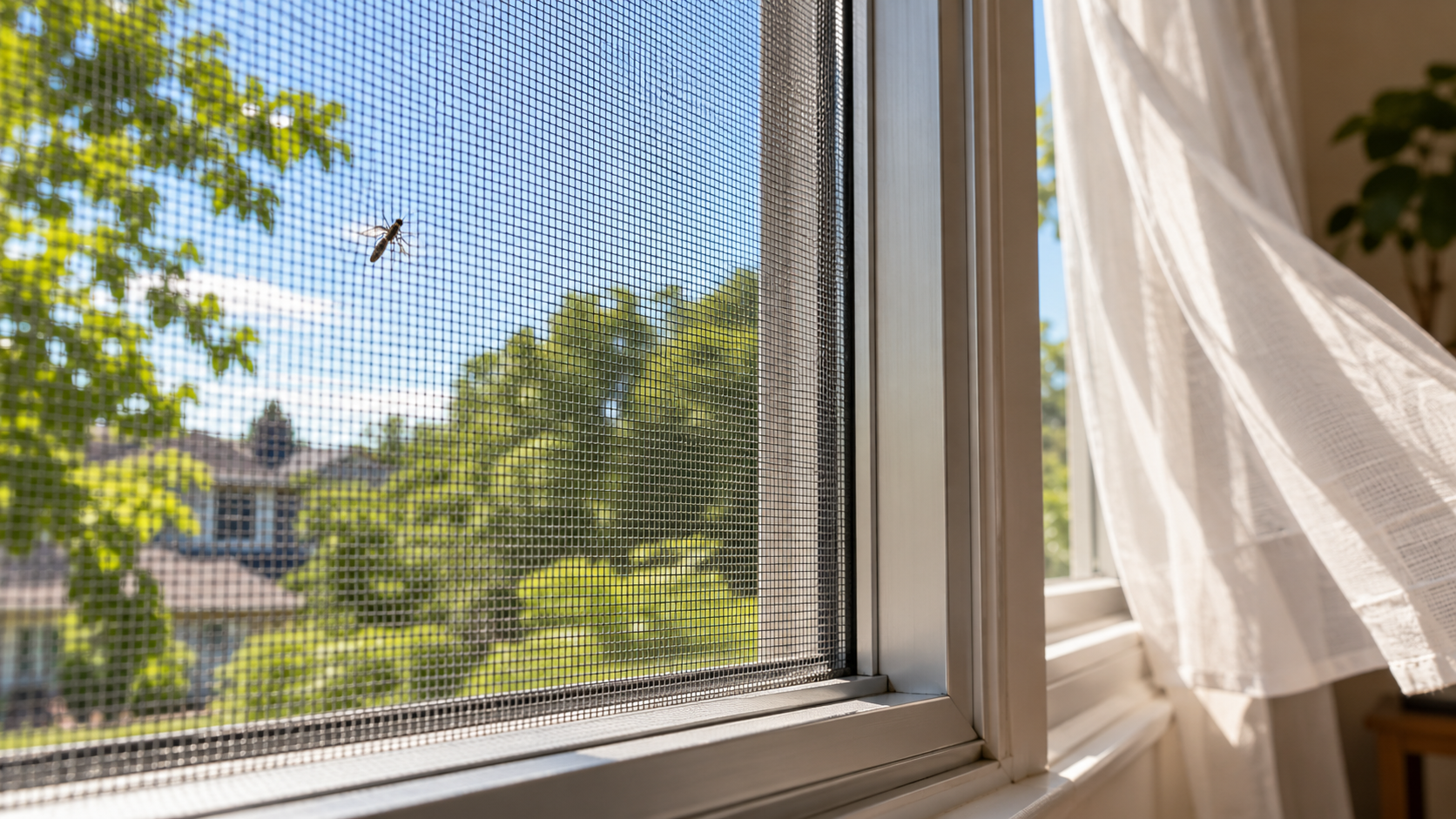
Window Insect Screen Explainer
A window screen is a physical size barrier. Its woven metal, fiberglass, or polymer threads form openings small enough to stop the target insects from passing, while thousands of pores remain open to air and light. The mesh does not repel insects chemically. It works only where it completely covers the window opening and where the frame, corners, and edges leave no larger path around it.
Air can pass because pressure differences created by wind, temperature, or building ventilation push it through the pores. The solid threads still obstruct part of the opening and create friction and turbulence. Engineers describe the open fraction as porosity and the resulting resistance as a pressure drop. Finer mesh excludes smaller insects but generally presents more resistance, so insect control and ventilation must be balanced for the intended setting.
Thread diameter and weave influence that balance. Two screens with similar opening count can have different open area if one uses thicker fibers. Pore shape, screen thickness, surface roughness, wind angle, and distance from the glass also affect flow. Air that strikes a thread separates and swirls before recombining downstream, using some pressure energy. That is why a screen can feel calmer than an unscreened window even though it remains visibly open.
The mesh is held under tension in a rigid frame. A flexible spline pressed into a groove commonly secures the material around the perimeter. Proper tension keeps the openings consistent and prevents the screen from flapping into the sash. Weatherstripping or the frame fit closes the boundary. A torn corner, loose spline, bent frame, or gap around a sliding panel can provide an easier route than passing through the mesh itself.
Dust, pollen, grease, and fibers accumulate on threads and reduce effective open area. Gentle cleaning can restore airflow, but the method must suit the mesh and frame material. Damage is repaired promptly, and pet-resistant or security mesh is chosen for its specific purpose rather than assumed to have the same airflow. Screens do not make an open window safe against falls; appropriate window guards or opening controls address that separate hazard.
The screen succeeds through scale and repetition. Each pore is too small for a particular insect yet enormous compared with air molecules, and the combined area of many pores allows useful ventilation. The threads impose a measurable flow penalty, while the frame and spline preserve the barrier at its edges. Choosing the right opening size, keeping the mesh clean, and closing perimeter gaps determine whether the screen performs both parts of its job.
Mesh pores are smaller than target insects but collectively large enough for air and light to pass. Key terms include mesh, pore, thread diameter, porosity, pressure drop, turbulence, spline, and frame.
Smaller pores and more thread area create greater friction and turbulence, so a larger pressure difference is needed to move the same amount of air.
Gaps at corners, loose spline, a bent frame, or an incompletely closed sash can provide an opening much larger than any mesh pore.
Explore more "Explainers"
Discover additional explainers across politics, science, business, technology, and other fields. Each explainer breaks down a complex idea into clear, everyday language—helping you better understand how major concepts, systems, and debates shape the world around us.