

Rotary Lawn Mower Blade Explainer
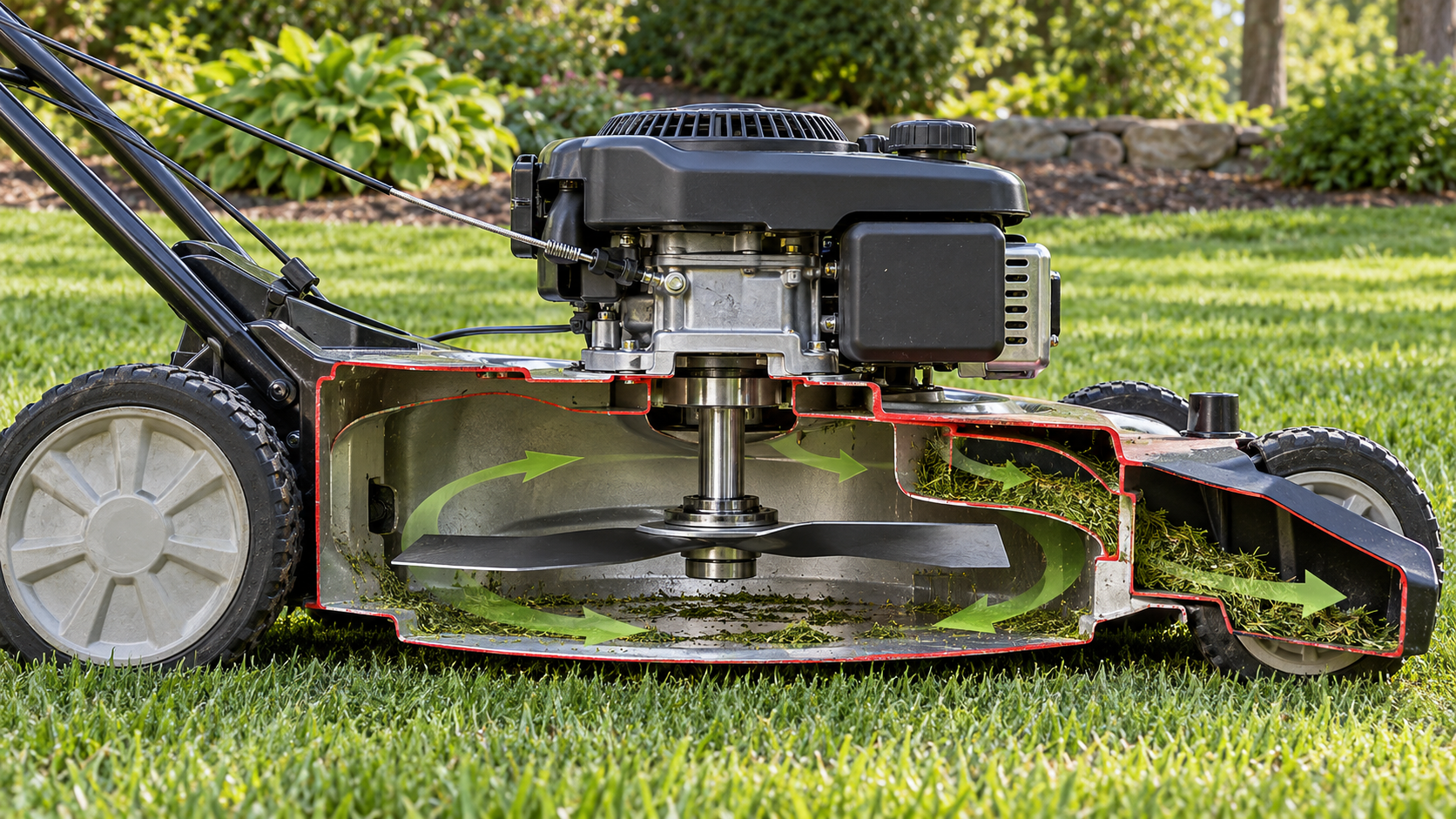
A walk-behind rotary mower uses a horizontal blade attached to a vertical engine or motor shaft beneath a protective deck. The sharpened outer portions travel quickly and meet upright grass stems, shearing them as the mower advances. Only the blade tips do most of the cutting because they move fastest and cover the largest path. Cutting height is set by changing the deck or wheel position relative to the ground.
The blade is also shaped to move air. Lifted trailing surfaces act like fan vanes, creating circulation inside the deck that raises bent grass before the cutting edge arrives. The spinning flow carries clippings toward a side or rear discharge, into a collection bag, or back through the cutting path in a mulching configuration. Deck curvature and baffles manage that flow, so removing guards or operating with incorrect parts changes both performance and safety.
Mulching blades and decks keep clippings moving long enough to cut them into smaller pieces before they settle into the lawn. This works best when grass is dry and the mower removes a moderate amount. Wet or very tall grass can clump, block airflow, and overload the blade. Forward speed, blade sharpness, engine speed, deck cleanliness, and the proportion of grass removed determine whether the result is an even cut or ragged strands and piles.
The rotating blade carries substantial energy. Stones, wire, sticks, and other objects can become high-speed projectiles, while contact with the blade can cause severe injury. Modern walk-behind mowers use an operator-presence control that stops the blade or engine when the handle is released. Shields, discharge covers, and trailing guards keep people away from the blade path and help contain objects; they are functional safety components, not optional trim.
The mower is shut down and the blade allowed to stop before clearing a chute, changing height, lifting the deck, or inspecting damage. The power source is disabled as the manual specifies before hands approach the blade, because a jammed blade can move unexpectedly. A dull, bent, cracked, or unbalanced blade is serviced or replaced correctly. Bystanders remain away, sturdy footwear and eye protection are used, and the mowing area is cleared first.
The machine combines cutting and airflow in one rapidly rotating part. Its sharp tips sever stems, its lift surfaces pull grass upright, and its deck shapes the moving air and clippings. The same speed that makes the cut efficient creates the central hazard. Good results and safe operation depend on a sound blade, intact guards, appropriate grass conditions, correct height, a clear lawn, and never approaching the deck until every moving part is stopped and isolated.
A fast horizontal blade shears grass at its sharpened tips, while shaped lift surfaces and the deck move clippings toward discharge, collection, or recutting. Key terms include rotary blade, tip speed, lift, deck, baffle, mulching, discharge, and operator-presence control.
Moist pieces stick together and to the deck, forming heavy clumps that resist the airflow meant to carry them through the cutting chamber.
The blade can strike hidden stones, wire, or wood and eject them at dangerous speed through or from under the deck.
Explore more "Explainers"
Discover additional explainers across politics, science, business, technology, and other fields. Each explainer breaks down a complex idea into clear, everyday language—helping you better understand how major concepts, systems, and debates shape the world around us.