

On This Day in Business: June 30, 1953
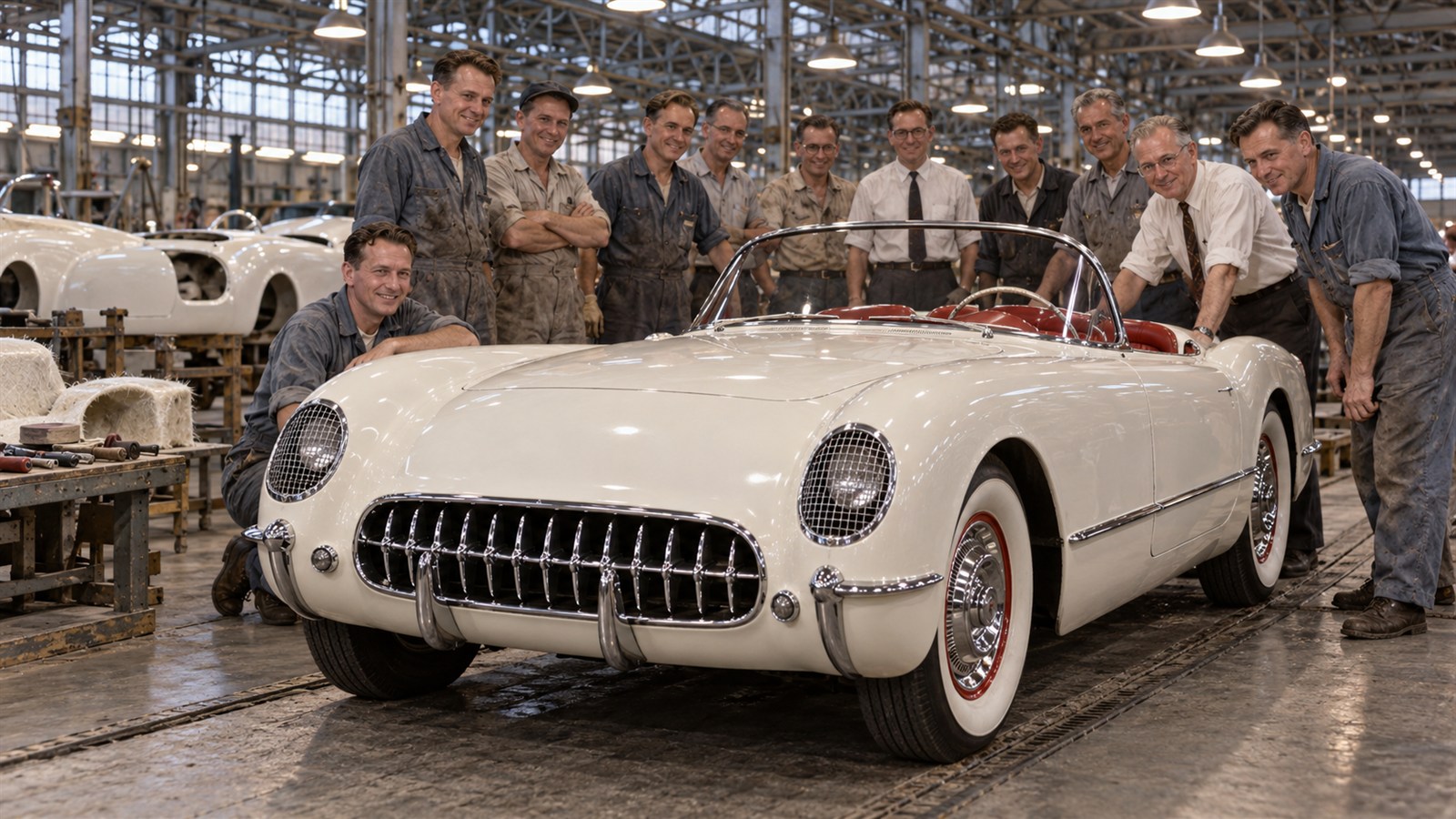
On June 30, 1953, the first production Chevrolet Corvette was completed at a small assembly operation in Flint, Michigan. General Motors had shown a Corvette concept at its Motorama exhibition in New York earlier that year and received strong public interest. The production car used a fiberglass body, a material chosen in part because it reduced the time and tooling investment required for low-volume panels. All 300 Corvettes built in 1953 were Polo White with red interiors and were assembled largely by hand. The first finished roadster marked Chevrolet's entry into the American sports-car market and turned a celebrated show vehicle into a product customers could own.
The launch was a market test as much as a manufacturing program. The car used an existing six-cylinder engine and two-speed automatic transmission, choices that controlled development but limited performance against the image suggested by its appearance. Fiberglass introduced challenges in fit, finish, grounding, and production consistency. Distribution was selective, prices were high, and early sales did not guarantee the model's future. General Motors had to decide whether the excitement generated by design could become sustained demand once buyers evaluated speed, reliability, comfort, and value on the road.
Engineering changes transformed the Corvette over the next few years. A V-8 engine, manual transmission, improved body, roll-up windows, and other refinements aligned performance with the sports-car promise. Racing and enthusiastic owners strengthened credibility, while successive generations maintained recognizable identity through major technical change. Production moved from Flint to St. Louis and later Bowling Green, Kentucky. The model became a halo product: its volume was smaller than Chevrolet's family cars, but it displayed design and performance capabilities that benefited the wider brand.
The first car matters because prototypes, showpieces, and production vehicles answer different questions. Motorama proved that the shape attracted attention; the Flint run tested materials and assembly; customers revealed whether the total experience justified the price. Chevrolet preserved the name long enough to improve weak elements rather than judging the idea only by its initial configuration. That patience was not automatic—poor early sales could have ended the program. The Corvette's later endurance demonstrates how a focused product can create strategic value beyond unit volume when it gives a broad company aspiration and technical identity. An icon begins as a sequence of operating decisions, not as a finished legend. Scarcity also affected perception. A hand-built run of 300 created exclusivity and allowed learning, but it could not prove efficient mass production. Low-volume launches need explicit learning goals so that premium attention does not conceal defects or delay the investments required for a repeatable process.
The first production Corvette was completed in Flint after strong response to the Motorama concept shown earlier in 1953.
Fiberglass reduced tooling needs for low volume but created new manufacturing challenges in fit, finish, and electrical grounding.
Three hundred hand-built 1953 cars shared Polo White paint, red interiors, a six-cylinder engine, and automatic transmission.
Early performance and sales left the program uncertain, forcing Chevrolet to improve the product behind its dramatic appearance.
V-8 power, a manual gearbox, body revisions, racing, and owner enthusiasm later aligned capability with the sports-car promise.
The Corvette became a halo product, showing how a small-volume model can shape the technical identity of a much larger brand.
Explore more of "On This Day ..."
Discover more events from the same date across news, politics, technology, sports, and other fields. Each link highlights significant moments that shaped history on different fronts.