

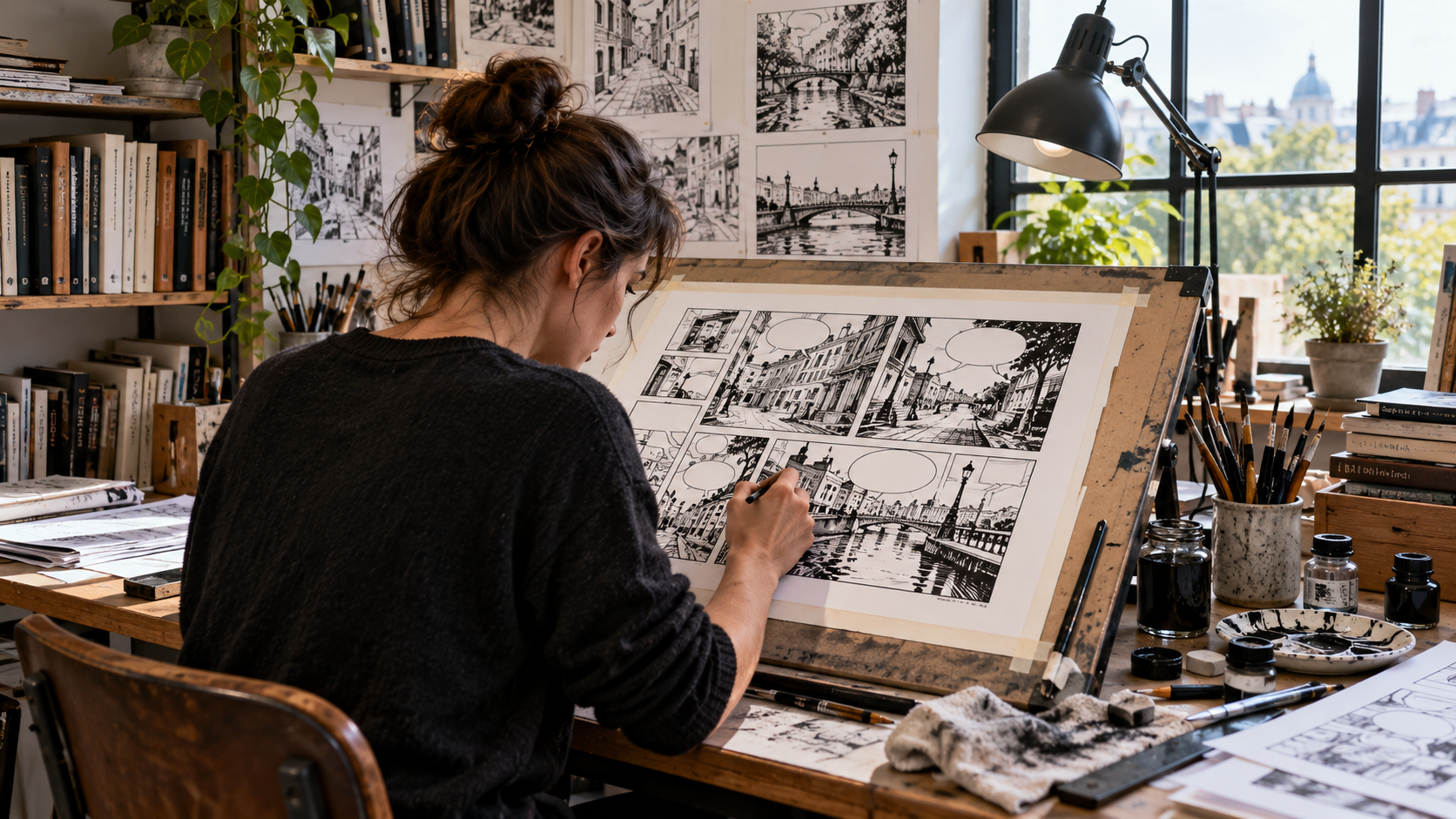
Graphic Novels Explainer
A graphic novel is an extended narrative told primarily through sequential images, often combining panels, captions, dialogue, and other written language. Despite the name, it can present fiction, memoir, history, journalism, biography, or instruction, and it can be created for any age. The Library of Congress notes that text and illustrations are both important to conveying the story. The term describes a form and publishing format, not a guarantee that the work is fictional, adult, literary, or originally released as one volume.
Sequential art controls time through layout. Panel size, shape, order, and spacing influence how long a moment feels and where the reader pauses. The blank space between panels asks readers to infer motion, change, or omitted events. Lettering, balloon shape, captions, and sound effects affect voice and rhythm, while color, line, perspective, and page turns establish atmosphere and surprise. Readers control their pace more directly than film viewers, yet the page design continually guides attention.
Creation may be handled by one person or a team that includes writer, penciler, inker, colorist, letterer, designer, editor, and others. Scripts range from detailed panel instructions to looser collaboration. Pages pass through thumbnails, rough layouts, finished art, lettering, coloring, and prepress. Digital tools can support every stage without changing the fundamental requirement that the images form a readable sequence. Production choices must work at the printed or displayed size, not only on a large drawing screen.
The boundary with comic books is porous. A graphic novel may be created as one long work, or it may collect serialized issues that were originally published separately. Comic books can also contain complete, sophisticated narratives, so length and binding do not determine artistic value. Manga, bandes dessinées, webcomics, and other traditions have their own histories and formats. Retail and library categories often place them together for practical reasons, but readers benefit from recognizing the specific cultural and publication context. Adaptations add another source of confusion. A prose novel converted into comics is a graphic adaptation; an original visual narrative is not an adaptation merely because it uses the word novel. Likewise, a book with occasional illustrations is not necessarily a graphic novel if the prose carries the story independently. A useful test is to remove the images: if the narrative becomes substantially incomplete, sequential art is doing essential work. The form's power comes from the designed relationship among images, language, and the reader's act of connecting them. A practical way to read or discuss Graphic Novels is to separate the basic definition from the choices made in a particular example. Graphic novels tell stories through sequences of images in which panels, page layout, and written language work together. Then identify who sets the relevant rules, which parts are creative decisions, and which parts follow from law, contracts, technology, or production limits. Examples that look similar on the surface can operate differently because their purpose, audience, timing, and surrounding agreements are different. A graphic novel may be an original book or a collected serialization; format history matters more than a rigid length or binding rule. It is also useful to check whether a source is describing a formal industry category, an informal critical label, or one organization's current practice. Those distinctions prevent a memorable anecdote from becoming a false universal rule. The date and market matter too: tools, distribution systems, and standard agreements change, while older examples can preserve assumptions that no longer apply everywhere. When a claim sounds absolute, compare it with a second type of source and look for the conditions under which it is actually true. Finally, compare the visible result with the less visible work that produced it. Occasional illustrations do not make a prose book a graphic novel when the written text can carry the complete narrative by itself. That approach keeps the explanation grounded while leaving room for reasonable disagreement about borderline cases.
Graphic novels tell stories through sequences of images in which panels, page layout, and written language work together.
Panel transitions require readers to infer movement, elapsed time, cause, and off-page action, making the space between images narratively active.
Creators use page turns, scale, composition, lettering, color, line, and repetition to control pace and emphasis.
A graphic novel may be an original book or a collected serialization; format history matters more than a rigid length or binding rule.
Fiction, memoir, history, journalism, fantasy, romance, and instruction can all use the form, so graphic novel is not a genre label.
Occasional illustrations do not make a prose book a graphic novel when the written text can carry the complete narrative by itself.
Explore more "Explainers"
Discover additional explainers across politics, science, business, technology, and other fields. Each explainer breaks down a complex idea into clear, everyday language—helping you better understand how major concepts, systems, and debates shape the world around us.