

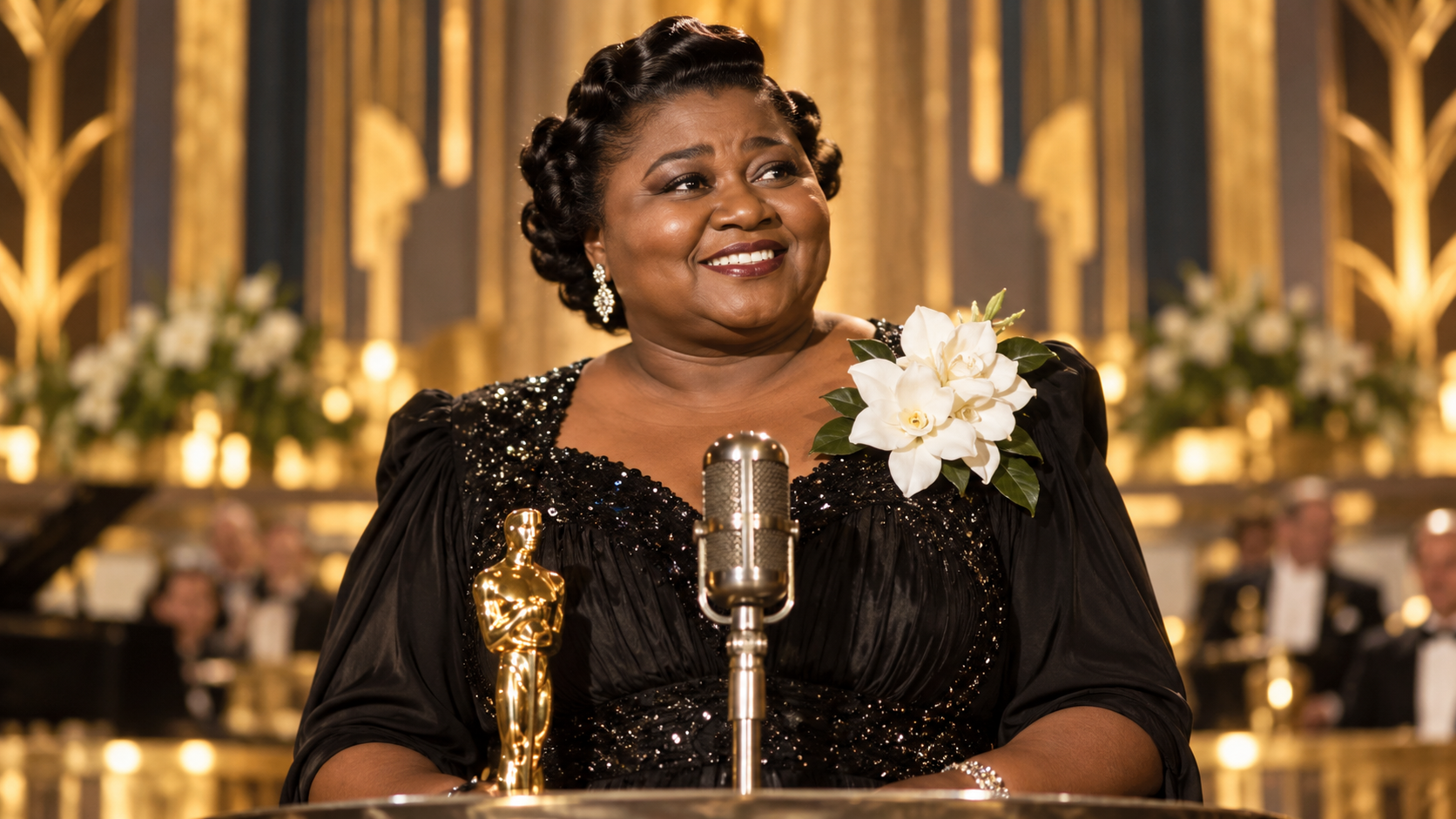
“I sincerely hope I shall always be a credit to my race and to the motion picture industry.”
When Hattie McDaniel accepted the 1940 Academy Award for her supporting performance in Gone with the Wind, she became the first Black person to win a competitive Oscar. Near the end of her brief speech, she said, “I sincerely hope I shall always be a credit to my race and to the motion picture industry.” The ceremony took place at the segregated Cocoanut Grove, where McDaniel and her guest were seated apart from the film’s white cast. Her sentence therefore carried two realities at once: an undeniable professional breakthrough and an industry that celebrated her while maintaining the exclusions she had to navigate.
The phrase “a credit to my race” reflects a burden familiar to many firsts. Success is treated not only as individual achievement but as evidence offered on behalf of a whole group. McDaniel had to receive recognition, express gratitude, and represent Black aspiration within a room structured by discrimination. Her composure should not obscure that pressure. The award acknowledged her skill, but the roles Hollywood made available to Black women remained sharply restricted, and the character of Mammy belonged to a film whose romantic account of the Confederacy has demanded sustained critical examination.
That context prevents two easy readings. McDaniel should not be reduced to the limitations of the part, as though accepting available work erased her agency or talent. Nor should the historic win be used to excuse the stereotypes and segregated conditions around it. Cultural progress often arrives through compromised institutions, and a breakthrough can be real without being complete. The plaque McDaniel received was later bequeathed to Howard University and then disappeared; the Academy presented a replacement to the university in 2023, creating another occasion to consider what institutions preserve, neglect, and finally choose to repair.
The quotation still matters because artists from underrepresented communities are often asked to be exemplary in ways their peers are not. Every role, mistake, or award can be interpreted as a verdict on more than one career. A better industry would honor excellence without demanding perfection as the price of belonging. Reviewers and audiences can practice that distinction by discussing McDaniel’s craft, the constraints of the part, and the film’s politics as related but separate questions. Her speech remains moving because it captures the hope of making a path inside an unequal system. Remembering the full setting does not diminish the achievement; it restores the courage and complexity that a simplified “first” can hide.
McDaniel spoke at the 12th Academy Awards in 1940 after winning Best Supporting Actress for Gone with the Wind. She was the first Black competitive Oscar winner, yet the segregated venue seated her apart from the film’s white cast and guests.
The line expresses pride and the unequal representational burden placed on a “first.” Her achievement was genuine, while the role and institution remained constrained by racism. Both truths are necessary to understand the moment without reducing McDaniel’s agency or excusing the system.
When discussing a historic first, separate the artist’s craft, the opportunity’s limits, and the institution’s rules. Ask whether the breakthrough altered access for others or left one exceptional person carrying a standard that peers were never required to meet.
Explore more "Quotes of The Day"
Discover more notable quotes from influential voices across politics, science, business, technology, sports, and culture. Each quote offers insight into how ideas, beliefs, and decisions shape the world around us.