

On This Day in Business: January 7, 1927
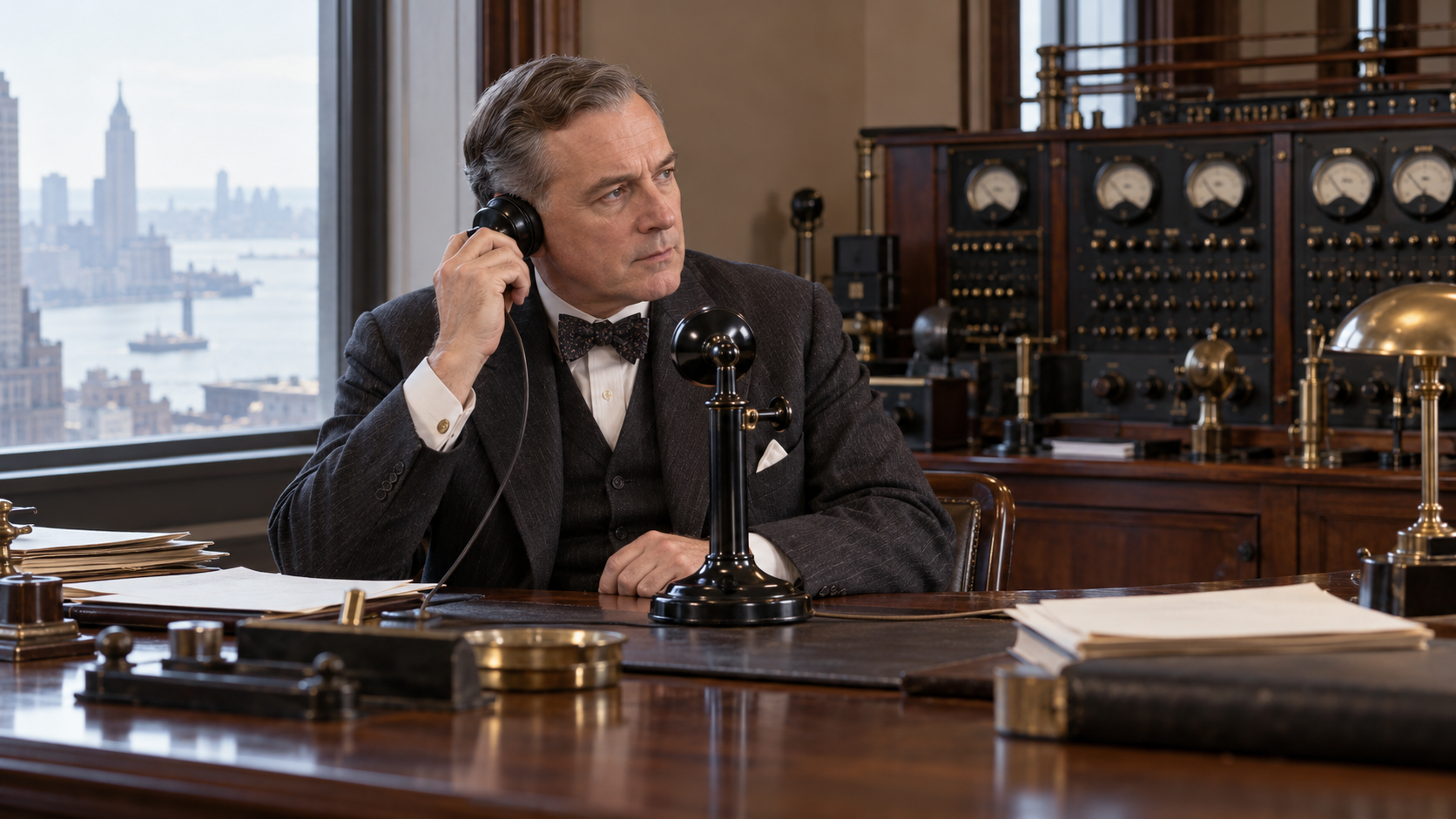
On January 7, 1927, commercial transatlantic telephone service opened between New York and London. Walter S. Gifford, president of American Telephone and Telegraph, spoke from New York with Sir Evelyn Murray, secretary of Britain’s General Post Office, in the formal inaugural call. Engineers had conducted an important test conversation the previous day, but January 7 marked the service’s official opening to paying customers. For businesses accustomed to cables, letters and ocean travel, the new circuit offered something different: a live voice exchange between two major financial and commercial centers. The achievement was a communications product as well as a technical demonstration.
The route combined ordinary telephone wires with long-distance radio. A New York call traveled by wire to a transmitter at Rocky Point on Long Island, crossed the Atlantic by radio to a receiving station at Rugby, England, and then continued by wire to London. The return voice used a separate path through Scotland and Maine. This arrangement allowed two-way conversation, but it was vulnerable to atmospheric static and changing radio conditions. Capacity was extremely limited. AT&T’s network history records that the system could handle only one call at a time, and the initial price was $75 for the first three minutes, placing routine use far beyond most households and many small firms.
Customers could request calls through operators rather than dialing London directly. The inaugural exchange connected existing local networks, turning an international call into a coordinated chain of operators, landlines and radio stations. Contemporary reporting described strong early demand despite the price and the uncertain sound quality. Financial institutions, newspapers, shipping interests and companies with urgent cross-border decisions had the clearest reason to pay. The service did not replace the faster written record of a cablegram or remove time-zone and scheduling constraints, but it introduced the immediacy of conversation into transatlantic business. A question could be answered during the same connection instead of through another message cycle.
Radio remained the basis of transatlantic voice service until the first telephone cable, TAT-1, opened in 1956 with better quality and greater capacity. International direct dialing came later still; early overseas calls required operator coordination. Those improvements should not be projected backward onto 1927. The first service was expensive, noisy and scarce, yet it established that live commercial voice communication across the ocean could be sold and operated as a regular network service. January 7 marks the moment an engineering experiment became an available product. It narrowed the practical distance between New York and London and previewed the communications infrastructure on which increasingly global businesses would come to depend.
AT&T and the British General Post Office built the service after years of radiotelephone experiments. A test call occurred on January 6, before the commercial opening the next day.
The system linked landlines to high-frequency radio stations: outgoing speech crossed from Long Island to Rugby, while the return path ran through Scotland and Maine.
Walter S. Gifford and Sir Evelyn Murray made the formal inaugural exchange on January 7, after which customers could request transatlantic calls through operators.
Only one call could use the circuit at a time, sound was vulnerable to atmospheric static and the first three minutes cost $75, sharply limiting ordinary use.
Businesses, financial institutions and news organizations gained a way to discuss urgent matters in real time instead of waiting through repeated written-message cycles.
TAT-1 replaced radio with a transatlantic telephone cable in 1956, improving capacity and reliability. Direct customer dialing arrived later, building on the service opened in 1927.
Explore more of "On This Day ..."
Discover more events from the same date across news, politics, technology, sports, and other fields. Each link highlights significant moments that shaped history on different fronts.